
CHAPTER 2: THE RIPPLE IN THE DUST
“Give it back,” Vance said. The words didn’t leave his mouth so much as they scraped past his teeth.
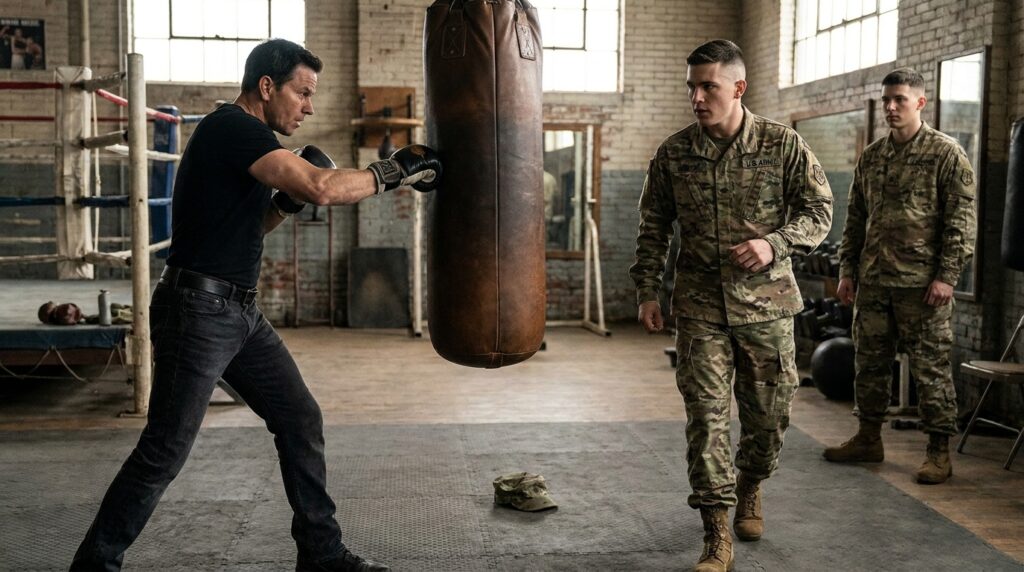
He didn’t move from the floor. He stayed pinned beneath the slow, rhythmic sweep of the seventy-pound bag, his shoulder blades flat against the cracked canvas mat. The gray dust he’d kicked up in his fall settled back down, coating the sweat on his throat like fine salt.
Miller held the brass key between his thumb and forefinger. The metal was cold, ungreased, biting into the old calluses of his palm. The stamped letters—Fort Meade Logistical Seal—looked sharp and dark in the low afternoon light leaking through the gym’s high, dirt-streaked windows. Beneath it, the small aluminum tag tapped against his knuckle with a thin, metallic click.
“Section Four,” Miller read, his voice dropping into the lower register he used when the gym’s furnace started to choke on cold air. “Demolition and Lease. You boys carrying keys for civilian grid lines now?”
Vance didn’t answer. He rolled his hip, kicking his boots out to steady himself before forcing his frame off the mat. Every joint in the boy’s knees made a dry, popping sound that echoed in the empty space between the ring and the weight racks. Private Miller, still hovering near the bench with his chin tucked into his collar, made a small, involuntary movement toward the door—a tracker checking his exits.
“It’s base property,” Vance said, squaring his shoulders. His uniform shirt was torn at the seam under the armpit, revealing a patch of skin already darkening to a deep, iron-colored bruise where Miller’s heel had found his balance. “You hold onto that, it’s retention of military hardware. They’ll come in here with a warrant before the sun hits the ridge.”
“Let them come,” Miller said softly. He didn’t pocket the key. He walked over to the rusted mechanical scale near the entrance, his boots dragging slightly across the grit. He laid the brass piece on the metal tray. The scale groaned, the counterweight sliding an eighth of an inch along the grooved bar with a high-pitched screech that made the private jump. “Your commander, Captain Vance—he still running the logistics outfit out of the north cantonment?”
Vance’s face didn’t change, but his eyes tracked the key’s reflection in the dull chrome of the weight bar. “Captain Vance is third generation. He doesn’t look at maps this small.”
“He looks at this one,” Miller said. He turned his back to the boy, an intentional choice, a calculated risk based on the weight of the boots behind him. He could hear the grit shifting under Vance’s heels. The boy was measuring the distance to the iron bar, calculating the leverage of a blind strike. “The base has been expanding three hundred yards every fiscal year since the treaty was signed. You think I don’t see the orange survey stakes out behind the equipment shed? You think I don’t smell the diesel from the graders?”
“The town needs the base,” Vance said, his voice flat, transactional. The heat of the initial fight had cleared out, replaced by the heavy, functional cold of two men who realized they were standing on opposite sides of a property line. “This gym doesn’t generate forty dollars a week in civilian dues. The boys from the barracks are the only thing keeping the lights from flickering.”
“The boys from the barracks come here to learn how to keep their heads down,” Miller said. He stepped closer to Vance, his frame casting a wide shadow over the trainee’s torn shirt. “You didn’t come here to box today, Corporal. You came here to start a fire. Someone told you to push me until I broke your nose, didn’t they? A civilian assault charge on a uniform looks real clean on an eviction notice.”
Vance’s jaw tightened. A small vein near his temple throbbed against the short, bleached hair of his military cut. He didn’t deny it. He didn’t monologue. He just looked at the scuff marks his boots had left across the floor—the evidence of his failure to stay upright.
“You’re old, Miller,” Vance said, his voice dropping below the hum of the transport planes outside. “Your knees are dry rot. Your hands are full of salt. You can drop me three more times before the whistle blows, but the barracks don’t stop. There’s eighty more kids in my unit alone who want to see if the old man can still take a punch. They’ll come in pairs next time. Then four. Then twenty.”
“Let them come,” Miller repeated. He walked to the corner, picked up the private’s dropped canvas cap from the mat, and tossed it straight at the kid’s chest. The private caught it against his ribs, his face turning the color of old paper. “Get him out of here, Miller. Tell your sergeant he’s late for the evening roll.”
The private didn’t wait for a second command. He grabbed Vance by the elbow of his uninjured arm, pulling him toward the heavy wooden double doors that led out to the gravel parking lot. Vance didn’t resist, but as he reached the threshold, he stopped, his hand gripping the unpainted frame until the dry pine splintered under his thumb.
“The key stays on the scale,” Vance said back over his shoulder. “For now. But everything in this valley gets weighed eventually, Miller. Make sure your balance is straight.”
The doors banged shut, the old iron latch rattling against the strike plate until the vibration traveled down the studs and died in the floorboards.
Miller stood alone in the center of the room. The silence came back instantly, heavy and saturated with the smell of old grease and cold sweat. He walked over to the windows, watching through the grime as the two figures cut across the gravel toward the black asphalt road that divided the town from the reservation. They didn’t talk. They walked with their heads down against the desert wind, their shadows stretching out like long, dark fingers toward the base wire.
He turned back to the scale. The brass key was still there, a bright, foreign eye against the dull gray iron. He reached out, his thumb catching on the rough edge of the tag. Section Four.
He knew the logistics section didn’t handle civilian disputes. They handled logistics—land clearing, asset relocation, structural disposal. The boy hadn’t dropped that key by accident. It was a marker left on a boundary stone.
Miller walked to the heavy bag, his wrapped hands hitting the canvas once, twice, three times in a slow, mechanical rhythm that didn’t have any power behind it—just the weight of a man trying to keep his fingers from stiffening up before the night came in. Every time the bag swung back, the chain shrieked against the hook, a sound like iron tearing in the dark.








