
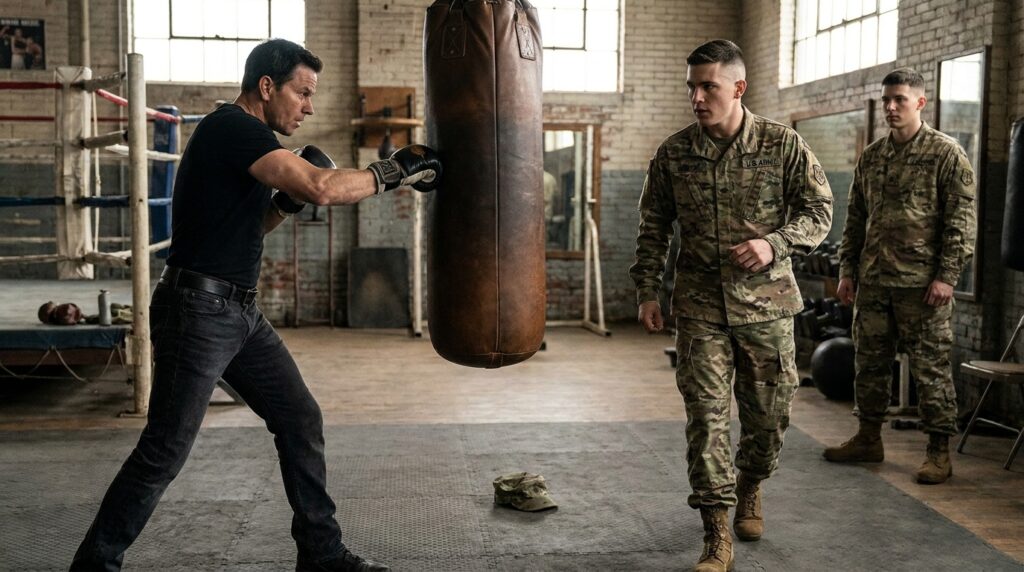
CHAPTER 5: THE UNEASY LINE
The teeth of the gear didn’t want to catch. Miller put his shoulder into the iron crowbar, his boots slipping on the grit-coated floorboards as he forced the tip deep into the seam of the concrete-set safe.
The small steel key Captain Vance had left behind was already twisted out of true, jammed tight into the dual-cylinder lock. It took three heavy, metallic raps with a five-pound mallet to shear the internal pins. When the heavy door finally split from the frame, it didn’t swing clean; it fell outward with a blunt, bone-jarring thud, striking the floor and sending a gray plume of masonry dust over Miller’s boots.
Inside the cavity sat a single flat bundle wrapped in oil-cloth, tied off with rotted hemp twine.
“You’re running out of clock,” a voice said from the threshold.
Miller didn’t drop the crowbar. He turned his head slowly. Corporal Vance stood in the entry, his left arm pinned tight against his ribs by a rough canvas sling that smelled of the base clinic. His face was a map of yellowing purple bruises, the skin around his eye split and held together by three black nylon sutures. Behind him, the high desert horizon was turning the color of wet slate, the first cold orange glare of dawn catching the exhaust plumes of three yellow earth-movers idling at the culvert line three hundred yards down the road.
“The platoon’s already moving the survey stakes to the eastern wall,” the boy said, his boots dragging as he walked toward the ring. He didn’t look like a conqueror; he looked like a piece of equipment that had been run through the gears and left out to dry. “The captain signed the detail order at four. They aren’t waiting for the county clerk to log the dispute.”
Miller used his wrapped thumb to tear the hemp twine off the oil-cloth. The fabric was stiff, saturated with old petroleum that had turned to a black, tar-like crust over thirty winters. He pulled back the layers, revealing the original land registration certificate from nineteen sixty-one.
The paper didn’t feel like the municipal ledger. It was thick parchment, watermarked with the state surveyor’s seal. But across the bottom third, stamped in the same precise, blocky clerk’s script that the private had warned him about, was a formal corporate lien assignment. His partner’s signature wasn’t at the bottom. The man who had signed the transfer was Miller’s own older brother—the one who died in the first deployment across the salt flats, whose name was etched into the brass plaque outside the garrison headquarters.
The holding company didn’t belong to a nameless real estate syndicate. The charter document inside the cloth listed the primary shareholders. The principal beneficiary was the base’s private deployment fund—a trust managed by the rotating garrison commanders to support the families of the fallen.
Miller stood in the center of his gym, the parchment heavy between his fingers, watching the orange dawn hit the canvas of the ring. The internal monologue was an empty room. The sovereign protector wasn’t defending a legacy from an invading machine; he was occupying an asset that had been purchased with his own family’s blood before he ever put on his first pair of gloves. The captain wasn’t trying to steal the land for a highway; he was recovering a leased parcel to fund the next line of replacements.
“He didn’t tell you either, did he?” Miller asked, his voice dropping into the low, mechanical hum of the nearby engines.
Vance stopped at the ring apron, his right hand gripping the rusted turnbuckle until the iron wire groaned. He looked at the watermarked parchment, then out through the grease-stained glass at the yellow graders currently cutting the fence line. “The captain said the asset had to be cleared before the deployment roster was finalized. He said it was family business.”
The boy’s shoulder dropped against the ring post. He was a third-generation uniform, built to follow the line on the map, but his eyes were fixed on the chalk line on the floor—the boundary where his individual pride had been broken by an old man who didn’t even own the mat he stood on. They were both cogs in the same rusted machine, grinding against each other while the gears turned somewhere far above the valley floor.
“Get in,” Miller said.
Vance looked up, his bruised brow furrowing. “The dozers are at the gate, Miller.”
“Get in the ring,” Miller repeated. He tossed the oil-cloth bundle onto the counter and stepped over the bottom rope, his knees clicking in the early morning stillness. He didn’t pick up his gloves. He just held up his wrapped hands, the canvas dirty, stained with the gray oil of the safe door. “We have twenty minutes before the blade hits the foundation. You want to learn how to guard that flank or do you want to go back to the barracks with a broken collarbone and an empty sheet?”
Vance stood still for three seconds, his breath coming in short, white puffs in the unheated room. Then, using only his right hand, he hooked his boot over the middle rope and dragged his frame into the square. His uniform shirt was still torn, the dark blood from his split eye dry against his collar. He didn’t adopt the rigid stance of the base manual. His hips dropped, his feet finding the wood beneath the canvas, his single free hand rising to protect his chin.
They stood three feet apart under the swinging shadow of the heavy bag as the first diesel exhaust rattle hit the side walls of the building, shaking the loose glass in the frames. They didn’t strike. They just held the line, two men waiting for the impact of a world they couldn’t turn around, finding the only balance they had left on a piece of floor that belonged to neither of them.








