
CHAPTER 6: THE GRADERS SHADOW
The iron didn’t sound the same when it hit concrete instead of timber.
Miller dropped the twenty-pound dumbbell into the bed of the rusted wheelbarrow, the impact releasing a sharp, metallic ring that bounced off the curved corrugated steel walls of the abandoned Quonset hut. This close to the motor pool, the silence was thicker, choked by the heavy, oily stink of dead batteries and the grey water that pooled in the drainage channels near the perimeter fence.
“The gate guard didn’t check the tarp,” Vance said.
He was leaning against the rusted frame of a non-operational three-ton truck, his right hand working a grease-gun into the hinge of a makeshift pulley system he’d rigged to the overhead rafters. The canvas sling was gone from his arm, replaced by a tight wrap of olive-drab utility tape that bound his shoulder to his ribcage. Every time he pulled the lever, his jaw went tight, the black nylon sutures near his eye pulling against the skin like tiny wires.
“The guard doesn’t look at salvage vehicles coming in,” Miller said, his voice flat, rhythmic. He hauled another load of iron plates from the barrow, stacking them on a low pallet made of rotting cedar ties. “They only look when the scrap goes out. To them, we’re just moving junk from one ditch to a smaller one.”
Through the high, curved ribbing of the hut’s entrance, the horizon was still choked by the yellow dust of the old gym’s demolition. The sound of the graders hadn’t stopped; it had just grown distant, a low, mechanical growl that vibrated through the concrete slab beneath their boots every time the blade hit a major foundation tie.
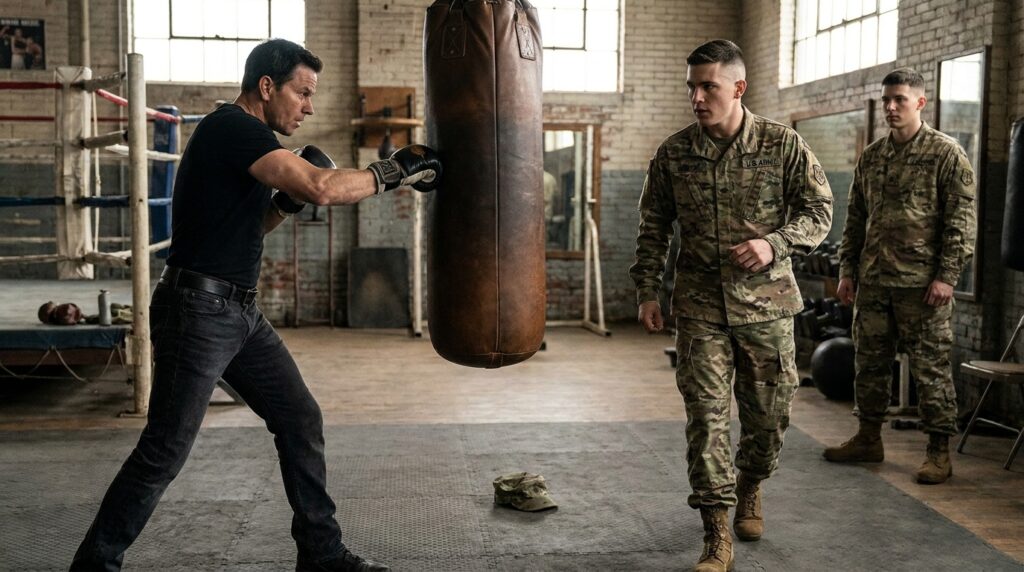
Miller walked over to the center of the floor where Vance had cleared a twelve-by-twelve square in the grease crust. It wasn’t a ring. There were no turnbuckles, no canvas mats to catch a heel—just four lengths of rusted chain hooked to the corners of old fuel drums that had been filled with gravel to keep them from rolling. On the side of the lead drum, a white stencil read: LOG-4-DEPT-RESERVE.
“The captain’s clerk came by the barracks after the noon muster,” Vance muttered, his right hand never leaving the grease-gun. “They’re assigning the Section Four details to the evening shift. They want the old lot completely graded and seeded with gravel before the magistrate’s inspectors arrive from the county seat on Friday.”
“The inspectors won’t look at the dirt,” Miller said. He stepped inside the chain square, his boots making a dry, sliding sound against the oil film. “They’ll look at the ledger entries we pulled from the safe. The captain knows that. That’s why he’s rushing the fence line.”
“He’s not just rushing the fence,” Vance said. He finally dropped the tool, the iron clattering against the frame of the truck. He reached into his field jacket with his uninjured arm and pulled out a single sheet of yellow carbon paper, the edges stained with the purple ink of a base mimeograph. He didn’t offer it to Miller; he just laid it flat on the top of the stenciled fuel drum. “The deployment orders for the north sector came down at fourteen hundred. My name’s at the top of the transfer list. I’m scheduled for the transport line next Thursday.”
Miller didn’t pick up the paper. His eyes stayed on the boy’s shoulder, noticing the slight, involuntary tremor in the deltoid where the muscle was trying to protect the cracked bone underneath.
“That’s seven days,” Miller said softly.
“Seven days,” Vance repeated. He took a half-step into the chain square, his boots crossing the oil-stained line Vance had scrubbed into the concrete. His guard came up slow, heavy, the left hand lagging three inches lower than the right to compensate for the torque on his collarbone. “He knows I can’t clear the medical evaluation with this arm. If I refuse the transport, it’s a structural discharge. I lose the commission, and my family’s name stays on the Section Four rider as a default.”
The hum of the base generator two sectors over kicked in, a high, rhythmic whine that made the grease in the drainage channels ripple.
Miller looked down at his own wraps. The white cloth was gone, replaced by the same gray industrial tape Vance was using—the only material available in the salvage yard that could hold a wrist straight when the bone started to soft-shoe. The landscape here had no edges, no civilian definitions. They were inside the iron engine now, training a boy to stand upright on a floor that belonged to the very logistics unit that was trying to erase him.
“We don’t have time for the left hook,” Miller said, his voice dropping into the flat, transactional register of the old gym. He didn’t drop his hands into a defensive frame; he took a short, lateral step, his elbow checking the air an inch from Vance’s wounded shoulder. “If you throw the hook, the torque pulls the clavicle out of the socket before the knuckle hits the leather. You work the lead straight. You let the mass of the truck do the pushing.”
Vance didn’t answer with words. He adjusted his heels, his weight shifting back onto his good leg, his eyes narrowing as he watched the gray tape on Miller’s knuckles rise to meet him in the desaturated glare of the corrugated ceiling. Outside, the dust from the old foundation rose high enough to blot out the ridge lights, leaving the hut in a deep, iron-scented twilight that felt less like a preparation and more like a siege.








