
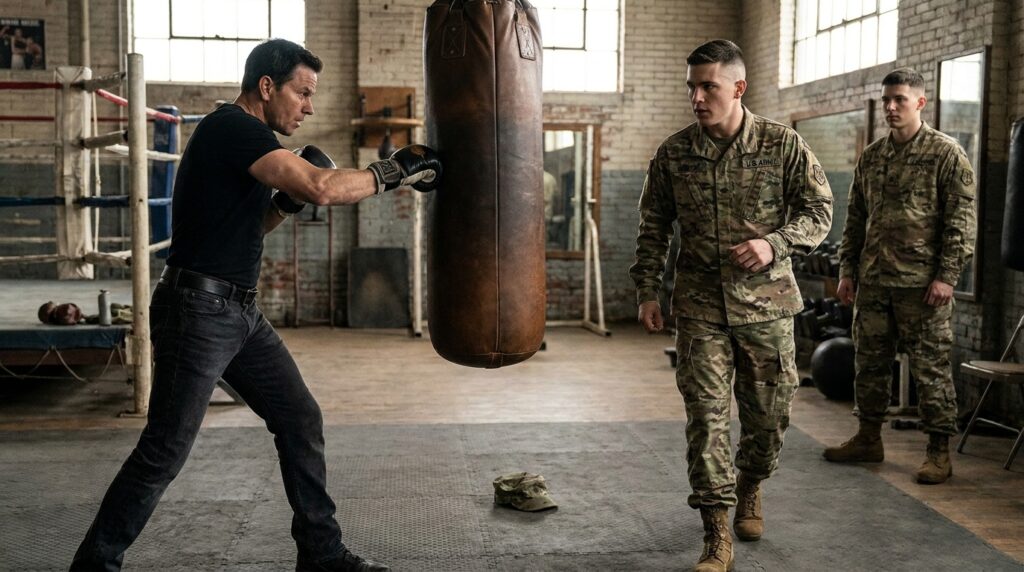
CHAPTER 3: THE BROKEN SCALE
The door frame didn’t give way with a crack; it groaned, a slow, metallic sigh of old iron screws shifting in dry pine.
Miller didn’t reach for the light switch. The fluorescent tubes overhead hummed like hornets even when they were dead, and the glare from the highway expansion project down the ridge provided enough desaturated white light to slice the gym into clean, jagged halves. He stayed on the threshold, his boots tracking cold gravel into the workspace, listening to the rhythmic click-tick of the corner scale as the wind outside rattled the external vent.
A figure was sitting on the low wooden locker bench near the water pipe.
It wasn’t Vance. The silhouette was slighter, the shoulders curved inward against the draft that always pooled around the concrete baseboards. Corporal Vance was six-foot-two of high-grade military issue; this was the other one, the silent witness, Private Miller. He sat with his hands tucked between his thighs to keep them from shaking, his standard-issue olive field jacket unbuttoned at the throat. On the floor between his boots sat Miller’s metal lockbox—the one usually hidden behind the spare canvas mats in the crawlspace.
“The lock was rusted,” the boy said. His voice didn’t carry the arrogance of the barracks. It was small, dry, the sound of paper scraping against stone. “A standard-issue combat knife takes the latch right off. You ought to keep better maintenance on your security, sir.”
Miller didn’t advance. He leaned his hip against the door frame, his hand resting on the smooth, worn leather of his pocketed wrapping tape. “You broke into a civilian establishment after taps, son. That’s forty-eight hours in the brig if your sergeant finds the grid coordinates. More if I call the county sheriff.”
“The sheriff won’t come,” the private said, finally looking up. The high-fenced stadium lights from the base hit his face, turning his skin the color of galvanized zinc. “The sheriff’s department signed the jurisdiction waiver for the north corridor last Tuesday. Anything within fifty yards of the highway centerline belongs to logistics now. That includes this foundation.”
The private didn’t move his hands from his thighs, but his chin jerked down toward the open box. A leather-bound ledger lay across the metal rim, its pages yellowed and frayed along the edges like dry tobacco leaves.
“I didn’t come here to steal your medals, Mr. Miller,” the boy muttered. “Vance is in the medical bay. They’re patching his collarbone, but the captain’s already filling out the paperwork. An unprovoked assault by a hostile civilian on a uniform. They have the statements signed by three other men who weren’t even in the room. They’re using the incident to trigger the emergency eminent domain clause.”
Miller took two slow, calculated steps forward. The floorboards didn’t bend under his weight, but the grit under his soles made a sharp, grinding sound. He reached down, his fingers closing on the cold metal rim of the ledger, lifting it from the boy’s lap. The paper smelled of old dampness and the faint, bitter tang of vinegar—the chemical footprint of cheap blue ink used forty years ago.
“This is my ledger,” Miller said, his voice flat, territorial. “My partner kept these books before the base laid the first strip of asphalt.”
“Look at the last five pages,” the private said, his voice tightening. “The entries from ninety-eight. The ones written in blue ballpoint. That’s not a civilian accounting script, sir. That’s a military logistical ledger format. Look at the column headers—Itemized Section Four Asset Relocation.”
Miller’s thumb caught the edge of the dry paper. He turned the pages slowly, the friction of the old sheets sounding like dead leaves in the silence of the room. His eyes tracked the faded entries. His late partner’s handwriting—thick, looping, undisciplined—stopped abruptly three-quarters of the way down a page dated November eleventh. Below it, a different hand had taken over. The script was small, precise, blocky, written with the mechanical regularity of an army clerk.
Every single line item after that date wasn’t listed as a membership fee or an equipment expense. They were listed as Lease Amortization Credits, paid out to an entity called M.D. Logistics & Development Holding Company.
“The captain didn’t send Vance here just to get into a fight,” the boy whispered, his eyes scanning the dark corners of the ceiling rafters. “They already knew what was in the books. They wanted you to touch him so they could seal the building before you had a chance to look at Layer Two. Your partner didn’t leave you the gym, Mr. Miller. He sold the ground right out from under the ring thirty years ago. You’ve been paying rent to a ghost.”
Miller didn’t drop the book. His knuckles turned white against the cracked leather cover, the iron-scented sweat of his palms dampening the old paper. He looked from the neat block letters of the military clerk toward the rusted mechanical scale in the corner. The brass master key Vance had dropped was gone from the tray, but a thin, oily smear remained on the metal where it had rested, catching the blue light of the base towers.
He could feel the structural logic of the valley closing in around him—a slow, heavy machine that didn’t use fists to break a man, but lines on a map and old ink that had dried before Private Miller was even born. The victory in the ring five hours ago didn’t mean anything. It was a false flag, a localized distraction while the real perimeter was being drawn around his ankles.
“You’re a long way from the barracks to be telling me this, kid,” Miller said, his eyes drilling into the private’s small frame. “Why aren’t you signing the captain’s statement?”
The private stood up, his knees shaking slightly as he pulled his field jacket tight around his ribs. He didn’t look Miller in the eye. He looked at the floor, at the chalk line that Vance had crossed. “My grandfather had a farm on the south ridge before they built the artillery range. He thought he had a deed too. He stayed until the dozers hit the porch because he couldn’t read the Section Four riders on the back of his tax receipt. I know what the clerk’s ink looks like when it’s done with a family.”
The boy moved toward the door, his shadow stretching out across the mats like a long, thin wedge. He didn’t say goodbye, and he didn’t ask for the box. When he pulled the door open, the desert wind hit the room again, making the ledger pages flip backward with a dry, frantic rattle that sounded exactly like iron scrap dragging across concrete.
Miller didn’t follow him. He sat down on the locker bench, the ledger heavy on his lap, his hand tracing the cold, blocky letters of the logistics company. The room was getting colder, the heat from the valley floor evaporating into the high desert sky, leaving nothing but the gray grit and the realization that the fence line wasn’t coming toward his property—it was already underneath it.








