
CHAPTER 7: THE DEPLOYMENT ROSTER
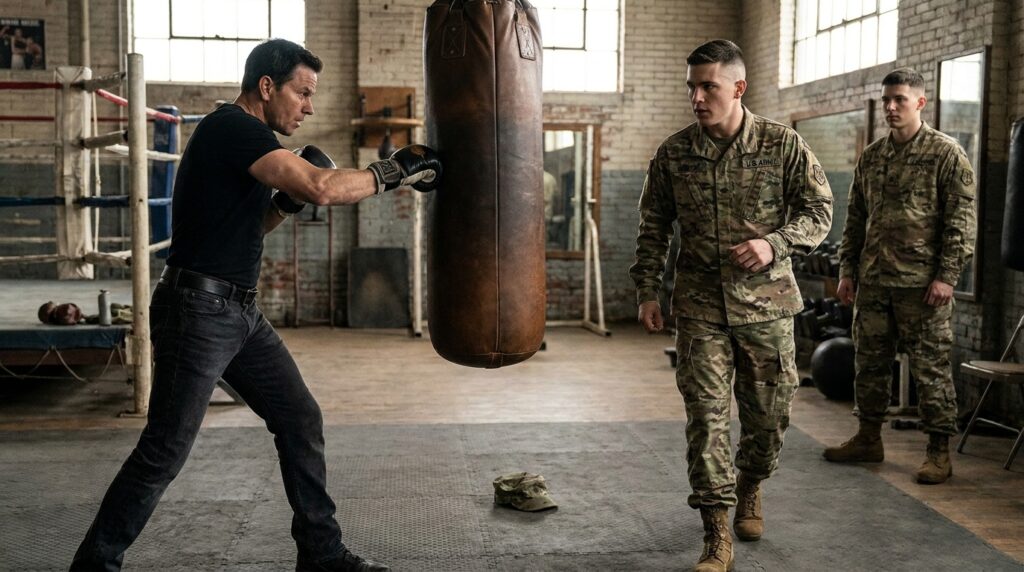
The straight lead hit Vance’s palm with a flat, dry thud that didn’t vibrate through his spine. He stayed planted, his right boot digging into the grease crust on the concrete slab, his jaw locked against the cold draft filtering through the Quonset hut’s split seams.
“Lower,” Miller said. He didn’t drop his hands. His own gray-taped knuckles remained poised inches from Vance’s left eye, catching the desaturated glare of the perimeter floodlights outside. “You’re leaning into the rotation again. If you shift the weight before the arm clears the hip, you’re giving away the baseline. The captain doesn’t look for the punch; he looks for the shoulder to drop.”
Vance exhaled, a grey plume of breath that settled over the stenciled fuel drum between them. “The line officers don’t use baselines, Miller. They use the manifest. The transport trucks are already backed up to the Section Four supply depot. They’re loading the field gear now.”
Miller took a short lateral step, his boot heel scraping against a discarded iron bolt on the floor. He didn’t offer a word of comfort. Comfort was an entry in a civilian ledger that had been canceled thirty winters ago. “Then you keep the jab short. You make them come to the center line. If they want the name on the roster, they have to carry it out of this grid.”
A sudden mechanical screech from the far end of the salvage yard cut through the hum of the base generator. It wasn’t the graders this time. It was the heavy iron arm of a knuckle-boom crane, dropping a stack of olive-drab supply crates onto the gravel apron sixty yards from the hut’s entrance. The impact shook the unbolted corrugated sheets of the roof, sending a fine shower of rusted scale down onto the cedar-tie pallet.
One of the crates skidded off the stack, its unlatched lid slamming against the concrete sill of the hut. It didn’t break open, but the heavy steel banding sheared with a sound like a pistol shot, scattering a handful of loose document duplicates across the damp floorboards near Miller’s feet.
Miller didn’t move toward the door. He stayed inside the chain square, his eyes fixed on the boy’s guard. But Vance’s gaze had already dipped to the floor, where the wind was tumbling a yellow carbon receipt against the base of the stenciled drum.
“Don’t look down,” Miller barked. “The moment the eyes drop, the perimeter’s gone.”
“It’s the Section Four manifest,” Vance whispered. He didn’t drop his hands, but his stance went rigid, the muscle in his deltoid shivering against the olive utility tape. “That’s the transfer duplicate from the logistics office. Look at the stamps, Miller. Look at the ink.”
Miller looked down without shifting his hips. The paper was identical to the yellow copy Vance had brought into the hut the day before, but this one carried a secondary identification block at the margin. It wasn’t signed by the base clerk. The hand that had verified the asset relocation was the same sharp, blocky script Miller had spent the previous night tracing in his old partner’s ledger—the handwriting of the clerk who had processed his brother’s deployment benefits back in ninety-eight.
Directly below the transfer authorization, under the column marked Compensation Offset, sat a single entry: Deed Reference Ledger – Grid Block 12 (Civilian Exemption).
The paper didn’t list an equipment allocation or a barracks assignment. It was a liquidation schedule. It detailed a direct transfer of funds from the M.D. Logistics & Development Holding Company to a private account held under the surname Vance—not the boy’s name, but the captain’s personal trust. The gym’s land hadn’t just been leveraged to a ghost shell company; the lease payments Miller had scraped together every winter had been systematically routed to clear a personal debt the captain’s father had accrued during the land clearing thirty years ago.
The decoy secret—the idea that the base simply needed the centerline for a highway expansion—cracked wide open, leaving nothing but the cold, greasy reality of a localized shakedown. The captain hadn’t weaponized the uniform to protect the base; he had weaponized the logistics unit to bury the evidence of a three-generation embezzlement scheme before the county inspectors could pull the grid records.
“He knew,” Vance said, his voice dropping into the flat, dead tone of a soldier who had found the bottom of a trench. “The captain didn’t put me on the roster to protect the unit’s readiness. He put me on it because my grandfather’s name is on the original lien transfer. If I cross the salt flats on that transport next Thursday, the account closes automatically under the service waiver. There won’t be a record left for the county to inspect.”
Miller walked out of the chain square, his boots heavy as he reached down to pick up the yellow carbon duplicate. The paper was damp, sucking up the cold moisture from the concrete slab until the purple ink began to bleed into the margins like old grease. The equal intellect of the antagonist wasn’t a matter of strategy; it was the simple, brutal leverage of a man who owned both the pen and the fence.
“The transport leaves from the north cantonment,” Miller said, his hand closing over the paper until it crumpled into a tight, hard ball. “The gate requires a Section Four clearance code to pass before the whistle blows.”
“I have the clearance,” Vance said, his right hand rising slow and deliberate until the knuckles were level with Miller’s chest. The purple bruises around his sutures looked black in the dimming light. “But the captain holds the muster roll. He’ll be at the staging point at five tomorrow morning to sign the physical assets over to the convoy. He won’t be carrying documents, Miller. He’ll be carrying the garrison guard.”
“Then we don’t look at the guard,” Miller said, walking back into the square and setting his heels into the oil crust. He didn’t check the entry behind him. He didn’t count the days left on the carbon sheet. “You have six days before the truck moves, Corporal. But you only have twelve hours before the captain signs that roll. Bring the hands back up. We’re tracking the center line now, and every inch we lose belongs to him.”
The crane outside whistled as it dropped its final load, the heavy iron gears grinding against the brake pads with a sound that filled the Quonset hut like the ticking of a colossal, rusted watch. The light off the ridge was completely gone now, leaving nothing but the desaturated white glare of the camp towers to split the floor into two clean, cold halves that didn’t touch.








