CHAPTER 9: THE QUIET IN THE WEEDS
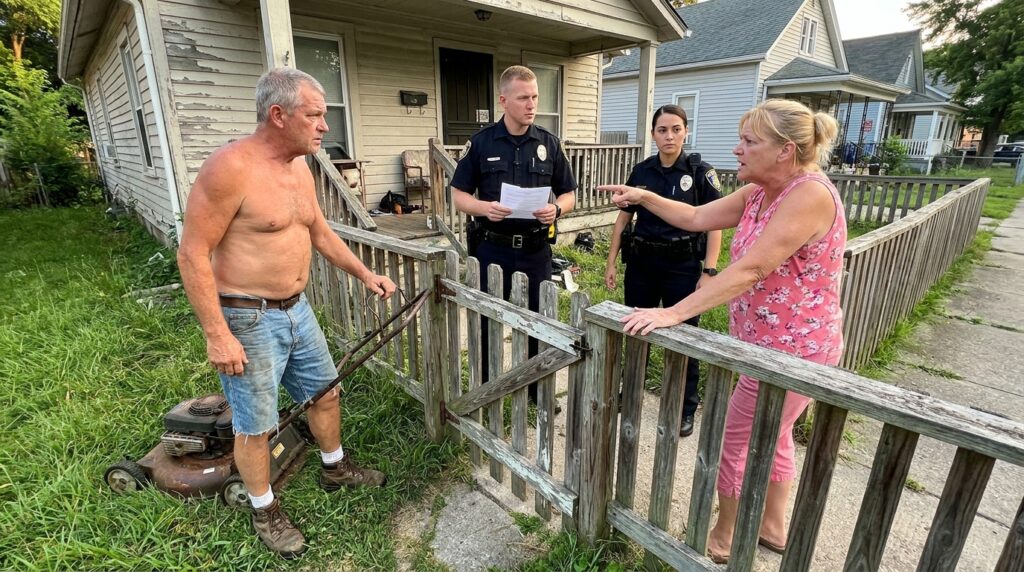
The heavy yellow quarantine ribbon went taut with a sharp, plastic twang as the supporting officer wrapped it twice around the rusted iron hinge of Miller’s front gate. The rain had settled into a dense, grey drizzle, casting a cold film over the entire street and turning the tall, uncut crabgrass along the property line into a sodden, dark green mattress.
Miller didn’t drop his hands from the rubberized grip of the lawnmower. He stood motionless, his bare chest slick with moisture, watching the blue and red strobe lights of the cruisers toggle back and forth across the blistered grey paint of his home. The perspective of the lane had narrowed to this single ribbon of plastic. Ten feet of exclusion zone. Ten feet where his boots weren’t supposed to tread, where his blade couldn’t turn, and where Brenda’s garage stood as an institutional anchor until the state attorneys sorted through thirty years of forged timber company stamps.
The mediating officer slid his vinyl folder under his arm, the heavy leather of his jacket squeaking as he turned toward the road. He didn’t look at Brenda. He didn’t look at the dissolved yellow pulp of her clipboard log sheets, which were currently washing down into the roadside ditch like grease-stained snow.
“The formal notice will hit your mailbox within forty-eight hours, Mr. Miller,” the officer said, his voice dropping into that rhythmic, low cadence common to men who worked the county clock. He reached into his pocket, his leather glove wet as he pulled out a yellow carbon copy of the quarantine order and pressed it against the damp steel deck of the mower. “Keep your machine out of the yellow. If the township structural crew sees a tire track inside the line before the engineering audit, the fine reverts back to your deed.”
“Understood,” Miller said. His voice was raw, containing the gritty exhaustion of a fourteen-hour shift followed by a fence-line blockade. He didn’t ask for clarification. He understood the math of the gray state. The bureaucratic engine didn’t move fast, and it didn’t move for free. He had saved his dirt from a fraudulent seizure, but the prize for his survival was a dead zone—a ten-foot strip of wilderness that would sit, rot, and gather seed until the county decided whose budget would cover the demolition of a concrete footer.
Behind the yellow ribbon, Brenda was a shadow against her own white siding. The tight blonde knot of her hair had completely collapsed, the wet strands hanging straight down her cheeks like rusted wire. Her bright pink floral top was dark, soaked through, the pattern looking less like a suburban uniform and more like a oil spill. She didn’t look at Miller. Her eyes were fixed on the mud near her foundation lip where the rusted industrial deadman rod stuck out like a broken rib.
“Brenda,” the supporting officer said, her hand gesturing toward the white porch steps next door. “Go inside. The civil marshals will handle the structural service tomorrow.”
Brenda didn’t reply. Her white sandals made a wet, heavy sucking sound in the lawn as she turned her back on the fence, her frame looking small, crooked, and tired as she ascended her pristine steps. The screen door clicked—that same deliberate, small sound—but there was no force behind it this time. The lock turned from the inside, a lonely sound that died instantly in the rain.
Miller waited until the two cruiser doors slammed shut. He stood in the weeds as the engines turned over, the heavy tires churning the grey gravel of the avenue as they pulled away from the curb. The red and blue reflections faded from his windows, leaving the street in the desaturated twilight of the storm. Across the asphalt, the blinds on the colonial-style houses stopped twitching. The audience was gone. The performance was over.
Slowly, deliberately, Miller unlocked his fingers from the mower handle. His joints flared with a dull, familiar ache, the skin of his palms red and lined from the coarse grip of the rubber. He reached down and grabbed the iron axle of the red machine, tilting it back on its rear wheels. He didn’t pull the starter cord again. He began to wheel the mower backward, away from the yellow tape, away from the rotten cedar rails, guiding it through the knee-high dandelions toward the corrugated metal lean-to behind his porch.
The rain hit the rusted tin roof of the shack with a loud, hollow rattle as he pushed the machine inside. The air smelled of wet canvas, stale gas, and the deep, silent iron of his father’s old tools hanging from the joists. He didn’t drop the canvas tarp over the deck yet. He stood by the door of the lean-to, his bare shoulder leaning against the damp cedar frame, looking out at the southern boundary.
The yellow ribbon flickered in the rising wind, a bright, unnatural line through the dark weeds. He had kept his lot. He had held the stake his father had driven into the gray clay thirty years ago with a five-pound sledge. But as the dark came down over the valley, bringing the heavy scent of wet coal smoke and ozone, Miller knew the friction wasn’t settled. The concrete next door was still resting on his deed, unyielding, heavy, and waiting for the first turn of the legal wheel. He wiped a mix of rain and grease from his chest, stepped inside his kitchen, and let the old wooden door click shut against the gray.