CHAPTER 2: THE APPROACHING CLIPBOARD
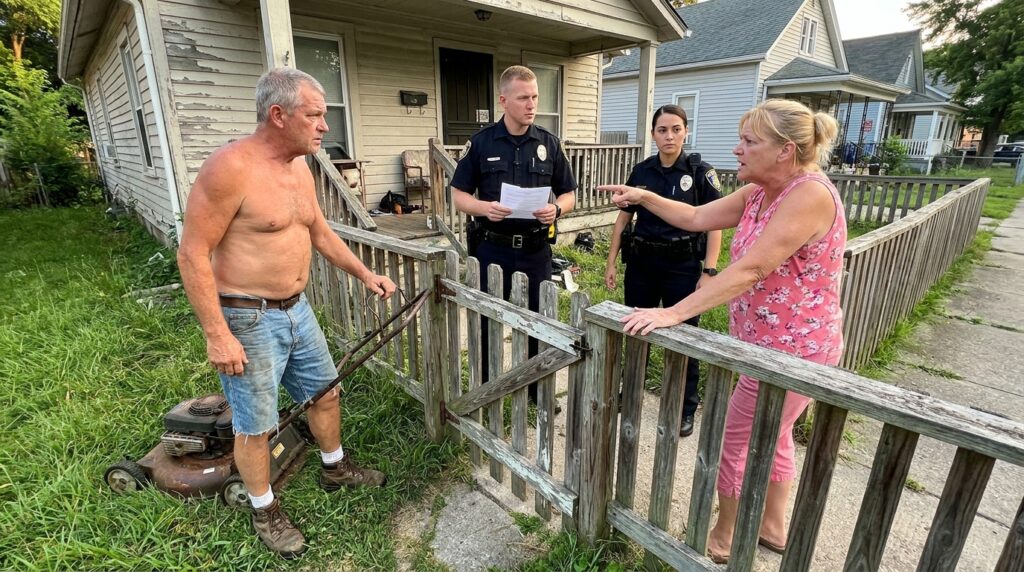
“You’re two inches over, Miller,” Brenda’s voice carried across the property line, dry and sharp as a dead branch snapping.
Miller didn’t drop the pull-cord. He kept his hand wrapped around the black rubber handle, the knots of his knuckles whitening against the grime from his morning shift. He felt the heat radiating from the brick foundation of his own porch, a low, oppressive weight that seemed to trap the humidity right against his bare chest. He didn’t turn his head to look at her yet. Instead, his boots shifted in the dry earth, feeling the hard, hidden ridge of the iron surveyor’s pin beneath his left heel. He had struck that pin three times last July, the blade of the old Briggs & Stratton screaming against the metal, leaving jagged nicks in the iron that never truly healed. It was his anchor.
“I’m cutting the weeds on my side of the cedar, Brenda,” Miller said. His voice was a low, guttural rasp, thick with the soot of the diesel yard. He didn’t raise it. In this neighborhood, shouting was a tactical error; it brought the neighbors to their windows, and once the audience arrived, the performance became policy.
“Your side of the cedar doesn’t include the easement, Miller. Check your deed. Or better yet, check the notice coming down from the county,” she said, her white capris rustling as she stopped exactly one inch from where the manicured rye met his choked dandelions.
She held the clipboard against her ribs like a piece of body armor. The aluminum frame was scratched, its corners oxidized into a dull, chalky gray from years of local committee meetings and code enforcement sweeps. Her thumb was hooked over the metal spring latch, holding down a stack of yellowing paper lined with handwritten columns—dates, times, descriptions of his lawn’s infractions, logged with the obsessive precision of a clerk who lived for the margin of error.
Miller finally looked at her, his eyes narrowing against the glare of the midday sun bouncing off her white vinyl siding. The perspective was all straight lines and hard angles on her side of the fence, but between them, the wood was rotting. The bottom rails of the cedar fence were soft, green with moss where the automatic sprinklers hit them every morning, the timber fiber expanding and crumbling under the constant, artificial moisture. It smelled of wet earth and slow decay.
“My father set these posts thirty years ago,” Miller said, his arm tightening as he gave the pull-cord a slow, testing tug. The engine gave a short, metallic cough, a puff of blue exhaust leaking from the rusted muffler, smelling of old oil and unburnt fuel. “He didn’t build on your dirt.”
“Your father was a drunk who didn’t know where his own line ended,” Brenda snapped back, her head tilting, her posture straightening into a rigid, vertical line. The pink floral pattern of her top seemed to vibrate against the desaturated background of Miller’s peeling gray siding. “He signed the variance in ninety-six. Two feet from the post line. It’s on the books, Miller. It’s been on the books since before they poured my garage slab.”
The mention of the ninety-six variance hit the dirt between them like a lead weight. Miller’s grip didn’t slip, but his mind calculated the risk. His father had been many things—tired, broken by the mill closure, prone to spending his Sundays with a bottle of bonded bourbon on the back steps—but he was meticulous about the land. He had worked thirty-two years to clear the mortgage on this patch of gray earth, and he wouldn’t have given away two inches of it for a neighbor’s convenience, let alone two feet.
Miller took a step forward, his heavy work boots dragging through the knee-high weeds. The friction of the dry stalks against his denim cutoffs made a dry, whispering sound. He stopped at the handle of the mower, his shadow falling across the weathered wooden gate.
“Let’s see the paper then,” Miller said, his voice flat, transactional.
Brenda didn’t lift the clip. Her fingers tightened on the edge of the board, the metal digging into her skin until her knuckles turned the color of lard. “I don’t have to show you anything. I showed the township inspector three weeks ago. That’s why your blight citation is sitting in the municipal queue right now. You think you can just let this place rot because you work the late shift? You’re dragging down the equity of every home on this block.”
She tapped her pen against the aluminum board—a sharp, rhythmic clack-clack-clack that sounded like an old typewriter ticking down a countdown.
Behind her, the street was dead silent. The heavy, sulfurous air before a storm had driven everyone else inside, their air conditioners humming a low, continuous drone behind screened windows. But Miller knew the blinds were twitching. He could feel the eyes from the colonial-style house across the asphalt, the neighbors watching to see if the blue-collar relic with the peeling paint would finally break under the pressure of Brenda’s filing cabinet discipline.
Miller didn’t break. He leaned down, his weathered forearms straining as he grabbed the starter grip again. He didn’t look at her face; he looked at the base of her fence where the cedar met the soil. There was a discrepancy there—a small, four-inch gap where her concrete landscape edging curved slightly too far to the west, encroaching around the root of an old stump he’d been meaning to grind down for five years. A tiny detail, a micro-mystery in the dirt, but to a man who measured clearances in thousandths of an inch on diesel blocks, it looked like a structural lie.
“The county stakes are still down there, Brenda,” Miller said softly, his thumb pointing toward the weeds near the gate hinge. “They don’t move for clipboards.”
“We’ll see what the township says when they get here,” Brenda said, her voice dropping into a cold, triumphant register. She reached into her capri pocket and pulled out a small, black cell phone, her thumb already hovering over the keypad. “I told them you were operating unpermitted machinery within the disputed easement and creating a public hazard. They’re already on the route.”
Miller stood his ground, the heat of the idle engine rising between them, the first heavy drop of rain hitting the rusted top of his fuel tank with a sharp ping. He didn’t pull the cord yet. He waited, his boots planted over the iron pin, listening for the distant, high-frequency whine of a municipal siren cutting through the humid air.