CHAPTER 5: THE BLUE FLINT SHADOWS
The wet gravel at the road’s edge didn’t splash so much as it chewed under the heavy, reinforced tires of the lead cruiser. The Ford sedan came to a stop with a low, hydraulic sigh, its front bumper overhang hanging inches above the weeds choking Miller’s drainage ditch. The roof lights didn’t spin; they toggled in a sharp, mechanical back-and-forth rhythm that sliced the grey afternoon light into alternating blocks of red and cold cobalt.
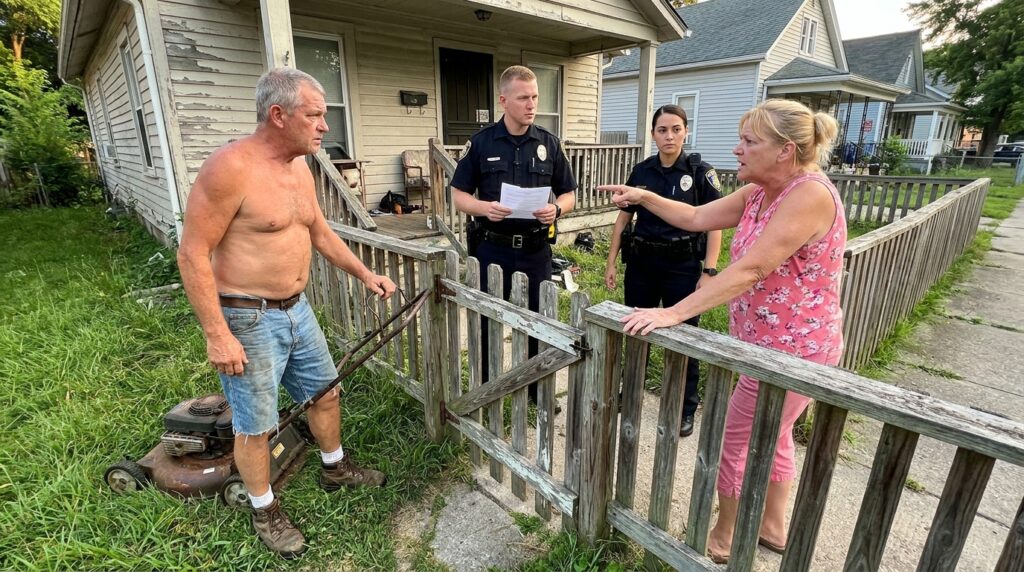
Miller kept his right boot planted squarely over the buried iron pipe. The rain was getting heavier now, the drops larger and colder, hitting his bare shoulders and tracking down through the black grease smudges from the diesel yard. He felt the cold moisture hit the hot, black housing of the Briggs & Stratton engine between him and Brenda, sending up a thin, almost invisible curl of steam that carried the sharp odor of scorched oil.
The door of the first car swung open, the rusted hinges giving a dry, short click before the mediating officer stepped out. He was in his early thirties, his dark blue uniform pressed with a rigid, institutional crispness that defied the midday soup of humidity. His leather duty belt creaked as he shifted his weight, his right hand resting naturally but loosely near the butt of his sidearm, not with aggression, but with the practiced caution of a man entering a known flashpoint. Behind him, from the second vehicle, the supporting officer emerged—younger, her eyes tracking the perimeter, her boots making a slow, deliberate scrape against the cracked asphalt as she stepped into the interaction lane.
“Slow down,” the mediating officer said, his voice dropping into the space between the properties like a lead block. He didn’t look at Brenda’s clipboard, and he didn’t look at Miller’s bare chest. His eyes were fixed on the line where the two lawns failed to meet. “One story at a time.”
“He’s running that unpermitted commercial salvage equipment inside my registered easement line,” Brenda said instantly, her sandals sliding slightly in the grass as she took half a step toward the car door. She held the aluminum clipboard out, the sharp corner pointing directly toward the mediating officer’s chest like an extension of her authority. “The township clerk has the blight file active, officer. I have the reference numbers logged right here.”
The officer didn’t take the clipboard. He stood by the front fender of his car, his cap brim catching the first heavy run of rain before it could hit his eyes. He reached into his pocket and pulled out a small, heavy black leather folder—not a ticket book, but a standard city-issue records pouch containing a folded sheaf of white county plat maps. The paper was thick, waterproofed with a synthetic laminate that had turned a dull, ivory yellow along the creases from being kept under the dashboard clip.
“We aren’t here for a blight inspection, ma’am,” the mediating officer said. His voice was low, rhythmic, carrying the practiced flatness of a man who spent his afternoons listening to people argue over six inches of dirt. He turned his attention to Miller, his eyes taking in the weathered forearms, the grease under the fingernails, and the absolute lack of movement in Miller’s boots. “You Miller?”
“Yeah,” Miller said. He didn’t take his hand off the rubber brake handle of the mower. The cold metal of the frame was vibrating slightly as the rain hit the engine deck. “I’m just cutting the weeds on my side of the wood, officer. Like my father did for thirty years.”
“He’s crossing the ninety-six boundary,” Brenda interrupted, her spine tightening until her neck tendons showed taut against her collarbone. The pink floral pattern of her top was soaked through now, clinging to her skin in dark, irregular blotches that looked like grease spots. “My husband paid for that clearance. It’s on the plat.”
The mediating officer didn’t look at the handwritten notes on her board. He slowly unfolded the laminated map, the paper making a stiff, plastic snap as it flattened out against the hood of the cruiser. The rainwater began to pool on the ivory surface, highlighting the crisp, black surveyor lines that demarcated Section 4.
“The county assessor’s office updated the GIS registry at midnight, ma’am,” the officer said, his voice remaining level, almost conversational, but with an undercurrent of absolute finality. He didn’t look up from the map. He reached out with one gloved index finger, pointing down through the rain toward the gray clay at the base of the gate hinge where Miller’s boot was set. “Show me exactly where you think the line is.”
Brenda froze, her pointing finger still suspended in the air between them. Her thumb slipped off the spring latch of the clipboard, and the top yellow sheet—the one with the heavy black grease smudge from the old timber mill logbook—bent double under the weight of three large raindrops.
Miller didn’t shift his weight. He looked at the officer’s finger, then down at the exposed rim of the iron pipe he had dug out with his bare fingers five minutes ago. The metal was dark, choked with layers of old iron scale that had been flaking off into the dirt since the late seventies. It didn’t look like an official marker to an outsider; it looked like a piece of junk buried in the weeds. But the officer wasn’t looking at the junk. He was looking at the coordinates printed along the margin of the county seal.
The supporting officer took two steps forward, her boots coming to a halt on the edge of Brenda’s manicured rye grass. She didn’t speak, but her hand moved down to her belt, her thumb hooking into the leather loop beside her flashlight holder as she watched Brenda’s volatile shoulder movements. The entire street had gone dark now, the pre-storm sky turning a deep, iron-filing grey that made the red and blue flashes from the roof lights look twice as bright against the wet siding of the houses.
“The line is the fence,” Brenda said, her voice rising an octave, the certainty in her posture starting to fray at the edges like old canvas. “The fence has been there since the garage was poured. You can’t just come out here with a computer map and change where the wood sits.”
“The wood doesn’t dictate the deed, ma’am,” the mediating officer said softly. He tapped the map one more time, then began to fold it back into the tight, tight rectangles of the leather case. “The dirt does.”