CHAPTER 6: THE FENCE LINE STAND
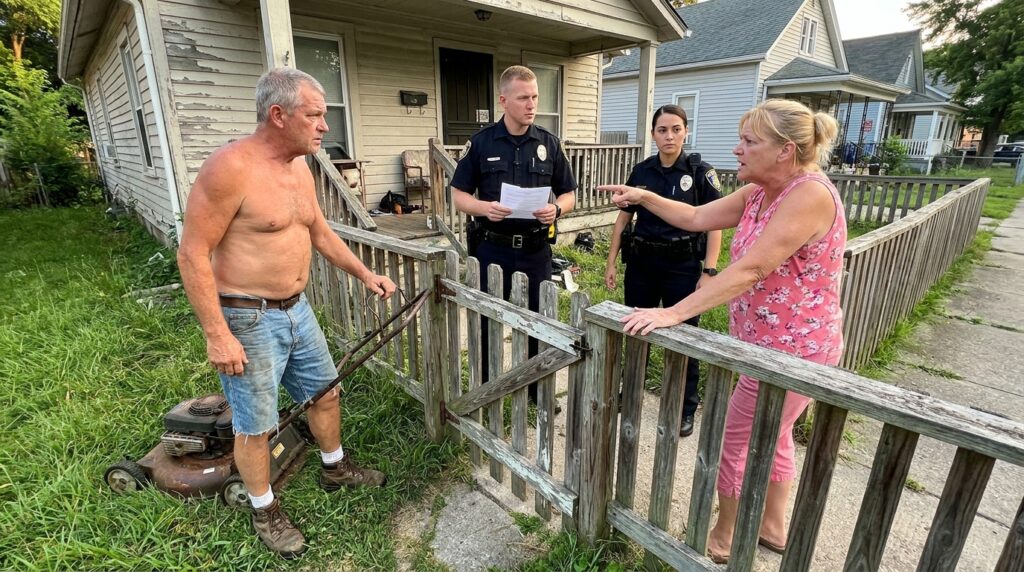
The wet cedar split with a wet, splintering crunch under Brenda’s descending hand. She didn’t drop her phone, but her open palm slapped the top rail so hard that a spray of collected rainwater trapped in the grain shot straight across the wood, speckling the old red paint of Miller’s idle lawnmower deck.
“Stop crossing my fence line like you own this yard!” she barked, her arm stiffening into a rigid lever. Her index finger stabbed through the humid air, the tip stopping inches from Miller’s wet chest. “It’s over, Miller. The town has the filing. This dirt is done.”
Miller didn’t flinch. His boots remained dug into the grey clay, his heel locking the rusted rim of the buried surveyor’s pipe beneath the matted crabgrass. The storm had finally opened up above them, the rain turning from heavy drops into a dense, vertical sheet that turned the peeling siding of his house into a dark, oil-slick grey. The smell of hot cast iron from the cooling engine block rose around his knees, thick and sulfurous, mixing with the sharp scent of torn wild mustard and wet earth.
“Slow down,” the mediating officer said, his voice cutting through the rhythmic thrum-thrum of the rain on the cruiser roofs. He stepped directly between them, his heavy leather duty belt creaking as he turned his shoulder to break their line of sight. He didn’t point his flashlight; the red and blue strobes behind him were already turning the falling water into a pulsing violet mist. “One story at a time.”
Before Brenda could switch her grip on the clipboard, the officer lowered his black folder, his gloved hand moving down with a slow, deliberate weight. He didn’t look at the handwritten log sheets she tried to thrust into his field of vision. He extended his index finger, pointing it straight down through the weeds at the exact junction where the rotten cedar post met the clay near the gate hinge.
“Show me exactly where the line is,” the officer commanded.
The dynamic shifted with the speed of a breaking belt on a lathe. The forced physical assessment pinned Brenda to the geography of the dirt, a space where her municipal code citations had no weight without a legal anchor. She took a short step back, her white sandals sliding on the slick rye grass of her own lawn, her clipboard dropping three inches as the rain began to turn the topmost yellow page into pulp.
“The line is right here,” Brenda said, her voice dropping its brassy ring, replaced by a tight, defensive hiss. She tapped her sandal against her concrete landscape edging—the curved, artificial border that Miller had noticed encroaching around the old tree stump. “My husband poured this edging according to the ninety-six variance. It’s been here for thirty years. You can’t just dig up the street and change it.”
Miller leaned his weight forward against the rubberized handlebar of his mower, his calloused hands gripping the steel frame until the vibration of his own pulse matched the low hum of the neighborhood’s air conditioners. “The edging curves four inches past your garage footer, Brenda,” he said, his voice dropping into the low register he used when a diesel block wouldn’t seat right. “Your husband didn’t follow the plat map. He followed the shade of the willow tree.”
“The ninety-six paperwork has his signature, Miller!” she screamed, her hand shaking as she rattled the aluminum board against her side. “Your father took the money. He signed the easement request for the garage clearance!”
The mediating officer didn’t look up from the base of the post. He adjusted the blue vinyl folder against his hip, his fingers flipping past the standard city-issue maps until he reached a historical land-grant supplement from the county tax assessor’s ledger. The paper was different from the others; it was a duplicate copy of a thirty-year-old municipal filing, but the seal at the bottom wasn’t the standard purple ink. It was a dull, raised brass stamp that had been pressed into the fiber so hard it had distorted the grain of the paper.
Miller’s eyes caught that seal through the grey slant of the rain. It was the old logging cooperative stamp—a defunct timber company logo that had been liquidated during the foundry closures of ninety-two. It wasn’t a county record mark. His father had never worked for the timber line, but Brenda’s husband had been their chief yard foreman until the gates were chained shut.
The supporting officer took half a step closer to Brenda, her watchful eyes fixing on the way Brenda’s thumb kept working the spring latch of the clipboard, her movements turning erratic, jagged. The street around them had gone entirely dark now, the neighbors on their porches visible only as pale silhouettes against their screen doors, watching the two blue-clad figures dictate the terms of the boundary.
“Ma’am,” the mediating officer said, his voice flat as a iron bar. “We pulled the certified GIS plat from the hall before we cleared the station. The ninety-six filing you’re talking about isn’t an easement. It’s a temporary construction allowance that expired in ninety-eight.”
He shifted his grip on the ledger, the wet paper making a thick, tearing sound against the plastic sleeve. He didn’t look at Brenda’s face as the color began to drain from her cheeks, leaving her skin the color of old tallow under her tight blonde knot. He kept his finger pointed at the mud by Miller’s boot.
“According to the county deed,” the officer said, “this weathered fence wasn’t built on the line. It was built two feet inside Mr. Miller’s property. If that garage concrete extends past the wood, you aren’t holding an easement, Brenda. You’re sitting on his land.”
Brenda’s phone slipped from her hand, landing with a soft, wet thud in the tall weeds at the base of the gate, the screen flickering twice through the gray mud before going dark.