CHAPTER 12: THE CONCESSION AT THE YELLOW TAPE
“The county order came down an hour ago, Miller,” Brenda said.
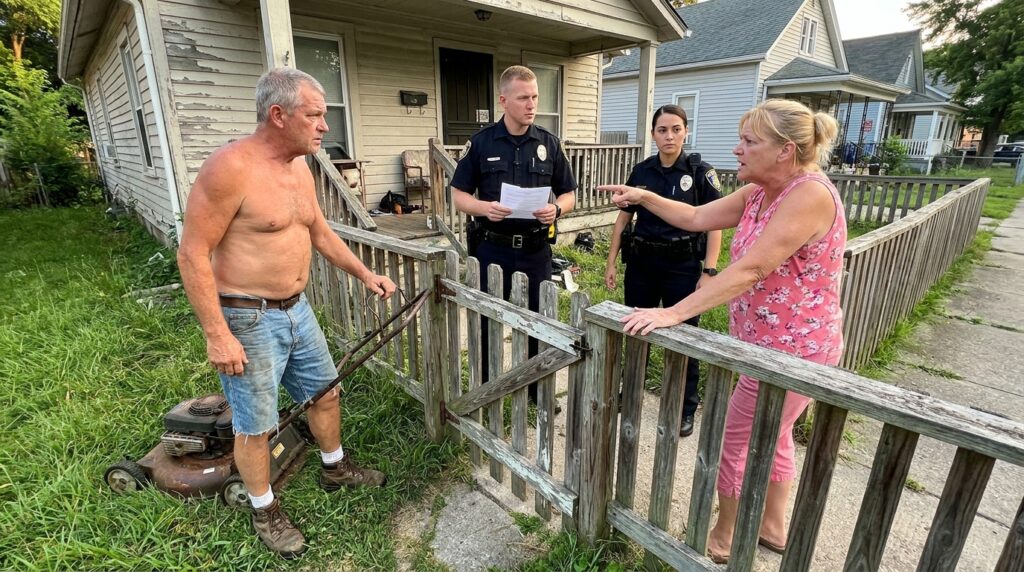
Her voice didn’t have the thin, brassy scrape of her old committee meetings. It was flat, wet, and small, carrying over the rotting cedar rails like the sound of dry grass brushing against a boot. She stood three inches from the bright yellow plastic ribbon, her hands buried deep in the pockets of a oversized, faded oilskin jacket that had belonged to her husband. The blonde knot at the back of her head had completely unraveled, the graying strands plastered across her temples by the constant, needle-sharp drizzle.
Miller stepped off his lower porch stair, his heavy leather work boots sinking into the waterlogged clay of his path. He was holding his father’s zinc-spined logbook under his arm, wrapped tightly in a greasy piece of shop tarp to protect the parched paper from the damp air. The perspective between their properties had completely desaturated; the manicured green perfection of her yard was now split by the jagged grey trenches where the marshal’s core drills had bitten into the soil, leaving puddles of thick, white lime slurry that looked like curdled milk.
“The marshals don’t work on sentiment, Brenda,” Miller said, his voice dropping into the low, rough vibration of a cold diesel chassis. He stopped three feet from her, his stocky frame casting a wide shadow over the plastic boundary line. “They found the high-line cable under the footer. They know what Harlan did.”
“They’re giving me twenty-one days,” she whispered. Her fingers twitched inside the oilskin pockets, causing the heavy fabric to rustle with a dry, metallic crinkle. “Twenty-one days to file an engineering variance or they bring the county excavator out to yank the retaining cables. If they pull those lines, Miller… the back wall of my garage drops straight into the hollow drainage ditch.”
“If they pull those lines,” Miller said, his teeth clicking together as a cold gust of wind came up from the culvert, “the southern pier of my kitchen goes down with it. Harlan didn’t just steal two feet of my yard, Brenda. He tied the weight of your building into the skeleton of my house.”
Brenda looked down at the mud between them. Her sandal toe dragged a small, slow crescent into the gray clay, exposing the rusted edge of the old iron pipe Miller had cleared yesterday. The metal was bleeding orange oxidation into the silt, a slow, continuous leak of iron scale that had been hidden since ninety-four.
“I didn’t know about the cables,” she said, her voice dropping until it was nearly lost beneath the low, distant hum of the morning traffic on the avenue. “Harlan… he told me he bought the clearance with cash. He told me your old man needed the money for the hospital bills after the foundry shut down its secondary line. I have the ledger entries in the house, Miller. Hand-written. Every dollar.”
“He didn’t buy the land, Brenda. He took a cash loan from my old man to keep his foundation from sliding before the concrete could set,” Miller said, his thumb pressing into the grease-stained tarp wrapping the canvas book. “The timber company stamp he used on the variance request was a forge. He used his foreman’s seal because the county clerk wouldn’t clear a structural tie-back without a licensed engineer’s signature. Your whole estate is built on a thirty-year bluff.”
Brenda’s shoulders dropped, the heavy oilskin jacket shifting against her neck with a stiff, coarse rasp. She reached into her right pocket and pulled her hand out slow. She wasn’t holding a clipboard or a phone. Her fingers were wrapped around an old, heavy pair of red-handled wire-cutters—the heavy industrial shears Harlan had stolen from the mill’s maintenance locker before the gates were chained.
“If we cut the line where it enters the concrete lip,” she said, her hand trembling as she pointed the rusted nose of the tool toward the muddy gap beneath her garage footer, “if we clear the anchors ourselves before the county crew comes back tomorrow… we can tell the inspector the lines were abandoned. We can say the foundation settled on its own.”
Miller looked from the red handles of the shears to the deep, jagged hole where the marshal’s drill had severed the first braided wire strand. The raw engineering fact of the tension was unyielding. The cables were under thousands of pounds of structural load; if someone took a pair of hand-shears to those iron tendons under the mud, the stored kinetic energy would snap the braid with the force of an uncoupled winch line, ripping through the clay, the yellow tape, and whatever flesh was standing within ten feet of the post line.
Worse, the sudden release would cause the gray clay beneath his kitchen pier to shift instantly, dropping his floorboards three inches into the draft before the sun could set. Her compromise wasn’t a solution; it was a desperate, uncalculated failure that would destroy both titles to save her from a fraud charge.
“Put the iron back in your pocket, Brenda,” Miller said softly, his voice flat as a steel rule. He didn’t reach across the yellow ribbon to take the tool. He stood steady over his father’s buried pipe, his eyes fixing on the pale, hollow look in her eyes. “The state has the serial numbers from the core sample. You can’t cut your way out of a municipal deed map. Tomorrow morning, when the civil marshals return with the secondary rig, we show them the logbook. We show them the loan entry from ninety-four.”
“They’ll condemn the garage anyway, Miller,” she said, the first real tear tracking through the gray silt on her cheek.
“They’ll condemn the wall,” Miller corrected, his arm tensing as he turned back toward his porch. “But they won’t pull the cables until they underpin my kitchen. We play the clock now, Brenda. No more clipboards. No more hand-cutters. We let the town pay for the concrete your husband didn’t buy.”
He turned his back on the ribbon, his boots heavy as he carried the wrapped ledger back toward his kitchen door, leaving her standing alone in the grey pre-dawn rain with the red-handled shears heavy in her hand.