CHAPTER 3: THE CODE ON THE PEELING DOOR
The paper didn’t flap in the dead air; it clung to the cedar siding like a wet leaf. It was printed on heavy, neon-orange cardstock that had already curled at the corners from the midday humidity, the adhesive tape leaving a sticky, gray residue against the blistered primer of Miller’s front door.
Miller didn’t use the copper key to open the door. He stood on the top step of his porch, his work boots grinding a fine layer of grit into the soft, sun-rotted pine boards. His thumb caught the edge of the orange card, ripping it free with a dry, fibrous tear. The bold black ink at the top read: MUNICIPAL CITATION: IMMEDIATE COMPLIANCE REQUIRED. Beneath that, typed out on an old dot-matrix printer that left faint, horizontal lines through the lettering, was the specific infraction: Section 412-B – Blight, Unauthorized Boundary Degradation, and Intentional Impediment of Public Right-of-Way.
He turned the card over. On the back, written in a cramped, left-leaning script that he recognized instantly from three decades of neighborhood association letters, was a handwritten calculation of the daily accrual fines. Brenda hadn’t just filed a complaint; she had calculated his financial exhaustion down to the penny. The fine doubled every forty-eight hours the “impediment” remained active.
Miller leaned his forehead against the door frame, the heat from the wood transferring directly to his skull. The smell of old iron and dry rot was thick here, right where the porch roof sagged three inches to the south. Through the screened window of his kitchen, he could hear the old compressor of his refrigerator kicking on with a low, metallic thud, rattling the copper lines behind the coils. It was the only sound on the block.
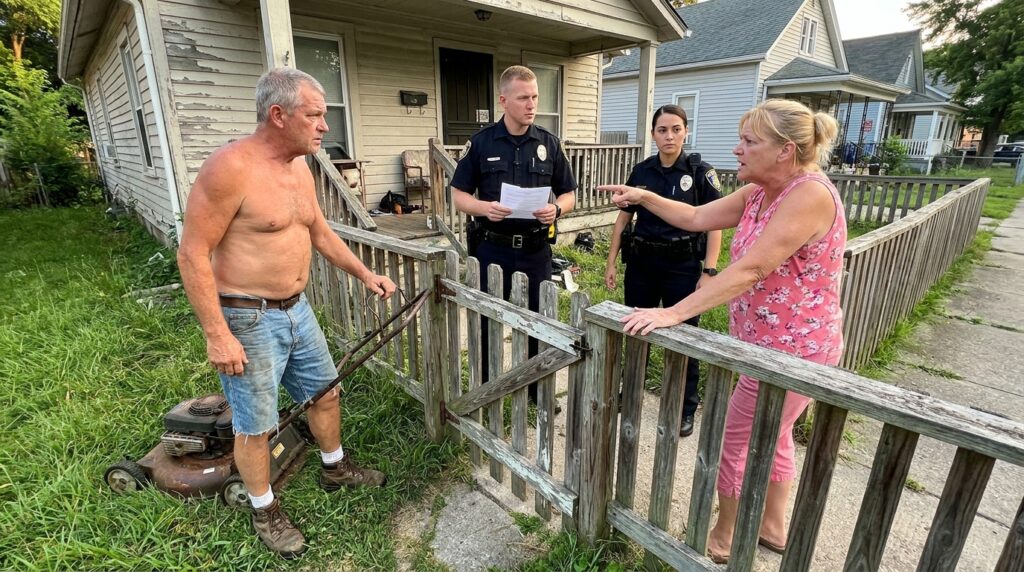
He walked back down the steps, the orange card folded twice and stuffed into the pocket of his denim cutoffs. He didn’t look toward Brenda’s house, but he could see her through his peripheral vision. She was still on her porch, her back straight as an iron surveyor’s rod, her fingers running along the hand-scratched notch in her aluminum railing. He’d seen that mark before—a small, V-shaped groove cut into the metal with a file, exactly aligned with the corner of her garage slab. It was a home-brewed baseline, an unofficial marker she used to justify the two feet she claimed was hers.
The grit under his boots felt thicker as he approached the mower again. He reached down and picked up an old, greasy rag from the deck of the machine, wiping the sweat and diesel carbon from his forearms. His mind was adjusting the numbers. The township office opened at seven tomorrow morning. He’d have to skip the early shift at the yard, lose four hours of flat-rate time, just to sit in a basement office waiting for a clerk named Arlene to pull a microfilm reel that might not even be in the cabinet anymore.
“You find it?” Brenda called out from her shade. She hadn’t moved an inch. Her voice had the thin, brassy ring of a cheap school bell. “The inspector doesn’t wait for independent contractors, Miller. The fine started running at midnight.”
Miller tucked the rag under the mower’s rubber handle. He didn’t answer. He didn’t give her the satisfaction of a verbal receipt. Instead, he knelt in the tall weeds near the fence line, his bare knees sinking into the damp, coarse crabgrass. The soil here was different from the rest of the lot; it was packed hard, gray with lime runoff from the concrete footer Brenda’s husband had poured for their garage back in the nineties.
He dug his fingers into the dirt near the corner post, scraping away the matted layer of dead thatch until his fingernails hit something unyielding and cold. It wasn’t the surveyor’s pin. It was a chunk of broken slag, a piece of industrial refuse used as backfill when the subdivision was graded after the war. But right beneath it, buried four inches deeper than it should have been, was the rusted edge of an old iron pipe—the original marker his father had driven into the earth with a five-pound sledge when the lot was split.
He cleared the dirt around the pipe’s rim. It was choked with rust, the orange flakes coming away in his palm like coarse cornmeal. When he looked up from the ground, tracing the line from that buried pipe to the corner of Brenda’s garage, the math didn’t work. The garage didn’t just line up with the fence; the concrete footer bulged out, its gray, rough-textured lip extending past the cedar posts, biting into his dirt like a tooth.
The wind shifted then, a cold gust from the west that brought the smell of ozone and wet asphalt from the interstate. The sky behind Brenda’s roof was turning the color of a bruised plum, the heavy, dark underbelly of the storm cloud rolling in fast over the tree line. Miller stood up, wiping his muddy hands on his shorts. He could feel the pressure dropping in his ears, a low, tightening ache that matched the knot between his shoulder blades.
He knew what Brenda was doing. The orange notice wasn’t about the weeds; it was an eviction by documentation. If he didn’t contest the citation within seventy-two hours, the municipal court would treat the boundary line listed on the complaint as an uncontested legal reality. She was using the township’s bureaucratic inertia to move the line without ever having to pay for a licensed crew to swing a transit.
He reached down for the starter cord again, his fingers locking around the rubber handle with a deliberate, slow pressure. His forearms tensed, the veins rising under the grease-stained skin. He wasn’t going to wait for seven o’clock tomorrow morning. He was going to cut this strip today, right up to the rotting cedar, and let the township cops see the dirt for themselves when they arrived.