
CHAPTER 8: THE REVERSAL AND THE CIVIL FREEZE
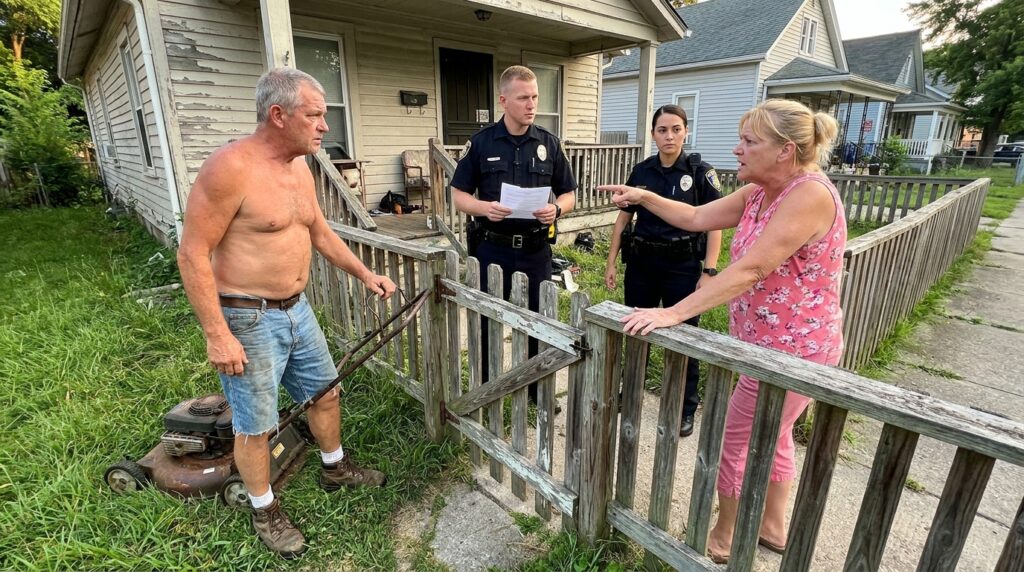
“This isn’t a civil boundary dispute anymore, ma’am,” the supporting officer said, her voice dropping like a heavy iron cleat onto the wet grass.
She shifted her boots, the sand-grit on the edge of Brenda’s manicured lawn grinding under her soles. Her left hand remained flat against the heavy nylon constraint strap of her holster, her fingers perfectly still despite the torrential downpour that was now streaming off the stiff brim of her service cap. Her eyes didn’t leave Brenda’s white, twitching fingers, which were still trying to scrape the melting yellow pages off the aluminum clipboard.
“You called an emergency line to report an active, violent trespassing violation,” the supporting officer continued, the cold authority in her tone cutting through the thick hum of the rain. “You signed a sworn statement in the municipal queue alleging that the deed holder was intentionally destroying property within a registered city easement. But according to the county surveyor’s live GIS feed, there is no easement. There never was. You weaponized a municipal unit to enforce a fraudulent boundary claim.”
Brenda’s mouth opened, but only a dry, whistling breath came out. The bright pink floral pattern of her top was plastered completely flat against her chest, the colors running together under the heavy lash of the storm like grease paint. She looked from the supporting officer’s silver badge to the closed blue folder in the mediating officer’s hands, her baseline confidence completely dissolving into the grey clay beneath her sandals.
“My husband… he wouldn’t have lied to the bank,” she stammered, her heels sinking deeper into the soft mud near her concrete border. “He had the timber company stamp. He showed it to the foundation foreman before they mixed the truck loads.”
Miller didn’t move from his position behind the red mower deck. His bare skin was numb now, chilled by the raw wind coming off the hollow, but inside his chest, a hard, calculated pressure was building. He looked at the edge of Brenda’s garage footer—the rough, grey mass of concrete that bulged like an old scar into his dirt. His eyes fixed on the micro-mystery he’d spotted moments before: the notched iron tie-back bracket buried in the mud. It wasn’t just a bracket; it was an industrial structural tension rod, anchored deep under his own soil to hold her building’s entire weight against the slope of the hill.
The mediating officer stepped closer to the foundation lip, his leather duty boots sinking four inches into the churned earth. He knelt down, the wet fabric of his uniform trousers pressing directly into the gray lime sludge. He reached out with a heavy flashlight, the beam cutting through the grey rain to illuminate the rusted iron bracket where it entered the concrete.
“Miller,” the officer called out, his eyes never leaving the iron rod. “You know what this is?”
“It’s an industrial deadman anchor,” Miller said, his voice low and gritty as a shovelful of gravel. He stepped forward, his boots heavy in the weeds. “The timber mill used them to tie down the high-line cables in the sorting yard. Her husband must have dragged three of them out of the scrap pile when they closed the secondary line in ninety-two.”
The mediating officer nodded slowly, his fingers tracing the coarse, pitted surface of the exposed iron. “If these rods are anchored beneath your deeded soil to support a structural load next door, we aren’t just looking at an encroachment of the footer. We’re looking at a severe engineering violation of the municipal safety code.”
The officer stood up, wiping the grey mud from his gloves onto his thighs. He pulled a heavy, bright yellow plastic clamp from the rear pouch of his folder—a municipal structural freeze tag, its brass locking pin glinting through the rain.
“Ma’am,” the mediating officer said, turning his shoulder completely away from Brenda to face Miller. “The blight citation against you is dropped. But I’m executing an immediate civil freeze on both parcels under Section 504 of the structural safety act. Because this foundation is tied into your property without a notarized easement or a certified engineering sign-off, this entire boundary strip is now a quarantined hazard zone.”
The words hit Miller like a physical blow. The victory of defeating the blight citation vanished, replaced by the cold, heavy reality of a civil lockdown.
“What does the freeze mean for my lot?” Miller asked, his hands tightening on the mower handle until the old joint injuries in his fingers flared with sharp pain.
“It means nobody touches this dirt until a structural surveyor from the capital comes out to inspect the structural integrity of that garage wall,” the officer said, his face unreadable under the flashing blue lights. “You can’t dig, you can’t clear, and you can’t run this mower within ten feet of the post line. Until the court determines if that building has to be demolished or moved, your southern boundary is locked by the state.”
Brenda let out a short, high-pitched gasp, her clipboard finally slipping from her fingers and landing with a metallic clank against the wet concrete edging. The yellow papers disintegrated instantly in the pooling water, the handwritten logs of Miller’s lawn infractions turning into grey mush that washed down into the mud around the rusted iron anchor.
Miller stood in the freezing rain, the red and blue lights of the cruisers pulsing against his bare chest, his eyes fixed on the unyielding gray concrete of the garage. He had protected his line, but the price of the dirt was an expensive, locked-down nightmare that left him holding a useless machine in a yard he wasn’t allowed to clear.








