
CHAPTER 9: THE CONCRETE CRESCENT
The starter gave its familiar, jagged screech—metal binding against metal in a dry casing—before the eight cylinders caught with a sharp, ragged exhaust backfire. Miller didn’t clear his high beams. He pulled the column shifter into reverse, his boot driving into the heavy steel pedal until the rear tires bit into the grease-slick gutter. The truck lurked backward, its steel bumper catching the rusted lip of a discarded cast-iron coal chute with a harsh, screaming scrape that sent a shower of orange rust flakes bouncing across the pavement.
Beside him, the man with the ruined earlobe didn’t touch the dashboard. He held the green canvas logbook against his ribs with both thumbs, his knuckles gray and pitted like zinc washers.
They’re tracking the terminal loop, the courier said, his voice flat, dry, and thin as packing paper. They don’t need a confirmation signature anymore. They just need the truck stopped before we reach the freight gate at the rail yard.
Miller didn’t answer. He threw the wheel over, the power steering pump groaning a high-frequency whistle as the F-150’s nose swung out into the lane. Forty feet ahead, the dark utility van didn’t brake; its front bumper dipped as the driver accelerated into a wide, aggressive crescent designed to pin the truck against the brick masonry of the archive wall. There was no flash of chrome, no municipal emblem on the panels—only the dull, desaturated sheen of commercial primer and the rhythmic, heavy thump of heavy-duty off-road tires chewing the wet slag.
Miller didn’t look for an exit route on the open road. He drove straight into the mouth of the crescent.
His right hand shifted the column lever back into first gear, his thumb remaining locked over the cold iron rod. The truck’s steel grill met the van’s front quarter panel at an angle of twenty degrees—a short, blunt impact that didn’t shatter the frame but sheared the fiberglass headlight housing of the pursuing vehicle with a sound like a heavy boot breaking dry pine. The shock traveled up the steering column, vibrating the old scars in Miller’s wrists, but the weight of the truck’s iron bumper won the displacement. The van skidded six inches sideways into the mud of the curb, its high-traction tires spinning uselessly against the slick moss of the masonry foundation.
The lane behind them opened. Miller blew through the gray curtain of the downpour, his engine screaming at three thousand revolutions as he navigated by the rusted steel spans of the high-line tracks overhead.
Where is the warehouse, Vance? Miller asked, his rasp dropping into the low hum of the transmission gears. His eyes stayed locked on the windshield film, tracking the faint, blue flashes of the industrial switch-engines half a mile ahead.
It’s not a warehouse anymore, the courier whispered, his fingers tracing the steel wire binders of the logbook. It’s the old cold-storage facility under the second pier. The company uses the sub-level to dry-dock the river tugs. But the mainframe… the old automated registry from eighty-two… it’s still wired into the local telegraph line behind the boiler room. The clerks never took the copper out of the walls. They just built a cinder-block partition over the junction box.
The truck crossed the iron plates of the railyard crossing, the tires bouncing with four short, rhythmic thuds that sent a loose socket wrench rolling across the floorboards. In the rearview mirror, the van had cleared the curb, its remaining halogen beam cutting through the rain like a yellow needle, accompanied by a second set of headlights turning off the industrial avenue three hundred yards back.
They’re closing the grid, Miller, the courier said, his thumb tightening against the green canvas until the wire binding began to warp. They’ve had forty years to map the escape lines from this block.
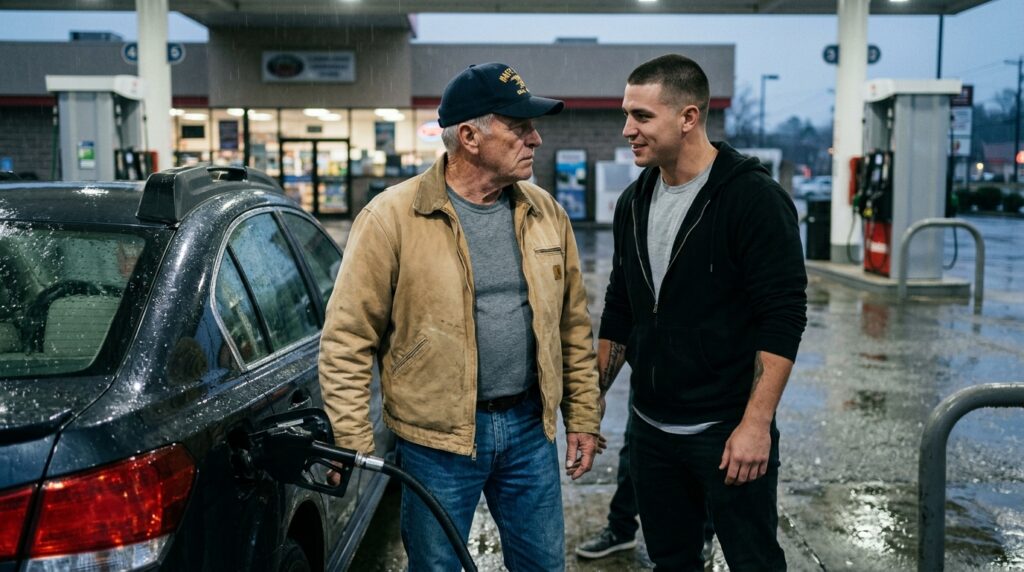
Let them map it, Miller said softly. His face remained fixed in the yellow glare of the dashboard, his Navy SEAL cap casting a deep, motionless shadow over his hard, focused eyes. They’re tracking a manual log from eighty-two with an automated system. The machine only knows how to close the gate we used when the plane went down. It doesn’t know what happens when an old mechanic changes the oil.
He didn’t hit the brakes for the terminal turn. He dropped the truck into second, the transmission grinding a protest as he forced the nose into a narrow, unpaved alleyway lined with corroded iron scrap bins and the rotted timbers of old flatcars, driving straight into the desaturated gray underbelly of the river district where the final truth was waiting behind the brick.








