
CHAPTER 7: THE RUSTED HORIZON
The door of the F-150 caught the first heavy gust of river wind as Miller pulled himself into the cab, his boots carrying three pounds of wet gravel slurry onto the floor mats. The engine didn’t fail him; it caught with that same stubborn, iron-on-iron groan before the exhaust pipe clearing its throat into the rising water of the pit. He kept the headlights dead until the truck cleared the terminal perimeter gate, the tires tracking the deep, parallel ruts left by the utility vans that had cut him off from the south road. He had only one line left—the state highway running straight north into the capital, a forty-mile stretch of desaturated asphalt pinned between abandoned industrial canals and chemical storage farms.
The roll of old, purple-ink ledger sheets sat heavy against his ribs, protected from the rain by the oil-stained lining of his canvas jacket. Every mile the truck traveled, the rhythmic thrum of the wheels against the concrete joints sounded like a countdown. He didn’t check his rearview mirror until he reached the high span of the canal bridge, where the gray expanse of the city appeared through the cloud base like an array of rusted iron teeth.
The address from the zinc tube led him away from the legislative center, deep into the old wholesale district behind the rail yards. Here, the state authority didn’t use glass or limestone; it used gray brick buildings with barred windows and fire escapes that had corroded down to jagged orange lace. The sign over the entry read Department of Maritime Archives, the gold lettering long ago flaked away by the sulfurous smog of the nearby diesel sheds.
Inside, the silence was absolute, save for the hum of an ancient, vibrating fluorescent fixture hanging over a long linoleum counter. A single man sat behind the barrier—not a field operator with a carbon-fiber weapon, but an administrative fossil in a frayed cardigan, his fingers stained with the dark gray graphite of an old ledger pencil. His hair was thin, white as lard, and his shoulders stooped under the weight of fifty years of processing shipping manifests that nobody would ever read again.
Miller didn’t drop the tool sack this time. He laid the rotted roll of purple-ink ledger sheets flat on the wood, his calloused thumb pinning the unredacted signature line right under the clerk’s yellowed spectacles.
The old man didn’t flinch. He didn’t call for security. He simply peered through his lenses at the indelibly stenciled signature from 1982, his jaw moving with a small, slow chew that smelled faintly of peppermint and stale coffee.
You’re late with the turn-in, Miller, the clerk said, his voice a dry, papery whisper that matched the sound of the rain against the skylight above. The Norfolk procurement office closed its books before the wall came down in Berlin.
Who signed the erasure order on the third day after the crash? Miller asked. His voice was lower than the city traffic outside, a gravelly rattle that had spent forty years waiting for this specific room. The corporate office at the terminal said it was a land dispute. Vance said it was an insurance audit. But this ink didn’t come from a commercial desk.
The clerk reached under the counter, his hand returning with a heavy brass key barrel that bore a small, distinctive notch near the pins—the hallmark of the old logistics pool locking mechanisms Miller had handled during his first month at Norfolk. He didn’t turn the key. He just let it sit between them on the wood, a cold piece of metal that had outlived the unit it was built for.
The company didn’t buy the terminal to clear the land, Miller, the old man whispered, his eyes remaining fixed on the unredacted name that had been crossed out with grease pencil. They bought it because the liquidation protocol from eighty-two was never legally rescinded. It was a standing order left on a dormant mainframe in the sub-basement here. Every time you bought bulk kerosene with an archived voucher number, the system flagged your location as an unspent liability. The men at the pump weren’t contractors trying to build a dock. They were the third-generation retrieval team, executing an automated loop that doesn’t know the war is over.
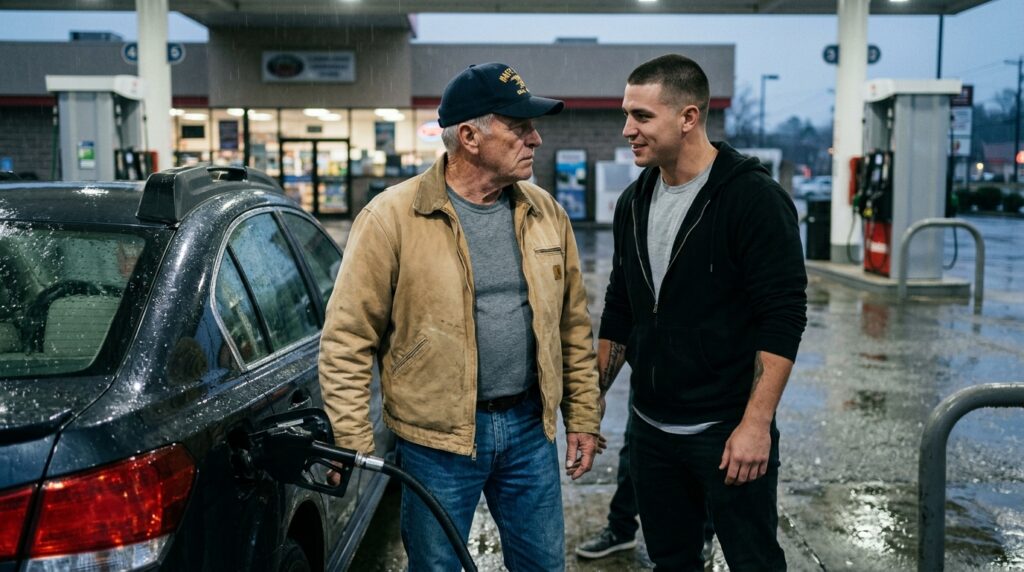
Miller looked at his cap resting on the counter—the gold thread of the Navy SEAL anchor frayed and dark with shop grease. The entire architecture of his flight—the forty years of changing names, the three-acre salvage yard, the silence he had built like a block wall—hadn’t been compromised by an enemy or a traitor. It had been compromised by the permanence of his own record, an unliquidated line item in a rusted filing system that kept grinding away long after the operators had gone home to die.
There’s no one left to sign the cancellation, the clerk added, his fingers sliding the ledger sheets back into the rusted zinc canister with a slow, definitive scrape. The registry is empty. The people who authorized your erasure are buried in the national cemetery, but the machine doesn’t care about a headstone. It just looks for the signature to match the exit manifest.
Miller didn’t take the brass key. He pulled his cap back over his brow, his fingers lingering for one brief second on the coarse canvas of his jacket where the old grease pencil had left its watermark. The ultimate truth was naked now, cold and desaturated like the rain falling over the railyards outside. There was no victory to be won against a corporate structure or an old grudge; there was only the continuous, pragmatic labor of staying one step ahead of an automated ghost that would never stop tracking his oil consumption until the F-150 ran out of road.
He turned toward the exit, his boots making a heavy, unhurried sound against the linoleum as he stepped back out into the gray twilight of the capital. The truck was waiting by the curb, its wipers still plowing through the film of salt and soot, its engine running on the last quarter-tank of unrefined diesel, ready for whatever horizon was left to clear before the dark caught up with him for good.








