
CHAPTER 8: THE CARBON COURIER
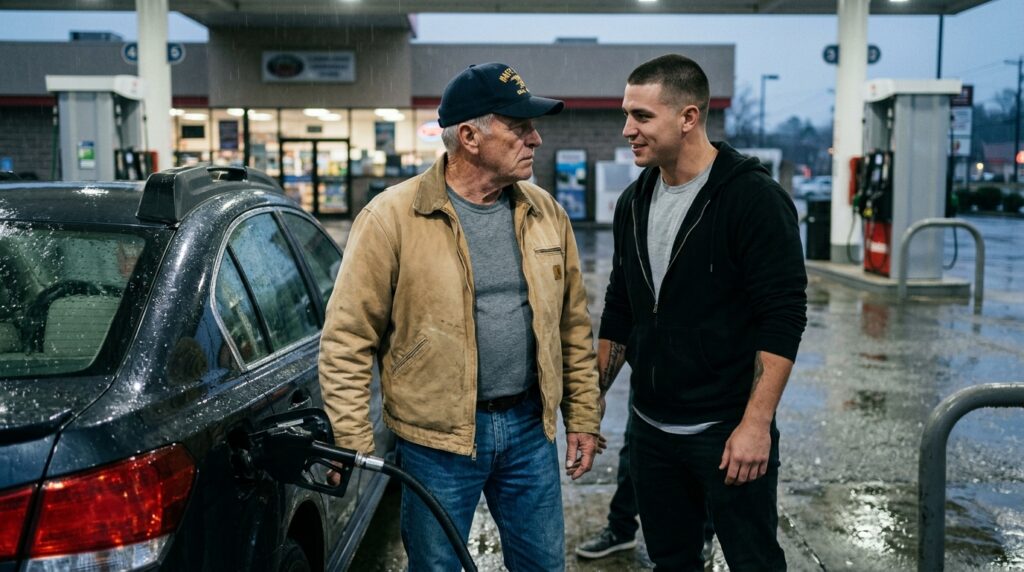
The glass doors of the archive building rattled behind Miller, the old brass latch catching with a dry, hollow click that was instantly swallowed by the roar of the city’s drainage grates. The rain here didn’t smell of river mud or the green salt of the canal; it tasted of soot, sulfur, and the cold, metallic discharge of the locomotive sheds two blocks south. He adjusted the brim of his Navy SEAL cap, pulling it low until the frayed anchor gold was shielded from the white spray thrown by a passing delivery van.
He didn’t make it to the F-150’s door handle.
A shadow broke away from the entry of a defunct customs brokerage house forty feet down the curb. It didn’t have the wide-set, tactical posture of the operators from the gravel pit. This figure was thin, narrow-shouldered, moving with the rapid, uneven hitch of someone whose knees had been ruined by structural labor. He wore a long, water-logged oilskin coat that dragged against the wet weeds growing out of the concrete seams.
Miller’s right hand went flat against his thigh, his fingers instinctively testing the canvas lining of his pocket to ensure the rusted zinc dispatch tube hadn’t shifted during his exit. He didn’t reach for a tool. He simply stood beside the truck’s rusted fender, his boots anchored into the cold asphalt, watching the shape close the gap.
Miller, the man said. The voice was a cracked reed, but it carried the flat, localized accent of the lower delta counties. The old clerk in there… he doesn’t have the whole book. He only sees the paper that comes down the chute.
Miller didn’t take his hand off his thigh. Who are you?
The man stopped five feet away, just clear of the truck’s side mirror. He pulled back the hood of his oilskin, revealing a face that looked like an old boot left in a swamp—leathery, deeply scarred along the left jawline by a high-velocity fragment, and missing the lower half of his right earlobe. His eyes were small, wet, and clear with the desperate clarity of a man who had been hiding in the same cellar for thirty years.
I was the third name on the sub-dock manifest before they stamped it DECEASED, the man whispered. His breath was shallow, smelling of cheap wintergreen lozenges and damp cotton. They didn’t cross me out because I died in the crash, Miller. They crossed me out because I was the one who drove the truck that hauled the remaining three crates out of the delta before the cleanup team reached the smoke.
Miller’s torso remained perfectly still, but his jaw set until the bone clicked beneath his weathered skin. You’re supposed to be in the national registry at Arlington. I saw the markers myself in ninety-two.
They put stones up for all of us to keep the audit clean, the man said, a short, bitter grin twitching the scarred corner of his mouth. He reached into his coat and pulled out a small, green canvas logbook—identical to the ones Miller kept in his cinder-block garage, but this one was bound with heavy steel wire instead of thread. Stamped across the fabric cover was the old Norfolk logistics prefix: 82-Proc-042. The terminal didn’t flag you because of your kerosene vouchers, Miller. The terminal flagged you because the company that bought the docks just initialized the secondary phase of the procurement sweep. They’re tracking the optics crates. They think you have the keys to the warehouse in the capital.
The sound of a heavy diesel engine shifted gears at the corner of the block.
A dark utility van, its windows opaque with security film and its fenders splattered with the gray mud of the lower county roads, turned slow onto the archival route. It didn’t turn on its high beams, but the tires hissed against the wet asphalt with a heavy, deliberate momentum that Miller recognized from the station forecourt forty miles behind him.
Get in the truck, Miller said, his rasp dropping into the quiet space between the downpours.
The old courier didn’t look back at the headlights. He simply turned toward the passenger side, his stiff knee scraping against the rusted rocker panel as he hauled himself into the cab, leaving a dark smear of river silt on the vinyl seat. Miller swung into the driver’s side, his hand hitting the key before his door had even latched against the frame, the old iron starter groaning into the gray dark as the automated loop finalized its target profile.








