
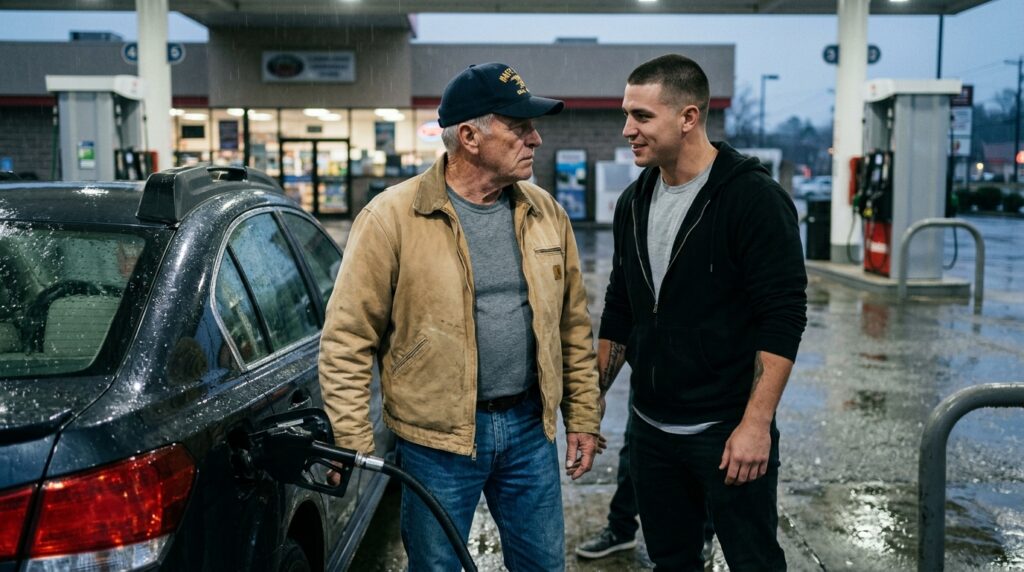
CHAPTER 3: THE DUST AND THE MANIFEST
The socket wrench felt cold, heavy, and balanced between Miller’s fingers. He didn’t lift his gaze from the carbon-slick invoice on the desk, but his shoulders settled into the iron frame of the stool. Every muscle group in his back locked into a quiet, dormant sequence. The water dripping into the external oil drum counted four more beats before the shadow at the top of the wooden stairs shifted again.
Come down from the rafters, Vance, Miller said. His voice didn’t carry more weight than the rain outside, but it cut through the smell of damp pine and gear oil with the flat finality of a closing valve. You’re tracking wood dust onto the drill press.
The silhouette above the heavy timber crossbeam straightened. A low, dry cough rattled down the ladder, followed by the heavy, deliberate scuff of work boots against the rungs. The man who descended wasn’t the young runner from the gas pump; he was broader, older, his skin the color of a wet cardboard box left out on the canal docks. He wore a grease-stained canvas apron over an old hunting jacket, his left hand tucked deep into his pocket while his right stayed loosely hooked over the iron rail of the ladder. His face was a map of local industrial failure—broken veins across a bulbous nose and graying hair that clung to his temples with the sweat of a long shift.
Vance took three steps away from the ladder, his boots crunching lightly over the iron shavings on the floor. He stopped exactly eight feet away, just outside the yellow circle of the desk lamp.
The kid at the station is mine, Vance said. His voice was thin, reedy, the vocal cords scraped raw by forty years of chemical vapors at the commercial terminal. He’s got three cracked ribs and a split lip. He says you didn’t even use two hands.
He crossed the line he shouldn’t have crossed, Miller replied. He didn’t turn his head, but his thumb remained hooked over the cold knurling of the socket wrench. His gaze stayed anchored on the laminated card. He’s carrying state paper with my name on it. Who gave it to him?
Vance let out a short, wet laugh that didn’t reach his eyes. He reached into his internal coat pocket, his movements slow and exaggerated to prove his hands were empty of iron. He didn’t pull a weapon. Instead, he dropped a thick, leather-bound ledger onto the edge of the workbench. The corner of the book was bound in oxidized zinc, and the pages within were yellowed, their edges swollen by thirty years of maritime humidity.
Nobody gave it to him, Miller. The terminal office has had that file since the consolidation in ninety-four, Vance said, his fingers lingering on the cover. My old man was the foreman when the Norfolk freight lines were dissolved. We didn’t know who you were until you started buying bulk kerosene under the salvage yard license. The shipping manifest numbers matched the logistics logs from the delta.
Miller let his eyes drop to the opened page of the ledger. The ink was faded purple—the indelible stencil ink of a military procurement office from 1982. There were six lines of typewriter text, each detailing specific crates of specialized ordnance delivered to a sub-dock at Norfolk. At the very bottom, beneath the authorization stamps, were three names. Two were crossed out with single, heavy lines of black grease pencil, the word DECEASED stamped beside them in faded ink. The third name was his own real name, unredacted, bold, and naked under the halogen glare.
This is a decoy, Vance, Miller said, his thumb tightening against the wrench until the cold steel began to bite into his palm. You’re small-time logistics. You don’t hold files from the Norfolk procurement pool. A shipping company doesn’t keep thirty-year-old black freight logs just to squeeze an old man out of a salvage yard by the canal. Who bought the terminal last winter?
Vance’s jaw twitched, the skin around his mouth turning a dull, flat gray. The smirk he had been trying to maintain collapsed into something hard, narrow, and defensive.
It doesn’t matter who owns the paper, Vance muttered, his eyes darting toward the darkness of the garage door behind Miller. The land under this shop is zoned for the canal expansion. The corporate office has the unredacted manifests. If you don’t sign the transfer deed for the acreage by Friday, those files go to the county prosecutor’s office. An old man with an elite service record and a missing identity trail makes for a very long investigation, Miller. They’ll dig up everything you buried under the swamp.
Miller stood up. The movement was so fluid, so devoid of preparatory tension, that Vance stepped back two full feet, his boot heel catching on a discarded iron pipe with a loud, clattering ring.
The socket wrench didn’t leave the desk, but Miller’s hand was now empty, his fingers resting lightly against the leather ledger. He looked past Vance’s shoulder, his hard, focused eyes capturing the small, dark silhouette of a sedan parked down the track, its lights turned off, its exhaust pipe coughing faint, white plumes of smoke into the cold rain.
The corporate office didn’t hire your kid to scare me off the land, Vance, Miller said softly, his gravelly voice dropping into the quiet space between the thunder claps. They sent him to see if I’d kill him. They wanted to know if the man from the 1982 manifest was still alive, or if he’d turned into a soft old mechanic. You told them I used one hand. That means they have their answer.
Vance looked at the window, then back at the ledger, his bravado completely evaporating into the smell of wet zinc. What are you talking about? It’s just a property dispute. The company wants the waterfront.
Miller leaned down, his face inches from the yellow light of the lamp, his weathered jaw set like iron. No. The company wants the third man on that manifest. And you just gave them the signature they were looking for. Get out of my shop.
Vance didn’t take the ledger. He backed toward the sliding door, his hands raised to his chest, his boots shuffling through the iron shavings until he slipped through the narrow gap into the rain. The car down the track didn’t turn on its high beams; it simply shifted into gear, its tires sucking against the wet slag as it glided backward into the dark, leaving Miller alone with the rotted purple ink of his past.








