
CHAPTER 1: THE FAULT LINE AT THE ISLAND
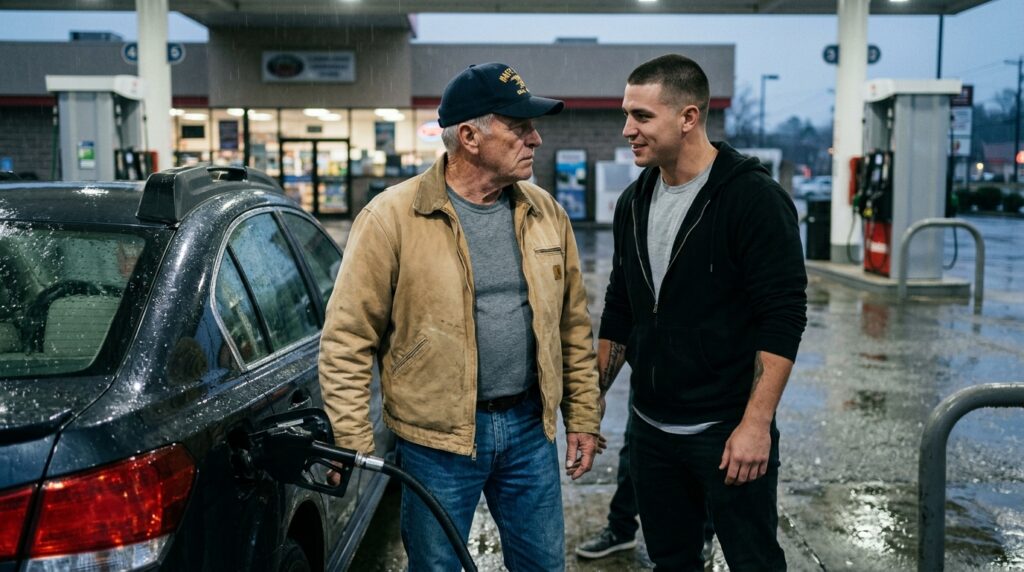
Nice hat, old man, you still playing hero at a gas pump?
The words cut through the heavy, rhythmic hiss of the June downpour, slick with the smell of cheap unwashed cotton and cheap tobacco. Miller did not let his fingers leave the rusted latch of the fuel nozzle. The metal was cold, vibrating faintly with the underground thrum of the premium storage tank. He kept his eyes fixed on the mechanical rolling digits of the meter—twenty-one dollars and forty cents, forty-one cents, forty-two cents. The rain was drumming a relentless, metallic beat against the roof of his faded F-150, bouncing off the hood in tiny, desaturated spikes.
He didn’t turn. He didn’t shift his boots. In the gray twilight of the forecourt, under the buzzing white glare of the overhead halogen tubes, the world was composed entirely of grit and friction.
You deaf, or just slow?
A shadow crossed the driver-side mirror, wide-shouldered and damp. The smell changed—now it was the sour tang of beer from two hours ago and the sharp heat of an adrenaline spike. The younger man stepped into Miller’s peripheral vision, crowding the narrow island between the truck’s rear fender and the rusted pillars of pump number four. He was twenty-eight, maybe thirty, with a short, jagged buzzcut that let the rain pool against his scalp, and a thick, dark line of ink curling out from the cuff of his black zip hoodie. His jaw was thrust forward, a smirking, restless movement that Miller recognized with a deep, visceral weariness. It was the face of an engine running without oil, looking for something to seize against.
Miller let the meter roll to twenty-five dollars. His internal count was different. He was tracking the distance between his right heel and the slick iron edge of the pump basin. Three inches. He was tracking the wet weight of his tan canvas work jacket.
I asked you a question, Chief. The young man’s shoulder hitched, his left hand coming out of his pocket, fingers twitching near the bill of Miller’s dark Navy SEAL cap. The faded gold lettering was dark with grease from the shop, but the anchor was still visible. You think that piece of cloth means people have to clear out for you?
Miller released the handle. The mechanical click of the shutoff valve sounded like a small bone snapping in the quiet of the station. He turned his torso slowly, pivoting on the ball of his left foot with the heavy, unhurried precision of an old crane. He did not raise his hands. He kept his elbows tucked close to his ribs, his chin low behind the collar of his jacket.
You picked the wrong pump, son, Miller said, his voice a low, dry rasp that sounded like gravel being dragged across iron. Now stay down and breathe.
The young man didn’t wait for the end of the sentence. He lunged, a clumsy, high-line grab aimed at the throat of Miller’s jacket, his boots scuffing a spray of oily water off the asphalt.
The world contracted to six square inches of wet skin and bone. Miller didn’t think; the decades of deliberate silence vanished behind the violent, instantaneous logic of a reflex he had spent forty years trying to forget. His left hand shot under the young man’s extended forearm, thumb driving deep into the soft tissue above the elbow joint while his right palm struck upward into the pectoral line, breaking the forward momentum. Before the aggressor could counter, Miller stepped deep into the gap, his hip catching the man’s center of gravity, and hoisted him with a short, brutal twist of his core.
The impact was loud—a wet, hollow thud as the younger man’s back met the concrete curb of the pump island, the air leaving his lungs in a single, ragged gasp.
Miller didn’t pursue. He stood perfectly upright in the downpour, his breath steady, his right hand reaching up with absolute deliberation to adjust the brim of his cap. He looked down into the young man’s stunned, pale face, watching the water mix with a smear of grease on the kid’s cheek. The young man lay there, his fingers clutching at the wet concrete, his mouth open but silent, paralyzed by the sheer speed of the drop. Miller turned back to the truck, unhooked the nozzle, and slid it back into its cradle with a dull metallic clink.
As he reached for his keys, his eye caught the puddle near the rear tire. Lying in the oily sheen, half-submerged in the gray water, was a small, laminated security badge that had torn free from the young man’s hoodie during the throw. It wasn’t a local mill pass. It bore the blue-and-gray logo of the state maritime regulatory commission, and stamped across the bottom in bold, red ink was Miller’s own real, unredacted surname—a name he hadn’t used since the night the transport plane went down in the delta.








