
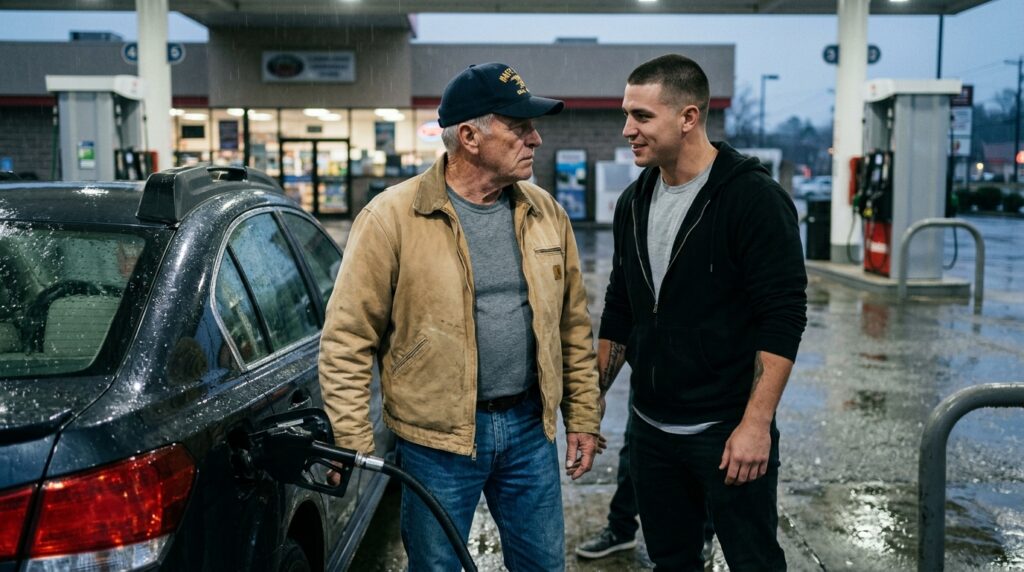
CHAPTER 2: THE COLD IRON LOG
Turn the key.
The starter on the F-150 groaned once—a dry, iron-on-iron rasp that vibrated up through the worn rubber of the steering wheel—before the cylinders caught with a heavy, unbalanced rumble. Miller didn’t look back at the pump island. In his side mirror, the dark shape of the younger man was already shifting from a sprawl to a clumsy, one-handed push-up against the wet concrete, his boots slipping twice on the slick blend of rain and leaked diesel fuel. The laminated security badge sat face-up on the passenger seat, its cheap plastic edge catching the green, rhythmic blink of the dashboard clock. It read Miller. Not the name on his current state driver’s license. Not the name on the deed to the three-acre salvage yard down by the shipping canal.
The truck rolled out of the station’s halogen glare and into the desaturated gray of the county route. The wipers ploughed through the downpour, leaving opaque streaks of salt-crust and road film across the windshield. Miller kept his speed at exactly thirty-five miles per hour. A man driving an old truck at thirty-five in a storm was invisible; a man driving at forty-five was running. His fingers, calloused to the texture of coarse emery cloth, remained loose on the rim. His heart rate had already dropped back to its resting sixty beats per minute, settled by the same cold, mechanical self-regulation that had kept him breathing when the world around him was burning down to charcoal.
The road flattened out as it approached the industrial canal. Here, the landscape was defined by the oxidation of old logistics. Rusted chain-link fences were choked with dead briars, and the corrugated iron roofs of defunct processing plants sagged under the weight of the water. Miller turned off the tarmac onto a dirt track lined with crushed slag. The tires crunched over the sharp stones, the sound wet and heavy, until the truck cleared the gate of his workshop.
The shop was an unheated three-bay garage built from rough-cut cinder blocks that sweated lime when the humidity spiked. Inside, the air smelled of stale gear oil, solvent, and the sharp, iron tang of the iron shavings piling beneath his drill press. He didn’t turn on the overhead lights. Instead, he pulled the heavy sliding door shut until the rusted iron latch dropped into its hasp with a definitive, dead latch.
He sat down at the workbench. A single goose-neck lamp cast a yellow, low-contrast circle over his logbooks—three-ring binders with canvas covers that had rotted down to loose threads at the corners. For twenty-four years, Miller had recorded every gallon of heating oil he bought, every old engine block he stripped, and every transaction with the regional distributors. He was a meticulous ghost.
He picked up the laminated badge from the truck seat and laid it under the lamp. The logo for the state maritime regulatory commission was authentic—the watermark was embedded in the plastic layer—but the typeface used for the name was a fraction of a millimeter narrower than standard agency issue. It was a rush job. It was an interrogation tool disguised as an ID card, designed to be dropped or shown to verify if the old man at the pump would flinch at the sight of his own ghost.
Miller pulled his latest bulk fuel invoice from the metal spindle on the wall. The receipt was dated three days ago, issued by the terminal foreman at the canal docks where Miller bought his wholesale kerosene. His eye traced the line items down to the registration code at the footer.
The paper felt different between his fingertips. The grain was too slick, lacking the dry, fibrous texture of the cheap carbon sheets the terminal had used since the nineties. He held the sheet directly up to the yellow bulb of the desk lamp.
The serial number stamped into the upper margin was 82-Proc-041.
The pencil in Miller’s right hand snapped cleanly across the grain of the cedar. His thumb stayed pressed against the splintered edge, the pain minor and distant. That wasn’t a commercial shipping prefix. The 82-Proc designation belonged to a defunct logistics channel out of the sub-dock at Norfolk—the very unit that had handled the untraceable freight manifests for the supply drops during the third month of his deployment in the delta. Someone hadn’t just found his current address; they had inserted themselves directly into his local supply line, altering the invoices he handled every single week to see if he was still monitoring the old operational codes.
A floorboard creaked in the storage loft above the drill press.
The sound was microscopic—the dry, microscopic slide of old pine shifting against an iron joist under less than a hundred and eighty pounds of weight. A normal ear would have dismissed it as the building settling under the weight of the rain. Miller’s hand went flat against the cold cast-iron bed of the workbench, his fingers identifying the smooth handle of a heavy three-quarter-inch socket wrench before his body even finalized the movement.
The downpour outside seemed to recede, leaving only the steady, rhythmic drip-drip of water leaking from the eaves into an empty oil drum near the door. He didn’t look up at the dark rafters. He didn’t reach for the light switch. He simply listened to the silence of his own house, realizing that the young man at the gas pump hadn’t been an isolated piece of road friction. He had been the perimeter guard, and the real infiltration was already sitting in the dark above his head, waiting for him to read the paper.








