
CHAPTER 4: THE COLD IRON MERIDIAN
The tail-lights of Vance’s sedan dissolved into the black, rain-mottled boundary where the slag track met the county road. Inside the shop, the single bulb of the goose-neck lamp hummed, its yellow filaments vibrating with the low frequency of the industrial power grid. Miller did not look back at the open doorway or the wet air blowing mist across the floorboards. His hands moved with an unhurried, heavy rhythm that had nothing to do with panic and everything to do with the simple economy of survival.
He closed the leather-bound ledger. The zinc-bound corners scraped against the iron filings on the workbench, a sharp, abrasive sound that remained in the small space between his ears long after the book was stowed inside a heavy canvas tool sack. He didn’t lock the garage door behind him. A lock was an invitation for a crowbar, and everything of value inside the block walls was already registered in his muscle memory.
The F-150 cleared the gate without headlights, its iron exhaust coughing a cold, gray plume against the wet weeds. Miller navigated by the silhouette of the cranes three miles south—six black skeletons rising over the shipping canal, their steel booms silhouetted against the desaturated orange glare of the municipal refinery.
The entrance to the regional shipping terminal was defined by gravel trucks and rusted scales. A single chain-link gate hung open, its padlock swinging from an iron link like an unspent pendulum. Miller parked the truck behind a row of dead flatbeds, where the shadow of the container stacks was dense enough to swallow the faded paint of his fenders. He walked toward the administrative shack, his boots making no more sound on the wet gravel than the rain hitting the mud.
The shack was constructed of corrugated iron panels that had turned the color of dried liver under thirty years of river salt. Inside, through the grease-filmed glass of the single office window, Vance was standing beside a gray filing cabinet. His canvas apron was gone, replaced by a cheap nylon jacket that rasped every time his arms twitched. Opposite him sat an older man in a tailored wool overcoat that looked out of place among the iron desks—a man whose fingers held a thin, clean sheet of corporate transfer paper with the distinct, unhurried confidence of an executioner.
Miller didn’t use the handle. He struck the latch side of the iron door with the heel of his boot, a single, short impact that sheared the small zinc screws holding the strike plate to the frame. The door swung inward, banging hard against the drywall with a hollow, dust-choking crack.
Vance jumped back, his hip hitting the edge of the desk, a row of plastic specimen cups rattling onto the linoleum. The man in the wool coat didn’t move his boots. He simply raised his chin, his eyes cold, grey, and entirely devoid of the small-town hesitation that defined Vance’s family.
You’re late, Miller, the man in the coat said. His voice was flat, unyielding, carrying the precise mid-Atlantic accent of an administrative officer from the old logistics command at Norfolk. The deed has been ready since six.
Miller dropped the canvas tool sack onto the desk. The weight of the zinc ledger hit the wood with a dead, heavy thud that flattened a box of brass paperclips.
The land isn’t what you’re tracking, Miller said. His rasp was lower now, matching the low thrum of the river barges passing thirty yards behind the wall. You bought this terminal through three shell companies registered in Delaware. The corporate land grab is a clean file for the county inspectors. But the manifest inside that sack doesn’t belong to a commercial entity. It belongs to the desk that authorized the transport over the border in August of eighty-two.
The man in the coat let his fingers rest on the clean transfer document. A small, cold smile touched the edge of his mouth, though his eyes remained fixed on the golden lettering of Miller’s cap. The gold thread was fraying, one small loop of the anchor hanging loose like a broken wire.
My father was the procurement officer who signed that purple ink, the man said softly. He spent twenty years in a federal facility because three crates of specialized optics vanished from the sub-dock at Norfolk during your unit’s third month. He died in a gray room believing one of the three men on that manifest had sold those crates to a scrap dealer in Baltimore to fund a civilian exit.
He was wrong, Miller said. He stepped closer, the wet canvas of his jacket brushing the edge of the desk, the smell of old grease and swamp water filling the small room until Vance began to wipe his nose with the back of his sleeve. The crates never left the transport plane. They went into the mud with the rest of the fuselage when the tail rotor sheared over the delta.
The man in the coat stood up, his wool shoulders squaring against the corrugated iron wall. Then your signature on the delivery log is a forgery, Miller. Or it’s a confirmation that you survived the impact while the other two went into the ground. Either way, the company doesn’t need the land. The company needs the identity trail. The moment you used your old leverage to secure the salvage yard deed twenty years ago, you left an ink trace in the state archives. We just had to wait for you to grow old enough to slow down.
Miller looked down at his own hand—the skin calloused, stained with black oil that would never wash out of the grain, the fingers steady against the cold iron edge of the desk. He felt the weight of forty years of silence balancing against the sudden, mechanical necessity of a final confrontation. The decoy secret—the simple land dispute that Vance had used to threaten him—was gone, dissolved into the cold, multi-generational ink of an old military grudge that had followed him down to this river mud.
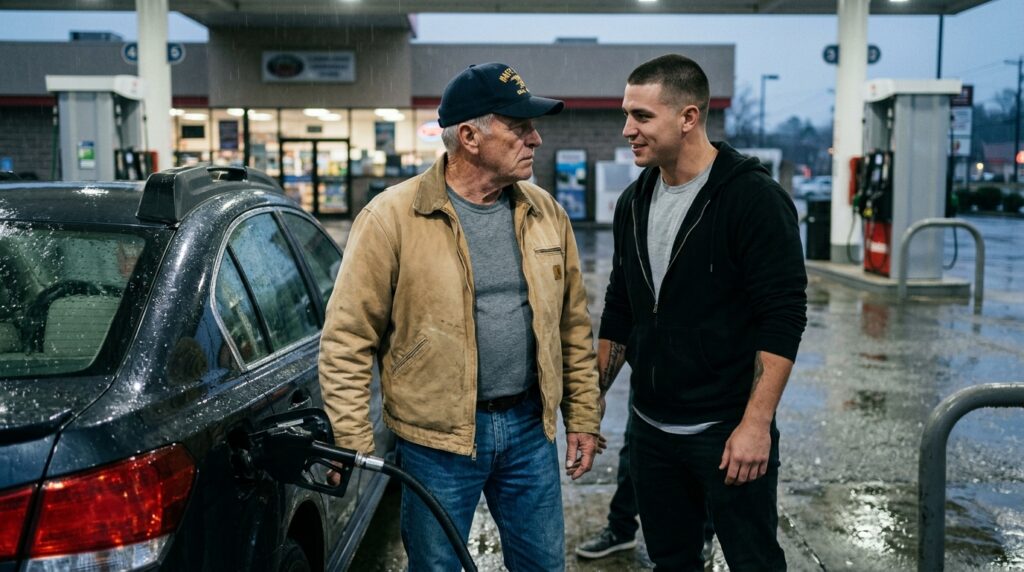
You shouldn’t have brought your boy to the pump, Vance, Miller said, his gaze shifting back to the foreman, who was now trembling against the filing cabinet. He’s too soft for this kind of work. And he doesn’t know what happens to things that get caught in the machinery.
The man in the coat reached toward his internal pocket, his fingers tracking a small, black shape beneath the wool.
Miller didn’t draw a weapon. He simply reached across the desk with his left hand, his thumb catching the man’s lapel with the exact, instantaneous grip he had used on the concrete forecourt three hours ago, his right hand pinning the clean transfer document to the wood like a metal stake. The room fell into an absolute, suffocating silence, broken only by the sound of the rain drilling into the iron roof above their heads—an echo of an old sky that had never truly cleared.








