
CHAPTER 8: THE BALLAST DRIFT
The gravel didn’t hold. Every time Miller shifted his weight three inches to the left, the wet limestone chips slid away from the shoulder of the rail-bed, tumbling into the stagnant black water of the drainage ditch below.
He kept his hand locked around the coarse canvas strap of Garrity’s makeshift sling, pulling the boy up the slope before the ballast could cave completely. The scent of the marsh was shifting—less salt now, more of the heavy, chemical musk of old creosote and rotting pine ties that had been baking under the coastal humidity since the mid-seventies.
“The signals are red behind us,” Garrity rasped. He stopped, his knees shaking against the iron plate of a tie-clip. He didn’t look at his arm; his eyes were fixed on the perimeter towers two miles back, where the white searchlight beams had stopped swinging. They were fixed, parallel lines cutting through the desaturated mist, pointing directly toward the terminal bunker they had left forty minutes ago. “They aren’t looking for a breach anymore, old man. They’re setting the grid.”
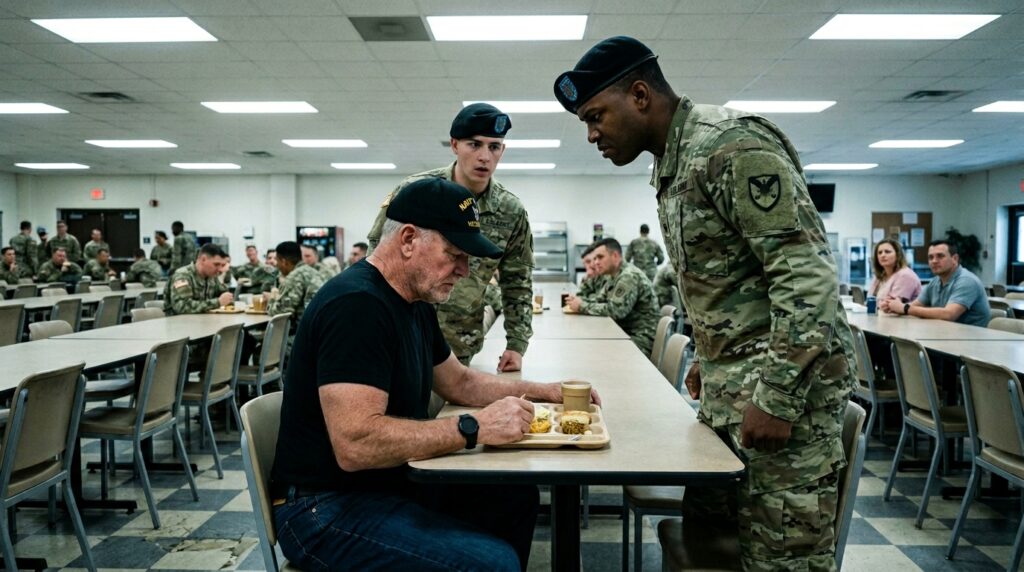
Miller didn’t answer until he found a solid pine tie that hadn’t surrendered its tar to the damp earth. He planted his heel, feeling the dull click in his knee-joint that always preceded a rain shift. His black veteran cap was soaked through, the canvas heavy and tight against his skull, holding the cold moisture against his skin.
“They aren’t setting a grid for us,” Miller said, his rasp low against the distant, rhythmic clack of an uncoupled freight car shifting on a distant siding. “You don’t deploy three active military police squads into a civilian marsh to catch a boy with a broken collarbone. They’re covering the transition logic. If the server logs show a physical interruption before the calibration completed, the contractor has to report a total system failure to the treasury board. They’re out there resetting the fuses so the insurance title clears by 0600.”
He reached down, his thick fingers tracing the side of the rail. The steel was cold, pitted with red oxide scabs that flaked off under his fingernails like dry skin. But six inches below the head of the rail, stamped directly into the web of the iron, was a fresh alphanumeric code: 3B-4M-1978.
It wasn’t a factory foundry mark. It had been chiseled by hand, the edges of the numbers rough and uneven, identical to the three-notched pattern on the key he had dropped into the junction box.
Miller stopped, his thumb resting inside the groove of the ‘8’.
“This isn’t a secondary spur line, son,” Miller muttered, his eyes tracking the silver rails as they disappeared into the wall of dark pine trees ahead. “This is the old ammunition loop we laid down during the mobilization for the Mediterranean deployment. The base command didn’t build this rail-head for the automated logistics network. They just laid the new concrete over the old iron we buried when we thought we were going home.”
“What does that mean?” Garrity asked, his breath coming short, a thin line of red foam forming at the corner of his mouth where his rib had nicked the lung lining during the scramble through the fence.
“It means the template was already here,” Miller said. He caught Garrity by the belt, hoisting him over the low iron switch-rod that controlled the track alignment for the commercial shipping yard ahead. “The automation didn’t invent a new way to discard a soldier. It just found the old ledger we left behind and updated the font.”
The glare of a low-wattage yellow bulb appeared through the pine branches—not a base security tower, but the equipment shack of the local timber contractor whose yard bordered the state highway line. The air changed, losing the clean sting of ozone and taking on the sour, heavy reek of diesel exhaust, wet sawdust, and old tallow grease from the ungreased gears of a stationary log-loader.
Miller didn’t head for the road. He guided the boy toward the shadow of a stacked pile of unbarked cedar logs, his boots sinking into six inches of wet mulch that smelled of rot and old iron wire. Beneath the corrugated tin roof of the loader shack, a small mechanical ticker was clicking in the dark—a civilian logistics terminal that was pulling its power directly from the base’s secondary line.
The white paper tape was spilling onto the dirt floor, its printed columns tracking something that had nothing to do with lumber.








