
CHAPTER 4: THE RESIDUAL ACCOUNT
“Drop the steel, Garrity,” Miller said. His voice didn’t rise above the wet hum of the secondary generator, but it had the specific weight of a structural beam cracking under load.
Garrity didn’t move his hand from his waist. His fingers were locked around the cold grip of the stolen pistol, his knuckles white and slick with sweat that smelled of panic and cheap tobacco. The beams from the military police weapons didn’t bounce; they hung in the oily fog of the motor pool yard, three solid white bars that pinned the young soldier against the split wood of the rifle crates.
The sergeant at the front of the line didn’t look at Garrity’s gun. He looked at Miller. The visor of his helmet was up exactly half an inch, enough to show two eyes that carried no malice—only the dead, unblinking clarity of a clerk executing a balancing entry.
“The perimeter is logged,” the sergeant said. He didn’t point his carbine at Miller’s chest; he kept it lowered toward the gravel, his thumb resting lightly on the selector switch. “The civilian evaluator is clear of the target zone. Bring the boy.”
Garrity’s head jerked toward Miller, his jaw dropping as the light caught the dark, wet sheen of the swelling along his collarbone. “Evaluator? Old man… what is he talking about?”
Miller didn’t look back at him. He pulled his hands from his pockets, slowly, letting the MP see his palms were empty before he reached up to touch the brim of his black Navy cap. The iron grommets were cold against his skin, carrying the bitter taste of zinc from the fence line. He reached into his T-shirt, pulling out a small, laminated security pass that had been tucked flat against his ribs—the backing plate wasn’t marked with a defense logistics logo; it bore the black alphanumeric stamp of the Office of Institutional Resilience.
“He’s talking about the audit, son,” Miller said softly. He stepped back from the crates, his boots grinding a handful of loose iron flakes into the wet dirt. “The weapons aren’t surplus. They’re props. The boxes are real, the serial numbers are active, but the firing pins were pulled before these crates left the factory in Ohio. They needed to see how far a red-line unit would go when the paper started to vanish.”
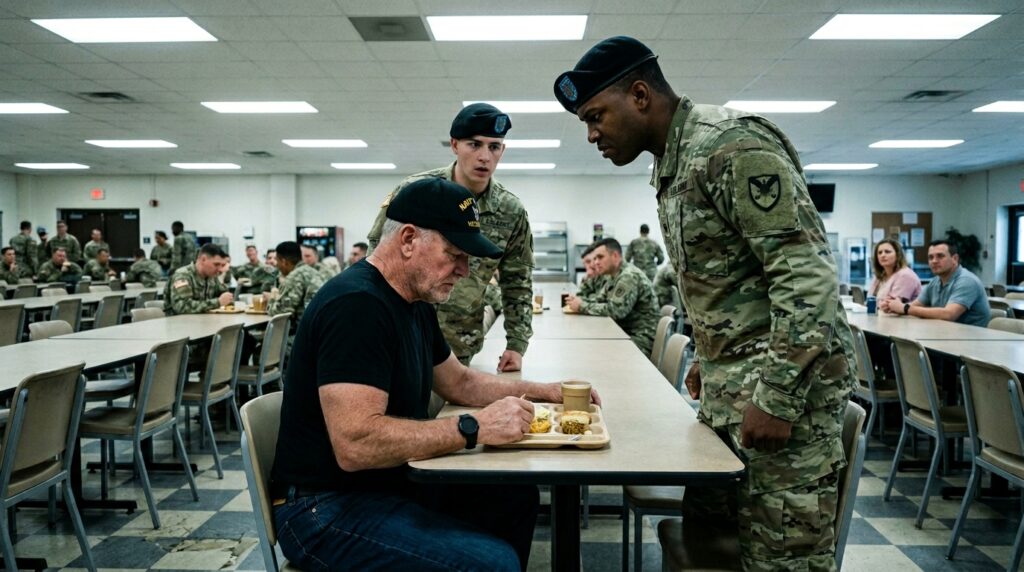
“You… you set the floor,” Garrity whispered. The pistol slipped an inch from his belt, the iron sight catching on the frayed thread of his waistband. “In the cafeteria. You didn’t just fight back. You were looking for me.”
“I was looking for anyone who still had enough grease in their gears to strike back,” Miller said. He felt the cold air from the open bunker door pressing against the back of his neck, carrying the scent of packing lard and ancient coal dust. “If you had moved your tray when he told you to, your file would have been signed off as compliant by midnight. You’d be sitting on a transport to a San Diego desk by the end of the week. But you didn’t. You held the line, which means your unit is still considered an active hazard to the administrative transition.”
The sergeant took two steps forward, his boots clicking against the concrete lip of the bunker. He didn’t use force; he simply reached down and took the stolen pistol from Garrity’s unresisting fingers, dropping it into a canvas recovery bag with a flat, dry chime of metal.
“Captain Vance is waiting in the transport, Miller,” the sergeant said, turning his shoulder to mask the boy as the other two officers guided Garrity toward the rear of the container line. “The evaluation sheet needs your signature before the 0400 shift change.”
Miller stood alone in the shadow of the three-high stack of iron containers. He reached into his pocket to retrieve his tobacco pouch, but his fingers hit something hard and thin instead. It was the receipt for his monthly veteran’s annuity voucher—the small, blue slip that arrived every thirty days from the treasury repository in St. Louis. He held it up to the weak amber light of the perimeter lamp.
In the lower right corner, beneath the automated signature of the regional director, was a small, three-notched watermark. It was identical to the filed grooves on the brass key that had opened the door, and identical to the inventory stamp on the boxes of modular carbines.
The system wasn’t clearing the titles to build a new infrastructure; it was using the scrap value of its old units to pay the maintenance fees on the ones left behind. His pension wasn’t drawn from an investment fund; it was the direct interest on the obsolescence of boys like Garrity.
He folded the blue paper twice until the watermark was hidden inside the crease, then tucked it back into his pocket next to the flint lighter that wouldn’t strike on the first try. He adjusted his cap, pulled the brim down until the fluorescent glare of the main base offices was blocked from his sight, and walked out into the desaturated gray of the tarmac toward the waiting truck.








