
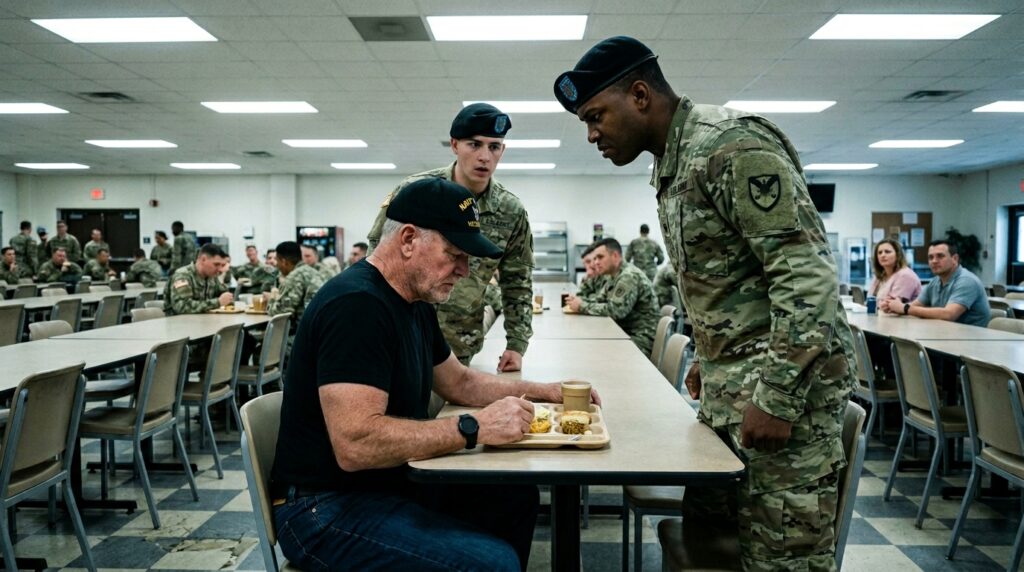
CHAPTER 6: THE DISCREPANCY BLOCK
“The gate log doesn’t match the pressure on the axle,” Miller said. He didn’t drop his boots from the uninsulated steel floorboard until the truck engine died with a wet, heavy cough of black soot.
The security guard at the rail-head terminal didn’t pull his hand away from his hip. He stood in the narrow triangle of yellow light cast by the gatehouse lamp, his slicker dripping grease-filmed rainwater onto the gravel. His chest patch read Logistics Command, but the gray web-gear he wore had the stiff, unwashed smell of a unit that had been pulled from active field storage less than forty-eight hours ago.
“The manifest is locked, evaluator,” the guard said, his teeth catching on a dry piece of commercial chewing gum. “Truck goes down the spur. You stay in the cab.”
Miller swung his leg out anyway. His left heel struck the wet stone with a flat, heavy thud that shot straight through the bone-chips in his knee. He didn’t look back at Vance, who sat frozen behind the steering wheel with his fingers still glued to the rim. Miller walked toward the low-slung concrete bunker that anchored the eastern rail-line, his black veteran cap pulled down to deflect the cold, needle-fine mist coming off the salt marshes.
The siding was packed with ten dark-gray flatcars, their hand-brakes tightened down until the cast-iron shoes bit into the steel wheels with a rusty screech. On top of them, the heavy transit cases weren’t stacked for shipping; they were wired directly to the deck plates with thick copper ground lines—the kind used to bleed static charge away from high-yield computing frames.
“You’re in the wrong sector, Miller,” Vance called out from the truck window, his voice thin against the rhythmic click of the cooling manifold. “The detention tier is forty yards west. You don’t have clearance for the loading terminal.”
“The numbers on the pipeline are sixty-two, Vance,” Miller said without stopping. He stopped beside a thick iron conduit that emerged from the gravel and ran straight up the side of the concrete bunker. The red protective paint was peeling away in dry, crisp scabs, revealing the pitted zinc beneath. “My first berth in seventy-eight had the same loop. Same pressure valves. Same automated return lines. You don’t use a high-flow cooling loop like this to store wooden crates of decommissioned carbines. You use it to keep a liquid-cooled server rack from melting through its floorboards.”
He reached the heavy iron door of the terminal building. The latch wasn’t sealed with a standard lead-wire lock; it used an old mechanical combination dial with five brass tumblers, the metal worn flat by decades of greasy thumbs. Miller didn’t look at a code sheet. He used his thumb-nail to trace the third tumbler until his skin caught on a tiny, shallow notch filed into the side of the housing—the identical mark from the cafeteria key, the manifest stamp, and his own pension voucher.
The dial turned three times left, twice right. The internal bars dropped with a heavy, hollow clunk that sounded like a dry branch snapping under water.
Inside, the air didn’t smell of Cosmoline or gun oil. It was cold—bitterly cold—and smelled of ozone, burnt copper wire, and the dry, synthetic dust of industrial cooling fans.
The room was low-ceilinged, the concrete walls weeping lime-streaked water onto a steel mesh floor. Instead of storage racks, the center of the floor was cut away, revealing a lower gallery where rows of dark, vertical cabinets hummed with a low, sub-audible frequency that made the water in Miller’s ears vibrate.
At the far end of the mesh walkway, pinned beneath the harsh glare of an unshielded mercury bulb, was a single metal chair. Garrity sat there, his good arm cuffed to the iron leg, his brown undershirt torn across the collar. A bundle of gray ribbon-cables ran from the back of his neck into the terminal panel behind him, the small copper contacts held against his skin by strips of industrial tape that had begun to lift from his sweat.
His eyes were open, but they didn’t track Miller’s boots. They were fixed on a small, flickering monitor that showed a repeating loop of the cafeteria altercation—the split-second tilt of his own balance, the precise moment Miller’s hand had crushed his thumb-joint, the unnatural, stunned silence of the dining hall.
“They aren’t rewriting your file, son,” Miller said, his rasp cut through the mechanical hum of the room. He didn’t touch the cables. He stood three inches from the chair, his hand resting on the cold iron of the frame. “They’re mapping the reflex. Every time your pulse spikes on that tape, the processors down there adjust the response parameters for the new automated defense network. They don’t want your discipline. They want your failure. They’re using the exact sequence of your breakdown to train the perimeter code.”
Garrity’s jaw twitched, a thin line of dry saliva catching the blue light of the screen. “The old man… he told me… I had a week left.”
“The old man was reading from the decoy sheet,” Miller muttered, his eyes tracing the gray ribbon-cables down into the floor grid where they met a large, heavy copper bus-bar. The nameplate on the main junction box was stamped with the corporate emblem of the contractor that administered the veteran retirement fund.
A heavy footstep sounded on the steel mesh behind him. It wasn’t the guard from the gate. It was Vance, his uniform coat damp from the rain, holding a small, gray plastic diagnostic key that matched the three-notched cylinder on the master board.
“He’s already past the calibration threshold, Miller,” Vance said, his voice dropping into the flat, empty register of a machine that had finished its stroke. “The contract you signed wasn’t for an inspection. It was for a stressor. If you hadn’t broken his grip in that cafeteria, we wouldn’t have the baseline data for the physical aversion metrics. You completed the template.”
Miller turned slowly, his boots grinding a fresh layer of oxide from the floor plates. He looked at the three notches on Vance’s plastic key, then down at the blue pension slip still tucked into the pocket of his own black shirt. The loop wasn’t closing; it was drawing tighter, and his own hand had been the one pulling the wire.








