
CHAPTER 7: THE SCRAP VALUE PARITY
“The logic doesn’t loop, Vance,” Miller said. He didn’t drop his arm from the metal rail, even as the high-frequency vibration from the lower gallery servers hummed through the zinc coating of the walkway, turning his thumb-joint numb. “A machine doesn’t build a habit. It doesn’t look at an old man in a cafeteria and feel the weight of thirty years of discarded grease. You can’t code that kind of friction into a silicon board.”
Vance didn’t lift the plastic diagnostic key. He held it exactly two inches from the master receiver panel, his fingers steady, though his uniform sleeve was stiff with dry marsh salt. “We aren’t coding the friction, Miller. We’re capturing the reaction time before the decay settles into the muscle. The network doesn’t need to feel the anger. It just needs to know exactly how many milliseconds it takes for an active-duty infantryman to drop his center of gravity when an unmapped threat crosses his line.”
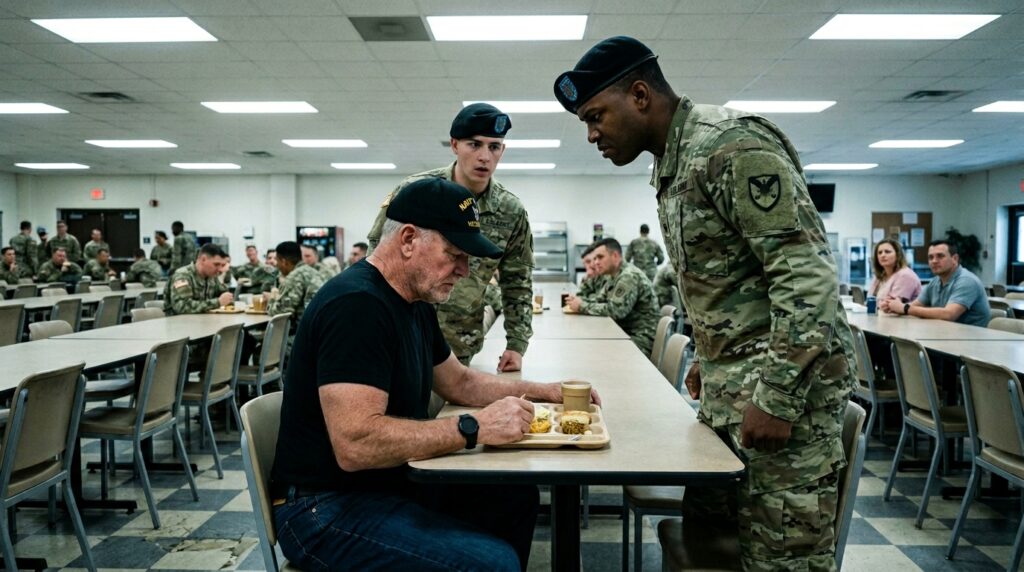
Miller looked back at Garrity. The boy’s head had rolled to the side, his chin resting against the coarse canvas strap of the makeshift sling. On the flickering monitor behind his hair, the loop of the cafeteria brawl had frozen on a single frame: the exact micro-second Miller’s heel had found the grout line between the rubber tiles, his weight shifting forward with the slow, irreversible momentum of an iron door closing.
The numbers at the bottom of the screen weren’t tracking time. They were tracking fluid displacement, skeletal stress points, and the precise monetary cost of the institutional recovery.
“The voucher,” Miller muttered, his rasp dropping into the lower register where the machinery couldn’t drown it out. He reached into his shirt pocket, his thick fingers tracing the crisp, double-folded edge of the blue treasury slip. “The watermark on my annuity—the three notches filed into the die plate. That wasn’t a clearance code for the bank. That was the asset ledger number for the Third Battalion’s ordnance account from seventy-eight. You didn’t buy these server racks with defense allocation funds, Vance. You bought them with the unspent maintenance reserves of my old platoon.”
Vance’s face remained completely desaturated under the mercury lamps. He didn’t deny it. He simply slid the plastic key into the slot. The machine didn’t beep; it gave a low, wet click as the internal contacts met the copper traces on the card.
“The legacy has to pay for the maintenance, Miller,” Vance whispered. The sound of his voice was identical to the dry rattle of the high-voltage cables behind the mesh wall. “An old soldier who sits in a garrison cafeteria eating industrial pork isn’t an asset anymore. He’s a storage fee. The only way the system keeps your pension voucher active is if we use the kinetic residue of your training to prime the replacement loop. Garrity’s unit isn’t being erased because they failed. They’re being harvested because you succeeded.”
Miller didn’t swing. Swing was for people who believed the room had a boundary.
Instead, he let his weight drop three inches, his boots settling into the iron mesh until the metal wires bit into the leather of his soles. His right hand didn’t move toward Vance’s throat; it went downward, his calloused fingers catching the thick copper bus-bar where it entered the main junction box. The metal was burning hot, vibrating with the static load of three hundred active processors drawing current from the secondary rail-head generator.
He didn’t pull the cable. He simply leaned his mass against the terminal housing, using the leverage of his stiff left knee to wedge the brass key—the boy’s key, the one with the three filed teeth—directly between the positive terminal and the ungrounded iron frame.
The arc didn’t make a loud report. It was a sharp, blue flash that smelled instantly of scorched tallow, vulcanized rubber, and the metallic tang of ionized salt-water.
The monitors didn’t go dark; they flickered once, the frame of the cafeteria fight dissolving into a vertical column of white static that looked like flaking zinc falling through a grease-trap. The hum in Miller’s ears changed frequency, dropping from a high mechanical whine to the dull, heavy thrum of an engine that had lost its oil.
Garrity’s eyes cleared first. The tension in his jaw slackened, his chin lifting from the cargo strap as the ribbon-cables behind his neck grew cold, their small indicator lights dying out one by one like embers in wet gravel. He looked at Miller, his gaze tracking the black Navy cap, the unwashed black T-shirt, and the grease-filmed hand still clamped onto the iron housing of the junction box.
“Old man…” the boy rasped, his voice carrying the dry, hollow rattle of the detention cells. “The file… did it strike?”
Miller didn’t look down at the blue voucher in his own pocket, though he could feel the faint, warm smell of scorched paper where the residual current had singed the edge of his shirt. He pulled his hand back from the steel frame, checking his knuckles out of habit—the skin was gray with carbon dust, the thumbnail split along the grain, but his grip remained centered.
“The file is closed, son,” Miller said. He reached down, his fingers unlatching the iron cuff from the chair leg with a single, unhurried twist of the iron pin. “The system doesn’t have the budget to run the calculation twice.”
Vance didn’t pull the diagnostic key from the slot. He stood by the dead panel, his fingers still resting on the gray laminate, his eyes fixed on the horizontal line of white oxide forming on the surface of the server racks as the cooling pumps died down to a complete, ungreased stop.
“You’re a civilian contractor, Miller,” Vance said, his rasp flat, carrying no more anger than a discarded logistics manifest. “The 0600 voucher won’t clear now. You’re off the books.”
Miller turned his back to the mercury lamp, his boots finding the dark, wet path through the gravel toward the perimeter gate where the rain was still shedding fine flakes of rust onto the marshland. He settled his Navy cap low over his eyes, the heavy brim blocking the last white bar of light from the terminal yard.
“I’ve been off the books since seventy-eight, Captain,” Miller said into the dark. “The scrap value was always zero.”








