
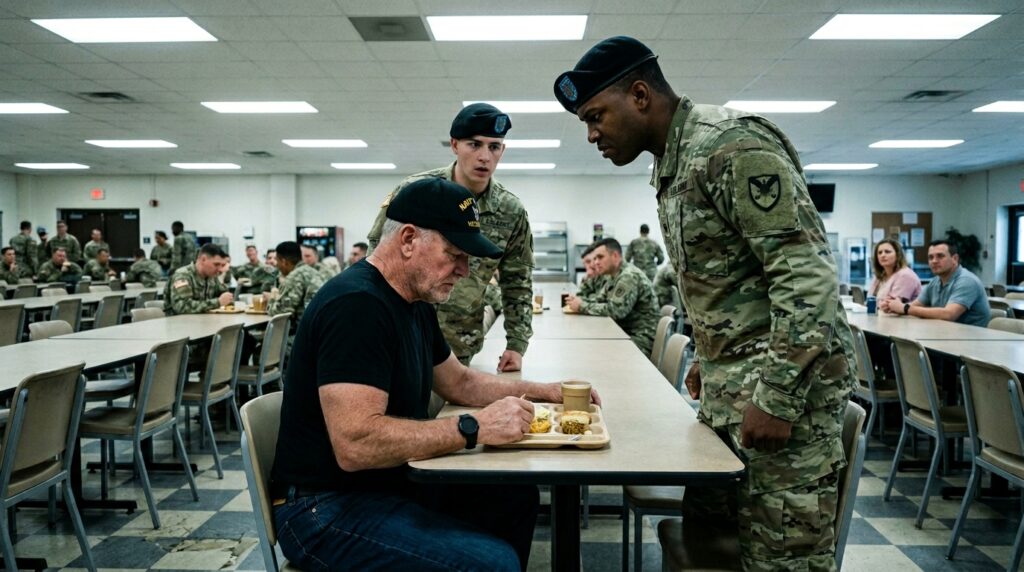
CHAPTER 2: THE SCRAP VALUE OF MEN
“The latch on that door hasn’t been greased since the budget re-alignment in twelve,” Miller said, his eyes fixed on the pitted steel plating of the interrogation table. He didn’t look up when the deadbolt clicked. “You can hear the orange oxide grinding inside the casing every time the handle drops.”
Captain Vance didn’t answer right away. He dropped a manila folder onto the center of the table. The cardboard was frayed at the corners, the fibers swollen from the humid salt-air that crawled off the tarmac every night at 0200. On top of the folder, he placed the small brass key Miller had retrieved from the cafeteria floor—the three notches filed into its spine catching the dull yellow glow of the security lamp.
“You’re a civilian contractor, Miller,” Vance said, his voice flat, carrying the dry rattle of a man who spent eighteen hours a day breathing recycled air-conditioner coolant. He sat down, his uniform coat tightening over shoulders that had begun to round from desk work. “You don’t evaluate the hardware anymore. You don’t evaluate the discipline. You’re paid to look at the logs.”
“The logs are clean because the boys write them,” Miller replied. He reached out with one thick, calloused index finger, touching the rim of the brass key, sliding it an inch to the left. The metal left a faint, greasy streak on the desaturated gray laminate. “But the grease doesn’t lie. A man who stops oiling his hinge is a man who doesn’t expect to own the door much longer. That boy on the floor today—Garrity—his rifle-bolt has the same scoring on the lugs. He’s stopped clearing his carbon after the third stage. Why would an infantryman leave carbon on his primary weapon unless he knows the serial number is getting struck from the registry?”
Vance’s face didn’t twitch, but his fingers tightened slightly around the edge of the file. “Garrity is Third Battalion, Fourth Marines. They’ve got a history.”
“They’ve got a terminal diagnosis,” Miller said. He leaned forward, the iron grommets of his veteran cap casting long, narrow shadows across his own cheekbones. The smell of the base motor pool—old diesel oil, vulcanized rubber, and the heavy musk of damp earth—crept through the low-yield intake vent behind him. “Don’t play the administrative shuffle with me, Captain. I spent thirty years watching units get hollowed out from the bottom up before the brass finally signed the scrap-warrant. You brought me in here to tell you how many days Garrity has left before he takes an service-issue sidearm into the latrine. I’m telling you he didn’t attack me because he was angry at an old timer. He attacked me because he thinks the past is the only thing keeping his present from being thrown into the furnace.”
Vance reached out, sliding the manila folder toward himself, but he left the notched key in the center of the gray table. He opened the file. Inside, the pages weren’t printed on standard high-grade stock; they were cheap, thin sheets, the ink slightly blurred as if run through an old drum copier on a secondary supply ship.
“The Third Battalion isn’t going to the latrine, Miller,” Vance whispered, his eyes scanning a column of numbers that had been stamped with a red alphanumeric marker. “They’re being re-allocated. The whole asset line is being dissolved into the tactical automation infrastructure out of San Diego. By September, Garrity’s payroll code won’t even exist. He isn’t getting a pension, and he isn’t getting an honorable discharge. He’s getting an administrative retirement due to structural redundancy.”
Miller looked at the three notches on the key. They weren’t factory cuts; they had been made with a small needle-file, the kind mechanics used to adjust the fuel pins on old five-ton trucks. Each notch was perfectly square, indicating a level of patient, meticulous labor that didn’t belong to a common brawler on a cafeteria floor.
“That’s the decoy,” Miller said softly, his thumb-nail catching on the first notch of the brass key.
Vance paused, the thin paper of the record rustling between his dry thumbs. “What did you say?”
“The automation code,” Miller muttered, his internal clock calculating the distance between the administrative office and the active motor pool where the Third Battalion’s equipment was being crated. “You’re letting them think they’re being replaced by machines because a man can hate a machine and still go home quietly. A man can understand a budget cut. But that boy’s key doesn’t fit an infantry locker, Captain. I know the barrel-type on those old storage cells behind the secondary ordnance depot. This key belongs to the underground dry-stores—the ones where the old chemical neutralizing agents were sealed after the seventies.”
The silence in the interrogation room became dense, heavy with the weight of unwashed concrete and the iron taste of older, darker secrets buried beneath the new asphalt of the base.
Miller stood up. His knee gave a short, metallic click—the legacy of an old fracture that always spoke up when the humidity crossed eighty percent. He didn’t ask for permission to leave. He took his Navy cap off the table and settled it low over his eyes, the heavy canvas brim cutting off the top half of Vance’s pale, unmoving face.
“He wasn’t trying to humiliate me,” Miller said, his hand already on the heavy, ungreased handle of the steel door. “He was trying to see if I still remembered how to open the boxes.”








