
CHAPTER 10: THE IRON BALANCING
“The die doesn’t change its strike, Captain,” Miller said, his boots coming down hard on the pitted steel threshold of the regional repository vault. He didn’t lift his palm from the cold frame of the heavy door, even as the high-voltage lines inside the brick casing hummed with the dry, hollow rasp of an overloaded grid.
Vance stood four feet away under the unshielded amber ceiling fixture, the damp fabric of his uniform coat dark with the residue of mud and pine tar from the timber road. He didn’t point his service-issue sidearm at Miller’s chest; he held it low, his thumb resting flat against the steel safety catch. “The regional desk has already closed the 0400 ledger, Miller. The transactions are locked into the system. If you drop that bar, you aren’t resetting the account—you’re just hollowing out the reserve.”
Miller didn’t answer right away. He reached into his shirt pocket, his fingers catching on the crisp, scorched edge of the blue treasury voucher. He drew it out slowly, placing it directly over the brass master-die plate bolted to the center of the vault frame. The matching three-notched watermark aligned perfectly with the horizontal cuts chiseled into the iron base fifty years ago.
“The reserve was spent when we were still in the gulf, Vance,” Miller said, his rasp dropping beneath the dull, heavy vibration of the main base generator two miles north. “You didn’t build this vault to protect the retirement pool. You built it to lock the template in. As long as these plates keep striking the vouchers, every old unit that leaves the service is turned into fuel for the next line of automated guards. The boy on the floor, the squad at the rail-head—they’re just the grease for the gears.”
Garrity leaned against the rusted iron bars of the inner gate, his breathing short, his face a pale silhouette in the desaturated gray light of the vault core. A thin trail of grease-darkened water from his wet cargo sling was dripping steadily onto the stone flooring, hitting the grout line with a light, rhythmic pitter-patter. “Break the plate, old man. Sign it off.”
“If I break the plate, the annuity goes black by sunrise, son,” Miller said softly. He didn’t look at the boy. He kept his eyes on the master-die, tracing the deep, clean grooves where the ink had dried into a hard, black crust. “The checks don’t print if the matrix is struck. Every old man sitting in those base cafeterias with a black cap goes onto the loss registry by 0600. The system doesn’t carry a dead line.”
Vance took one step closer, his boots grinding a handful of loose iron filings into the dry stone. His face carried no malice—only the heavy, transactional weariness of a man who had executed the same budget re-alignment four times in his career. “You’re a professional, Miller. You know how the ledger balances. You can’t save the boy’s code without striking your own signature from the pension roll. The legacy doesn’t have a third column.”
Miller didn’t shift his stance. He reached down, his thick index finger catching the iron ring of the vault’s master override lever—an old, ungreased mechanic’s bar that hadn’t been pulled since the mobilization of seventy-eight. The metal was rough under his skin, coated in a layer of old tallow lard that had turned white and brittle with age.
He looked at Vance. He looked at the three notches on the captain’s plastic diagnostic card, then down at the blue slip of paper between his own fingers.
“The code was always dirty,” Miller whispered.
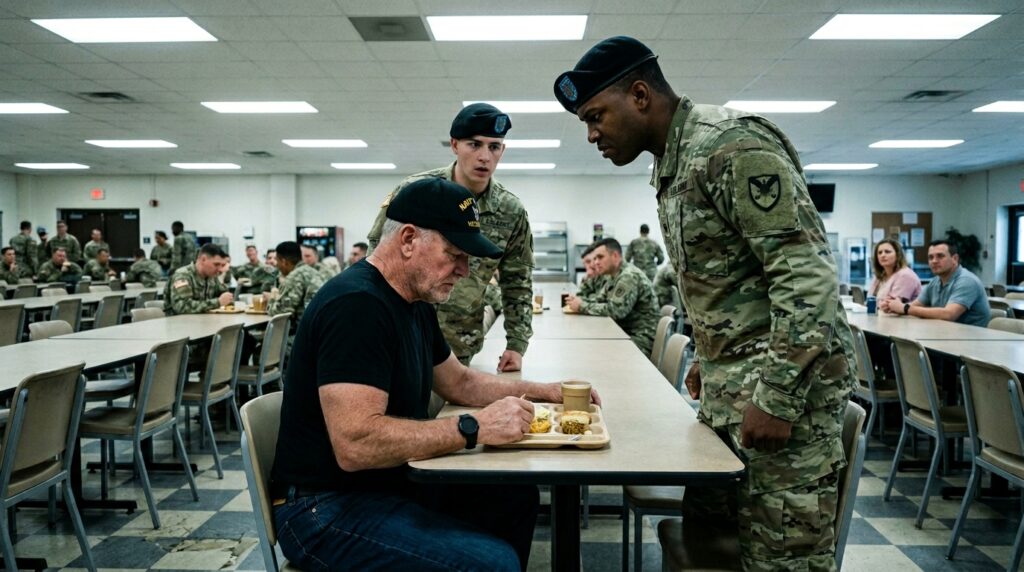
He didn’t swing wide. He dropped his weight three inches, letting gravity settle into his hips exactly as he had on the checkerboard floor of the dining hall, and drove his heel down onto the iron override bar.
The sound wasn’t a roar; it was a short, sharp clack of cold iron pins snapping inside the casing. The blue treasury voucher didn’t tear—it simply dissolved as the main power bus behind the wall shorted out, sending a clean, bright horizontal flash of static through the vault frame that smelled instantly of ozone, burnt canvas, and old grease.
The lights didn’t go dark all at once; they faded into a dull, desaturated bronze that turned the concrete walls into a flat, narrow box. The rhythmic clicking of the logging yard tickers outside died instantly, leaving nothing but the sound of the marsh rain hitting the corrugated steel roof with a heavy, unhurried thrum.
Garrity’s head dropped back against his sling, his shoulders relaxing as the digital monitors along the casing went dead, their screens flattening into clean, gray glass that reflected nothing but the amber outline of Miller’s veteran cap.
Vance slowly lowered his arm, his thumb slipping off the safety catch as the terminal panel behind him gave a final, faint hiss of white steam from its cooling loop. He didn’t look at the broken die plate. He looked through the open door at the long, empty line of the highway where the morning mist was beginning to turn the color of wet lead.
“The account is clear, Miller,” Vance said, his voice flat, carry no more weight than a struck line on a payroll ledger. “The 0600 shift isn’t coming.”
Miller didn’t look back at the vault core. He reached down, took his Navy cap by the brim, and set it one inch lower over his eyes, blocking out the last yellow reflection of the repository lamps. He walked through the iron threshold, his boots making a dry, crunching sound on the gravel road as he headed out toward the state line.
“The shift never came, Captain,” Miller said into the gray morning. “We just stayed late.”








