
CHAPTER 5: THE DIESEL ENGINE LOGIC
The floorboard of the utility truck didn’t isolate the road; it hammered it directly into the soles of Miller’s boots. Every seam in the asphalt of the western perimeter road sent a dull, metallic shudder through the frame, vibrating the iron eyelets of his veteran cap against his forehead.
Captain Vance kept both hands on the wheel, his knuckles gray and bloodless under the dim green illumination of the tactical dashboard. Between them sat the metal dispatch box, its olive-drab latch sealed with a single-use lead wire that rattled against the casing like a loose tooth.
“The rail-head at sector nine is already locked down,” Vance said. His eyes didn’t leave the narrow corridor of the headlights. “The trains are chartered under a commercial logistics flag. Once those boxes hit the flatcars, they aren’t military property anymore. The account closes.”
Miller didn’t look at the officer. He looked through the side glass, watching the rusted spikes of the fuel-depot fence slide past in the dark. The smell of unrefined petroleum and wet weeds was stronger here, leaking through the rotted rubber weatherstripping of the passenger door.
“You’re running the engine too lean,” Miller said, his rasp low against the transmission whine. “The manifold is white-hot under the cab. You smell that? That’s the oil cooking in the valve guides. A man who knows his machine doesn’t push the RPMs when the temperature needle is pinned in the red.”
“We don’t have the luxury of the maintenance schedule, Miller,” Vance muttered. He reached down, tapping the physical trip ticket clipped to the clipboard on the dash. “Look at the stamp on the routing guide. That’s a direct priority release from the regional coordinator. No intermediate stops. No secondary inspection.”
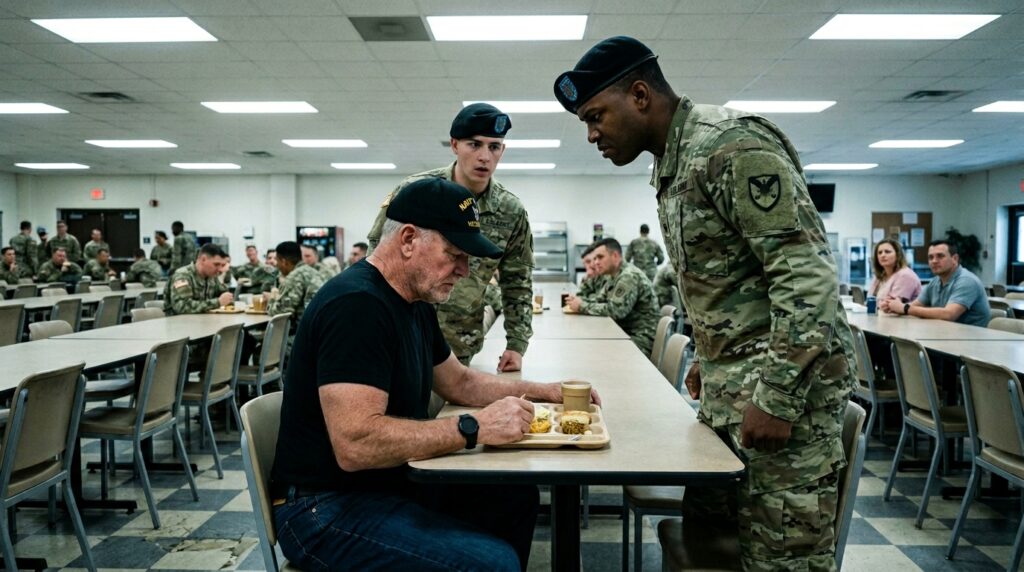
Miller reached out with his left hand—the thumb still stiff from the cafeteria scuffle—and turned the clipboard toward the green dash light. The ink-stamp wasn’t the standard violet ink of the base transportation officer. It was a dense, oily black smudge, the edges slightly blurred by the humidity of the cab. In the center of the seal, hidden within the administrative code, were two parallel hairline fractures across the die.
It was the exact same flaw he had seen on the inspection stamp inside the ordnance repository folder three hours ago.
“The transportation desk didn’t clear this truck, Vance,” Miller said. His thumb came down on the ink, smudging the dry carbon across the paper. “This manifest was struck from the same press as the evaluation logs. The base command isn’t waiting for these boxes at sector nine. They’re already behind us.”
Vance’s foot didn’t lift from the throttle, but the truck veered two inches onto the gravel shoulder before he corrected the wheel, the loose stone clattering against the unlined wheel wells like shrapnel. “You signed the report, Miller. The audit is complete. Your voucher clears at 0600.”
“I signed for a psychological baseline on Third Battalion,” Miller said, his internal calculator tracking the mileage markers along the fence. “I didn’t sign for a ghost transport. If those boxes are empty props with the firing pins pulled, you don’t need a high-priority rail clearance to move them to the scrap yard. You don’t hide an empty box from the terminal supervisor unless the box isn’t the asset you’re trading.”
He leaned closer to the metal dispatch box between their seats. In the narrow gap where the lid met the base, a tiny white grain had shaken loose from the packing material inside. It wasn’t the sawdust or grease-paper used to preserve rifle stocks. It was a fragment of synthetic polymer—the clean, white edge of a standard data-core cartridge housing used in the base’s automated signal facility.
The realization didn’t come with a shock; it arrived with the cold, heavy precision of an iron gear falling into place.
They weren’t moving the rifles to clear the titles. They were moving the battalion’s operational records—the digital fingerprints, the response metrics, the stress logs of every boy who had broken down under pressure during the evaluation cycle. The hardware in the boxes was just the ballast to make the truck ride low on its springs.
“Where is Garrity?” Miller asked. His voice had dropped below the noise of the manifold, a hard, level sound that made the captain’s right foot twitch on the accelerator.
“He’s in the holding block behind the secondary rail-head,” Vance said, his gaze fixed straight ahead as the twin steel tracks of sector nine appeared in the distance, silver lines cutting through the desaturated gray of the marshland. “He’s being processed for the transition unit.”
“There is no transition unit,” Miller said, his hand already moving toward the heavy iron latch of the passenger door as the truck began to slow for the perimeter gate. “A machine doesn’t need a training cadre, Vance. It needs a template.”








