
CHAPTER 8: THE DOMESTIC REALITY OF AN OLD KITCHEN
The cab of the blue truck smelled exactly like 1994—stale tobacco, dried pine needles from an air freshener that had long since turned into a brittle strip of brown cardboard, and the faint, sweet tang of anti-freeze leaking somewhere behind the dashboard. Marcus climbed into the driver’s seat, his movements slow and methodical, his heavy work boots dragging across the rusted door sill. Each joint in his lower back gave an independent, dull pop as he settled his weight onto the cracked vinyl bench. He didn’t turn the key immediately. He simply sat in the cold, letting his hands rest on the steering wheel, his split leather gloves matching the worn, black rubber of the rim exactly.
To his right, David sat pressed against the passenger door, his head slumped down so low his chin was buried under the collar of his denim jacket. He was still shivering, his thin shoulders jerking in small, irregular increments that made the rusted springs inside the bench seat click softly beneath him. His bare wrists were red, chafed raw by the dry salt wind of the back lot, and his fingers were tucked away, hidden from view as if he could conceal the tremors that had brought him to the edge of the river lot.
“You left the chair,” David said. His voice was small, dry, and hollowed out by months of bad meals and worse choices. It was the first time he had looked Marcus in the face since the crunch of salt broke the exchange. “They said you couldn’t even make it to the porch without the rig.”
Marcus turned the key. The starter gave a long, heavy groan, a mechanical struggle of old iron pistons moving through cold grease, before the engine caught with a loud, irregular thud that sent a vibration straight through the floorboards. He slotted the lever into gear, the linkage clicking into place with a dry, metallic notch that he knew by feel alone.
“The chair was for me, David,” Marcus said softly. His rasp was lower now, muffled by the rattle of the heater fan as it began to push cold, dusty air over their boots. “Not for my legs.”
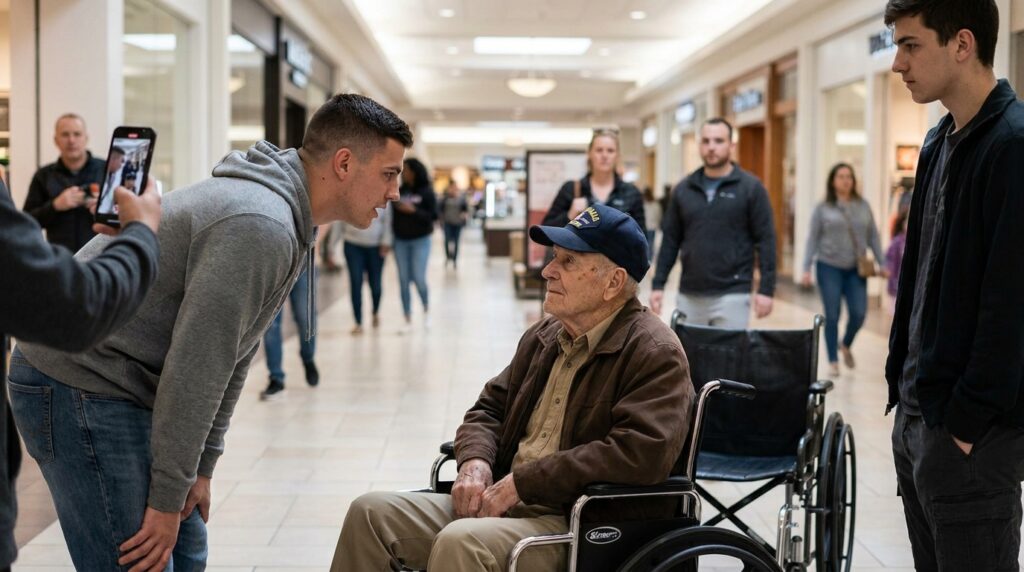
He let the clutch out slowly, the truck creeping past the crooked chain-link gate and onto the gray asphalt of the perimeter road. In the rearview mirror, the industrial back lot began to shrink, its pitted drums and corrugated containers fading into the uniform gloom of the midwestern twilight. The empty wheelchair was two miles behind them now, sitting in a dark mall alcove, an abandoned monument to a penance that had finally run out of ground to keep.
The drive back to the house was silent, defined only by the rhythmic thump of the tires over the frost-heaved lanes and the dim, yellow glare of the dashboard gauges reflecting off David’s gaunt cheekbones. Marcus kept his eyes on the road, his hands steady on the wheel, tracking the familiar potholes of a neighborhood that had spent forty years giving up its edges to the rust. He knew the tools were gone—the drop-forged iron jaw wrenches he had carried since his first day on the assembly line were currently sitting in the trunk of a gray hoodie’s car—but the loss didn’t carry the weight he thought it would. The steel had been paid for decades ago; the boy next to him was the only invoice that still required a signature.
When the truck finally idle-rattled to a halt in the driveway, the small frame house looked smaller than Marcus remembered, its white clapboards yellowed by chimney soot and old rain. He killed the ignition, the sudden absence of the engine’s rumble leaving a deep, ringing vacuum inside the cab.
“Come inside,” Marcus said, his gloved hand reaching for the door latch. “The kitchen’s cold, but the stove still works.”
David didn’t move for a long second, his eyes fixed on the dark windows of the porch, looking for the ghost of the boy who had walked out that same door three winters ago. But as Marcus stepped out onto the concrete apron, his boots striking the ground with that same flat, unyielding cadence, the younger man finally unlatched his side, his slight frame following the old man’s shadow up the steps and into the quiet gray of the interior.








