
CHAPTER 5: THE TEMPERATURE OF GROUND SALT
The wind off the river carried the smell of diesel exhaust and frozen mud, cutting straight through the heavy canvas of Marcus’s brown utility jacket. It was Thursday, precisely four in the afternoon, and the light over the industrial back lot had already flattened into a bruised, chemical purple. He stood in the narrow gap between two decommissioned shipping containers, his boots planted in a ridge of frozen slush that had turned the color of iron filings under the weight of passing trucks.
He wasn’t sitting. His knees were stiff, locked into a rigid, defensive posture that sent a dull, throbbing ache straight to his lower back, but he didn’t lean against the corrugated metal. The steel behind him was coated in a thin sheen of frost that would have torn the skin right off his knuckles if he touched it bare.
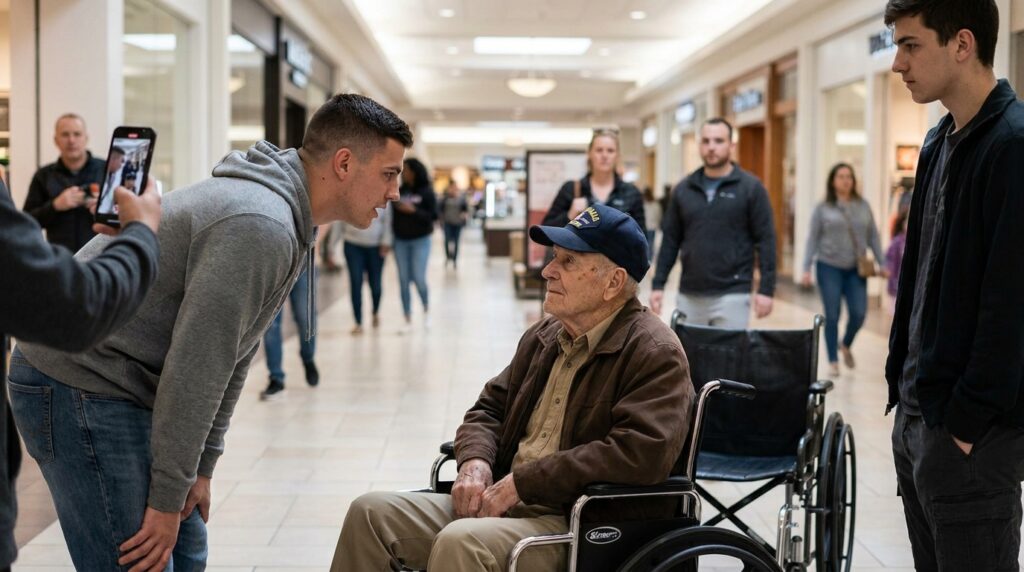
Forty yards across the cracked asphalt, near a chain-link gate that hung crooked on its hinges, the gray hoodie was waiting. The young man had his hands shoved deep into his pockets, his shoulders hunched against the wind as he stamped his sneakers to keep the blood moving. Next to him stood the same silent companion from the mall, his dark casual jacket zipped up to his chin, his eyes tracking the occasional delivery van that rumbled past the outer perimeter wall. They looked exactly like what they were—kids trying to look like fixtures of a landscape that didn’t care if they froze to death.
Marcus reached into his right pocket, his fingers curling around the small brass ring of keys. His palm was slick with sweat despite the sub-zero chill, the metal biting into his calluses with a familiar, heavy pressure. He had spent the last forty-eight hours in his basement, cleaning the grease off the old iron tools he hadn’t touched since the winter David left. He hadn’t brought the wheelchair. He had left it exactly where he rolled it in the mall alcove, a piece of abandoned theater that had served its purpose. Standing on his own feet felt like a violation of the quiet safety he had spent three years paying for, but the white prescription label in his pocket had left him no room to negotiate.
A dark figure stepped out from the shadow of the concrete warehouse across the lane, his stride irregular and heavy, his boots dragging through the salt crust. Even from this distance, Marcus recognized the hitch in the right hip—the residual mark of a high school football injury that had never healed right because there was never enough money for the physical therapy.
David was smaller than he had been three years ago. His shoulders were narrow beneath a thin, denim jacket that offered no protection against the river wind, and his hands were tucked into his armpits to keep them from shaking. He stopped five feet from the gray hoodie, his head down, his posture completely drained of the defiance that had once made him slam the kitchen door and walk out into the dark.
Marcus didn’t move from the gap between the containers. He watched the gray hoodie pull a hand from his pocket, his fingers holding a small, brown paper bag that caught the low light. David reached out, his bare wrist showing white and thin against the dark denim, but the young man jerked the bag back, his mouth moving in a short, transactional sentence that didn’t carry across the wind.
The silence of the lot felt thick, greasy with the scent of old oil and road salt. Marcus let his hands drop from his pockets, his fingers straightening inside his heavy work gloves as he prepared to step out onto the open asphalt. The illusion of his immobility was officially gone; there was only the cold ground beneath his boots and the debt that had finally come due at the edge of the city.








