
CHAPTER 1: THE FRICTION OF GIVEN GROUND
“Touch someone weaker again, you’ll answer to me.”
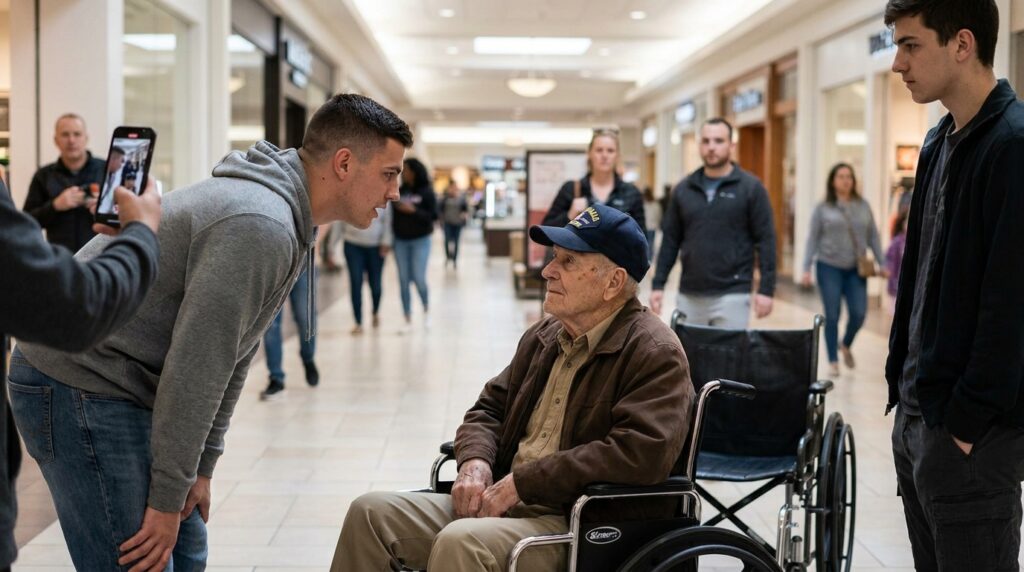
The words smelled of cheap vape juice and sour energy drinks, cutting through the lukewarm air of the corridor. The young man in the gray hoodie didn’t move his hands from his pockets, but his shoulders rolled forward, casting a sharp shadow over the small, vinyl-padded seat of the wheelchair. He was leaning so close that the metal grommets of his hood drawstrings clicked faintly against one another. To his right, his companion stood like an unblinking fence post, arms crossed over dark casual canvas, eyes scanning the scattered afternoon shoppers who instantly adjusted their walking lines to bypass the sudden pocket of heat.
Marcus kept his fingers flat against the fraying brim of his navy cap. He didn’t look up at the gray fleece or the athletic chest hovering inches from his face. Instead, his gaze remained fixed on the floor—on the exact spot where a square of linoleum had yellowed worse than the others around a rusty brass expansion joint. The mall was old, the sort of place where the air always carried a faint smell of burnt cinnamon and damp floor mops, a structure slowly giving up its grip on the earth. He understood that kind of giving up. He had spent three years inside the geometry of this chair, mapping every crack in the tile, learning how to exist exactly at eye-level with other people’s belt buckles.
“You hear me, old man?” The shadow leaned an inch lower. A sneaker squeaked against the floor, a sharp, rubbery sound that carried an edge of impatience. “I saw how you talked to the girl at the counter. You think because you’re sitting in that rig, nobody’s going to call you on your garbage?”
Marcus let out a slow, measured breath through his nose, his chest barely rising beneath the stiff weight of his brown utility jacket. The fabric was heavy, smelling faintly of garage dust and old grease—the remnants of a life spent turning wrenches before the joints refused to clear the morning cold. He could feel the pulse in his throat, steady and dry, like an engine ticking over on its last half-gallon of fuel. The boy in front of him had the clean, unblemished skin of someone who had never had to pick his teeth up off a concrete floor, yet he carried himself with the heavy, unearned authority of a playground marshal.
The silence between them stretched, thick and gritty as sand caught in a bearing. Marcus didn’t answer. He didn’t shift his hips. In the reflection of the glass across the corridor, past the display of cheap luggage, he watched the companion’s eyes dart toward a security guard three hundred feet away, who had stopped near an escalator to talk into a small black radio. The boy in the gray hoodie didn’t see the guard. He was too locked into the theater of his own chest, waiting for the flinch, the apology, or the pathetic reach for the wheels that would signal total submission.
Instead, Marcus let his hands leave the brim of his cap. They slid down to the cold, rusted steel of the armrests, his palms cupping the metal until the chill of the iron seeped directly into his calluses. He felt the specific friction of the bolts beneath his thumbs—the small, loose washer on the left side that always rattled when the floor got rough. He didn’t look at the gray hoodie. He looked at the floor between the boy’s shoes, where a tiny, blue plastic cap from a prescription vial lay forgotten in the dust. It hadn’t been there twenty minutes ago.








