
CHAPTER 3: THE RECOIL OF RUSTED GROUND
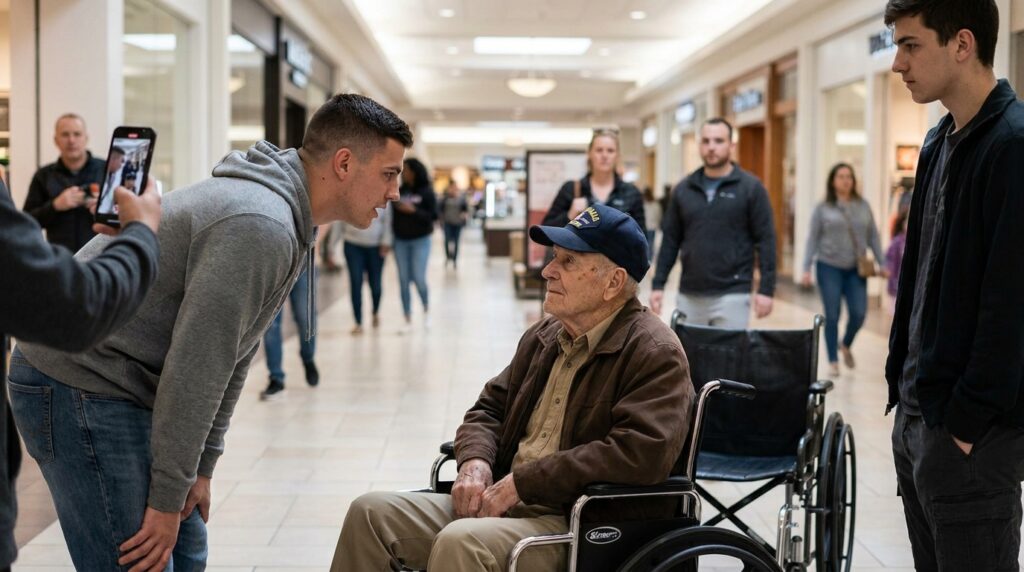
The young man in the gray hoodie lowered his chin, the bravado draining from his chest like water down a rusted pipe. He took a second small step backward, his shoulder brushing against a circular clothing rack of clearance jackets, setting the metal hangers into a frantic, rhythmic clicking. The sound was thin and hollow, a minor distraction in the heavy silence that had settled over the lane. His companion was already moving, his heels tracking a quiet, shuffling path toward the wider pedestrian intersection by the food court, clearly wanting no part of whatever weight the old man had just brought to the surface.
“Alright,” the aggressor muttered, his voice dropping into a flat, defensive register that lacked any of its prior edge. He lifted his hands from his pockets, fingers spread open in a brief, performance-staged gesture of surrender. “Alright. We got the message.”
He didn’t look Marcus in the eye again. He turned on his heel, his rubber-soled sneakers scraping the yellowed linoleum as he accelerated his stride, catching up to his companion within three paces. They didn’t run, but their movements were hurried, their heads bent close together as they dissolved into the shifting stream of weekend shoppers under the distant, hazy skylights.
Marcus didn’t watch them go. His knuckles remained white where they rested against the dark canvas of his trousers, his chest rising and falling in shallow, deliberate increments as his knees sent a hot, throbbing reminder of his physical limits straight up his spine. The adrenaline was a cold, metallic taste at the back of his throat. He remained perfectly upright, his calves still pressed against the rear vinyl padding of the chair, refusing to give up the single foot of territory he had reclaimed.
The small crowd of secondary witnesses had already unfreezed, their faces smoothing over with the practiced indifference of modern consumers as they filled the space the young men had abandoned. Nobody approached Marcus. Nobody offered a nod or a word of validation; in this corridor, trouble was an infectious agent, and the old man standing beside an empty wheelchair looked like a carrier.
Slowly, the joints in Marcus’s fingers unlocked. He looked down at the floor between his boots, his gaze finding the small cylinder of blue plastic that had fallen during the initial confrontation. It sat in the shadow of the wheelchair’s left footrest, its translucent walls catching the low-grade light of the corridor.
He bent his knees, a sharp, grinding ache blooming in his lower back as he reached down. His calloused fingers closed around the plastic container. The surface was smooth, slightly scratched from the grit on the floor, but the white paper label stuck to its side was clean enough to read under the direct glare of the fluorescent tubes.
The prescription wasn’t for the boy in the gray hoodie.
Printed in faded, standard dot-matrix ink was a name Marcus hadn’t spoken aloud in thirty-six months: David Miller. And below it, a handwritten notation in black ballpoint pen, scrawled across the warning text: Thursday. Back lot. Bring the rest.
The plastic felt dangerously light in his palm. Marcus turned the bottle over, his thumb tracing the ridged edge of the blue cap. This wasn’t a random encounter. The boy hadn’t targeted a vulnerable stranger out of a simple, aimless desire for dominance; he had been looking for a leverage point. He had been looking for the grandfather of the boy who owed him ground.
The realization settled into Marcus’s bones with the heavy, dry friction of an iron door latch dropping into place. The isolation he had built around himself over these three years—the meticulous routine of the chair, the calculated immobility that kept him from hunting for ghosts in the bad parts of the city—had just been breached in the middle of a brightly lit shopping center. The boy in the hoodie hadn’t backed down because he was broken; he had backed down because he had delivered the package.
Marcus looked up, his eyes scanning the dense flow of winter coats and strollers forty yards out, but the gray hoodie was gone, swallowed entirely by the desaturated landscape of the retail floor. His hand tightened around the bottle until the thin plastic groaned against his calluses, the sharp edge of the cap digging into his thumb. The false peace of the corridor had cracked wide open, leaving him standing on two feet, surrounded by strangers, holding a piece of paper that pulled him right back to the edge of the dark road he had spent three years trying to forget.








