
CHAPTER 2: THE LEVERAGE OF OLD IRON
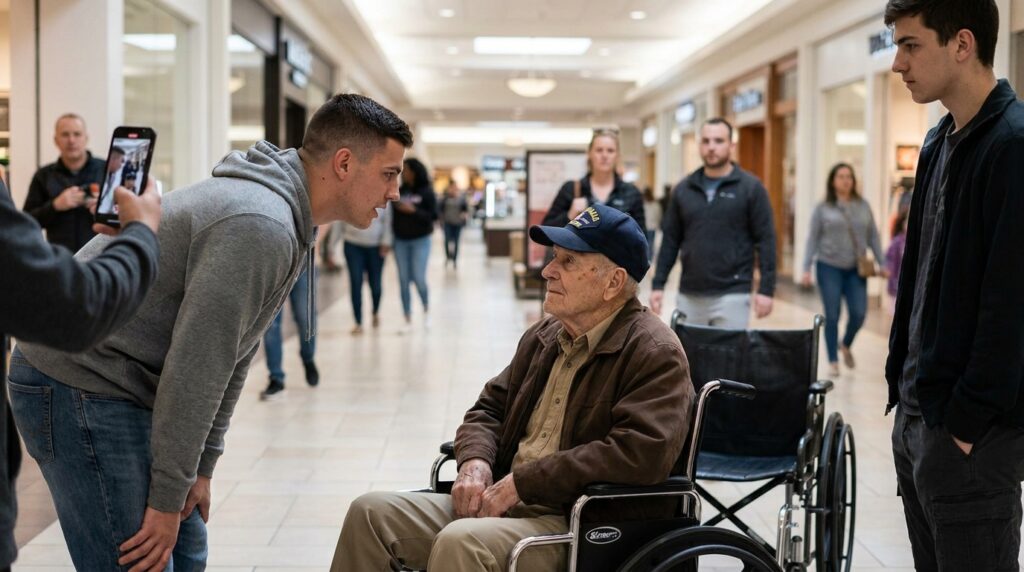
The steel armrests felt ice-cold under Marcus’s palms, a sharp, unyielding contrast to the lukewarm breeze drifting from the mall’s ventilation shafts. He didn’t look up at the gray hoodie, nor did he acknowledge the silent shadow hovering to the right. Instead, he simply allowed his weight to shift forward, his boots planting flat against the yellowed linoleum. The small, loose washer on the left side of his wheelchair gave a single, distinct rattle—a metallic click that sounded tiny in the vast, vaulted corridor, yet it carried the finality of a firing pin dropping into an empty chamber.
Then, he began to stand.
It was not a sudden, explosive movement. His body no longer possessed that kind of elasticity; the cartilage in his knees had long since worn down to a dry, grinding friction that felt like gravel turning in an unlubricated casing. It was an exercise in leverage, a calculated distribution of mass that he had practiced in the privacy of his small, concrete-floored kitchen. His shoulders rose first, the stiff canvas of his utility jacket groaning against the strain as his back straightened. The movement was fluid, uninterrupted, and heavy with the inertia of a man who had spent decades lifting things the earth wanted to keep.
The boy in the gray hoodie didn’t move at first, his jaw remaining slightly slack as his mind struggled to reconcile the slight, seated figure with the torso that was suddenly rising past his chest. As Marcus’s head cleared the level of the wheelchair’s headrest, the physical geometry of the lane transformed completely. The young man instinctively took a full step backward, his rubber soles dragging across the tile with a dry screech. His athletic posture, previously coiled like a spring over what he assumed was a helpless target, collapsed into an awkward, defensive hunch. His hands remained inside his pockets, but the fabric bunched tightly around his knuckles as he lowered his center of gravity, suddenly hyper-aware of the space he had so easily invaded.
Marcus stood fully upright now, his slight frame appearing taller than it had in years under the desaturated light of the skylights. He did not step away from the chair. The wheels remained pressed firmly against the backs of his calves, a physical anchor he refused to abandon. His weathered face remained entirely expressionless beneath the shadow of his navy cap, his gray eyes locked onto the bridge of the younger man’s nose. He didn’t breathe heavily; his respiration remained low and transactional, the steady cadence of an old machine that knew exactly how much fuel it had left in the tank.
The companion observer on the right had frozen entirely, his arms dropping to his sides as his gaze shifted rapidly between Marcus and the gray hoodie. The passive compliance that had sustained his presence moments ago had evaporated, replaced by the distinct, pale stillness of a witness who realized the script had been completely flipped.
“You picked the wrong man to threaten today,” Marcus said.
The voice was a low, gravelly rasp, scraping against the walls of the corridor like an iron spade hitting frozen ground. It wasn’t loud—it didn’t need to be. The sound carried the dead weight of absolute certainty, devoid of the performance or the frantic posturing the youth had brought into the lane. Marcus didn’t raise his chin, nor did he ball his fists. His arms hung loose and still at his sides, his thumbs lightly brushing the seams of his trousers, tracking the familiar, reinforced stitching of his work clothes.
The young man in the hoodie swallowed hard, his Adam’s apple bobbing behind the frayed edge of his collar. The mocking curve of his mouth had flattened into a thin, tight line, the blood draining from his lips until they were nearly the same color as the concrete pillars behind him. He looked down for a fraction of a second, his eyes tracking the distance between Marcus’s boots and his own, measuring the ground he had so carelessly given up. The space between them felt different now—no longer an open corridor for a public display of dominance, but a narrow, high-pressure trench where every micro-movement carried a heavy consequence.
Marcus didn’t give him the satisfaction of an aggressive stride. He simply stayed where he was, a vertical column of weathered skin and oil-stained fabric, letting the silence work like water under a cracked foundation. In the periphery, the scattered shoppers continued their slow, rhythmic drift around the pocket of tension, their faces turned away, ignoring the small, private war that had just been won without a single blow being struck. But beneath the silence, Marcus’s eyes remained fixed on the tiny blue cap on the floor, and the faint, hand-written ink across its side that he was finally close enough to read.








