
CHAPTER 4: THE HARD OUTCOME OF AN ANCHORED LINE
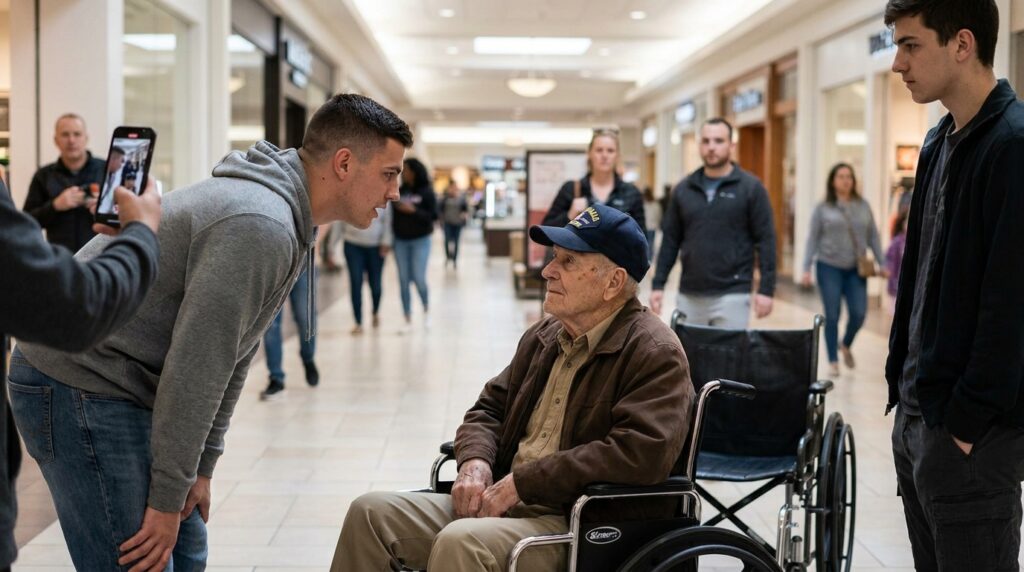
The blue plastic cylinder sat heavy in Marcus’s palm, colder now than when it lay on the grit-dusted tile. He stood perfectly still beside the empty wheelchair, the metal frame casting a long, angular shadow that looked like a cage split wide open. His knees burned—a deep, rhythmic ache that throbbed in time with the distant, mechanical thud of an escalator three corridors over. He had spent three years believing that if he simply stayed small, if he anchored his weight into the vinyl padding of that seat and refused to move, the world would leave the rest of his name alone.
It was a lie he had constructed out of grease and loose washers. The immobility hadn’t been an infirmity; it was a self-imposed penance, a heavy anchor dropped into the floorboards to keep himself from running after David into the gray, needle-strewn alleys of the city’s North Side. He had told himself that by staying in the chair, he was keeping a vigil, a quiet center that his grandson might one day find when the streets finally broke him. Instead, the streets had simply used the old man’s stillness to calculate his coordinates.
The white paper label on the bottle was thin, its edges slightly frayed where it had scraped the linoleum. Marcus turned it over, his thumb tracing the blue-black ink of the handwritten note: Thursday. Back lot. The letters didn’t shake. They were written with the sharp, precise block cadence of a kid who had learned his penmanship from a probation officer’s ledger. The young man in the gray hoodie wasn’t an enforcer; he was a courier delivering an invoice to the only person left who still carried the Miller blood.
Marcus looked down at the wheelchair’s stamped steel footrests, his gaze catching the dull glint of the nickel plating. For thirty-six months, he had let his boots rest on those plates, letting the world believe the strength had drained from his legs, because it was easier to be an old man in a rig than a grandfather who had survived a war only to lose his house to a ghost. The stillness had been a shelter. But looking at the small plastic vial, he realized the shelter had turned into a target.
He didn’t return to the seat. With a slow, deliberate movement that made the iron brackets of his utility jacket groan against his shoulders, Marcus pushed the wheelchair backward. The small, loose washer gave one last, brittle rattle before the caster wheels spun around, the entire assembly rolling three feet into the recess of an alcove beside a closed shutter. It sat there, empty and small, looking less like a lifeline and more like an abandoned piece of industrial junk left behind by the morning maintenance crew.
He slipped the prescription bottle deep into the pocket of his brown jacket, his fingers brushing past a small, brass split-ring holding two keys—one to his kitchen door, the other to a rusted metal toolbox in his basement that hadn’t been opened since David left. The iron key felt cold against his knuckles, its teeth sharp and familiar. The boy in the hoodie had given him a choice, but the choice had already been made three years ago when he chose to survive the first text message, the first police knock, the first long night spent listening to the police scanners over an untouched plate of supper.
Marcus turned away from the alcove, his boots striking the floor with a heavy, flat cadence that echoed off the glass storefronts. He didn’t have the fluid stride of the younger men, nor did he have the light, unburdened posture of the shoppers drifting toward the exit signs. Each step was an effort of pure mass—a hard, mechanical labor of bone pressing against bone, paid for in small, hot increments of pain that radiated up through his hips.
He walked past the luggage display, past the faded plastic planters filled with dusty silk ferns, his eyes fixed on the glass double doors at the end of the corridor where the winter light was already dying into a flat, desaturated gray. The world outside the mall didn’t look like an open horizon; it looked like a dark road lined with rusted surfaces and sharp edges, waiting to see if the old man could still carry his own weight without the iron wheels behind him. He pushed through the heavy glass bar, the cold air hitting his face like a slap of wet canvas, and stepped out onto the concrete apron of the lot, his boots crunching lightly into the gray grit of the salt.








