
CHAPTER 6: THE INTERVENTION OF HEAVY IRON
The crusted salt snapped under Marcus’s work boots with a sound like dry bone splintering. He didn’t offer the advantage of a warning call or a hurried stride; he simply moved into the open lane of the back lot, his tall, unbent frame cutting across the purple dusk. His gaze never left the brown paper bag held between the gray hoodie’s fingers. The hot, metallic ache in his knees had gone completely numb, replaced by a cold, transactional focus that narrowed the sixty feet of open asphalt down to a single point of impact.
David heard the crunch first. His head jerked up, his gaunt face hardening into a look of sheer panic as his hollow eyes found Marcus. His pale lips parted, but no sound came out, his throat locking against the unexpected silhouette of the old man walking on his own two feet. He instinctively reached toward his denim jacket pocket, his knuckles bunching against something small and heavy that gave a dull, metallic click against a lighter—a sound that didn’t escape Marcus’s ears.
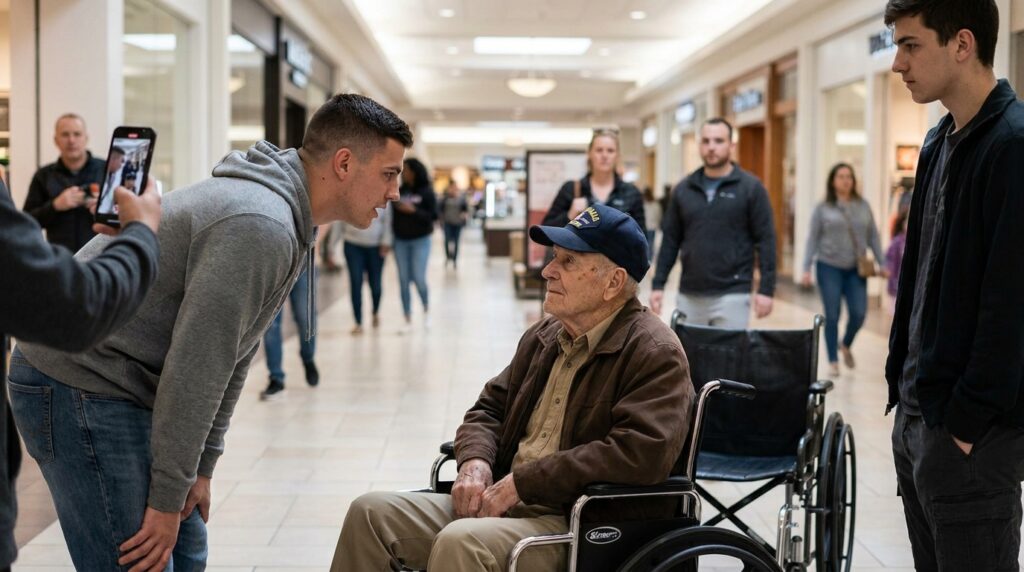
The boy in the gray hoodie turned slower, his shoulders rolling back with a defensive twitch until he recognized the weathered face under the navy cap from the mall corridor. A sharp, mocking grin tried to form on his mouth, but it died before it reached his eyes. The physical reality of Marcus standing upright in the freezing wind, stripped of the metal wheels and the safety of the public corridor, changed the math of the encounter.
“You’re a long way from the food court, old man,” the youth said, his hands remaining outside his pockets now, fingers twitching against the seam of his jeans. “We didn’t say anything about a family reunion.”
Marcus stopped ten feet out, exactly where the oil from a rusted drum had leaked into the gravel, turning the frozen mud into a black, glassy glaze. He didn’t look at David. He kept his gray eyes fixed on the bridge of the hoodie’s nose, his arms hanging loose and still at his sides. The work gloves he wore were stiff, stained with thirty-year-old motor oil from the toolbox he had hauled out of his basement that morning.
“The bag goes back in your pocket,” Marcus said. His voice was the same low, gravelly rasp that had cleared the mall corridor, completely untouched by the sub-zero wind. “The boy isn’t buying anything from you today. Not with what’s left of my name.”
The companion observer shifted his weight, his sneakers grinding a patch of black ice into gray slush. His arms were no longer crossed; he had let them drop to his sides, his eyes darting toward the open gate behind them, calculating the escape lane before the first word was even paid for. He knew the old man wasn’t a tactical threat in a sprint, but the sheer lack of fear in the veteran’s posture suggested a reserve of violence that didn’t belong in a simple collection dispute.
“He owes for three months of the blue bottles,” the gray hoodie said, his voice rising slightly to fight the wind, though his feet remained planted. He didn’t raise the bag higher; instead, he lowered it toward his waist, his thumb hooking into the twine handle. “He told us you were tucked away in that rig for good. Said the house was clear.”
Marcus finally let his gaze drop to David. His grandson looked worse up close—the skin around his cheekbones was tight and gray, his lips split from the frost, his entire body shivering so hard the metal zipper of his jacket rattled against its track. The boy was looking at Marcus’s boots, his mind still visibly spinning around the fact that the anchor had cleared the floor. He looked like a machine with its gears stripped out, waiting for someone else to turn the crank.
“Go to the truck, David,” Marcus said softly, his voice dropping below the register of the wind. “The blue one by the hydrant. The keys are in the visor.”
David didn’t move immediately. His eyes flicked from Marcus to the gray hoodie, his fingers still buried in his pockets, tracking the hidden weight that had clicked against his lighter. He was caught between two different kinds of leverage—the immediate, sharp threat of the street and the heavy, unyielding inertia of the old kitchen he had fled. But the absolute stillness of Marcus’s posture left no room for a third option. With a short, ragged breath that came out as a plume of white steam, David turned his shoulder and began a slow, hitching walk toward the outer gate, his boots dragging through the crusted salt.
The gray hoodie took a half-step forward as if to intercept, but Marcus simply adjusted his line, his broad shoulder closing the gap before the youth could finish the stride. The distance between them was less than four feet now, close enough for Marcus to smell the sour energy drink on the boy’s breath again, close enough to see the small, pale scar where a ring had been torn out of his left eyebrow. Marcus didn’t raise his hands, but his knuckles remained flat against his thighs, his thumbs hooked lightly into the reinforced fabric of his work pants. He was an iron post sunk deep into the asphalt, and the young man would have to break him to get past.








