
CHAPTER 7: THE FINAL TAXATION
The sound did not travel through the air. It was a low, hydraulic groan that climbed the iron nails of the diner’s framing timbers, vibrating straight through the rubber soles of his boots until his teeth clicked together over the stale taste of lard. Behind the glass pane, the state highway did not collapse with a sudden roar; it subsided in blocks, the dark asphalt rafts tilting into the gray slush of the limestone slurry like ore-cars tipping at the sorting pocket.
The veteran did not look back at the ridge. He didn’t need to trace the line of the fault where the clay met the slag-cement. He knew every yard of that interface because his own youth was buried beneath it, tamped down with five hundred sacks of quick-setting lime that had cost him his rank, his name, and the right to exist under the light.
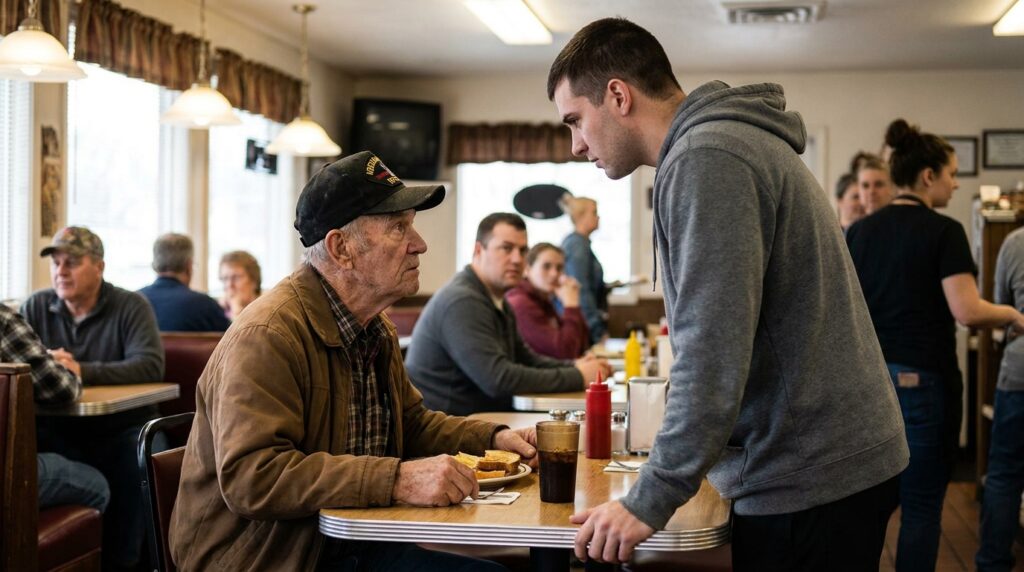
He reached into his jacket pocket. His fingers closed on three quarters—heavy, pre-seventy-five silver pieces that had remained at the bottom of his lining since the winter the third shift went dark. The metal was cold, smelling of gun-oil and the dry graphite dust he used to clear his firing pins. He didn’t drop them into the mud. He stepped backward, his heel finding the solid granite pad of the propane enclosure where the young man was already crouched, his gray hoodie clutched tight around his knees as if the fleece could insulate him from the motion of the basin.
The veteran placed the three coins flat on the concrete lip of the tank base. They lay exactly three inches apart, their stamped edges catching the desaturated yellow light from the diner’s emergency lamps.
“That’s for the breakfast, Vance,” the veteran said. His voice was a flat, low-register rumble that stayed underneath the hum of the power lines. It was the same rhythm he had used when the final bulkhead was secured and the pumps were left to choke on the sulfur mud. “The tax is paid.”
The boy looked up from his knees, his face the gray color of wet mortar. The leather pouch was still tangled in his fingers, the silver chain wrapped so tight the metal had turned the skin of his knuckles a bruised blue. “You’re just going to let it take the road? My father said you were the only one who had the layout of the lower galleries.”
“The layout doesn’t change the chemistry, son,” the veteran said. He pulled the bill of his veteran cap down until the cold sleet stopped hitting his eyelids. “The limestone was always going to dissolve. Your father knew it when he signed the completion certificate for the municipal water authority. He didn’t want a mechanic; he wanted an asset that could hold the bank off until the mortgages were cleared from the books.”
The ultimate truth was now open between them, flat and bare as a stripped gear. There had been no military desertion, no rogue operation, and no stolen settlement cash. The veteran hadn’t disappeared to run from his team; he had vanished to keep the county from discovering that every house built on the shelf was anchored to a dissolving lime-vault—a vault his own team had been ordered to seal with structural concrete that was too thin to resist the sulfur runoff. The silence he had maintained for three decades wasn’t an act of cowardice; it was the sovereign protection of a town that would have been uninsurable before the children were even old enough to walk the boundary lines.
Across the ditch, the telephone poles did not snap. They simply leaned together, their top-wires touching with a dry, white snap that turned the sleet into small puffs of steam before the circuit breakers tripped at the substation two miles out. The diner didn’t go dark; the auxiliary generator beneath the kitchen annex kicked in with a rhythmic, diesel-throated cough that restored the yellow glare to the corner booth where his sausage plate still sat undisturbed.
The boy looked down at the three quarters on the concrete pad. His hand slowly uncurled from the leather pouch, the silver chain slipping through his fingers link by link until the stamped military disc settled in the dust near the veteran’s boots. The unearned arrogance that had driven him across the threshold that morning was gone, replaced by the heavy, geriatric weight of an entire valley’s liability.
“Where are you going?” the boy asked.
The veteran didn’t answer with a location. He turned his face toward the state road where the asphalt rafts were settling into the gray silt, his eyes tracking the narrow strip of solid gravel that still held along the ditch line. The town’s social hierarchy had collapsed inside the walls of the booth, and the physical hierarchy was resetting itself outside in the rain, but his center of gravity remained exactly where it had been thirty years ago—planted, unhurried, and completely clear of debt.
He stepped off the granite pad, his boots finding the coarse bite of the un-poured aggregate on the lot’s edge. He walked away from the diner, his brown jacket absorbing the yellow sleet until the fabric turned the dark, desaturated color of wet iron, leaving the young man and the dead man’s medallion behind him on the only six feet of ground that wasn’t moving.








