
CHAPTER 5: THE PERSISTENCE OF SEDIMENT
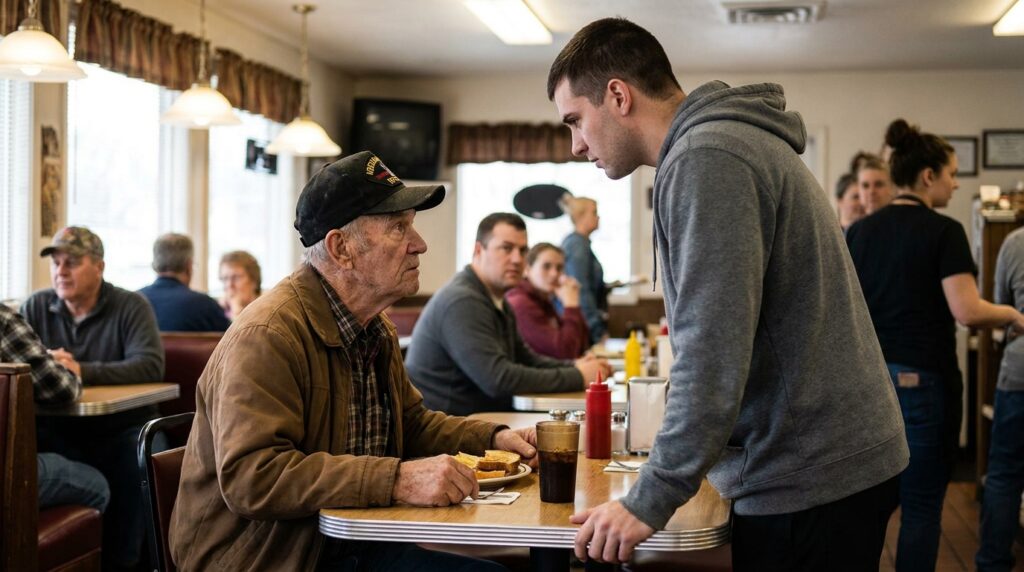
The bottom of the coffee pot tapped the thick ceramic rim of his mug, but the waitress didn’t tilt her wrist to pour. Her hand stayed frozen, the tendons in her forearm standing out like old rope under her skin. She wasn’t looking at the veteran, nor at the boy whose knuckles were still white against the formica. She was looking down at the baseboard behind the counter where the old copper supply line entered the wall.
A dull, rhythmic thudding was traveling up through the floorboards—not the sharp vibration of a truck on the state highway, but a heavy, liquid hammer that rattled the small steel spoons inside their tin canisters.
The veteran felt the pulse through his boot soles first. It was five beats every three seconds, the exact stroke-rate of the municipal booster pump three miles north. They had turned the valves early. The summer intake wasn’t scheduled for another twenty days, but the gray water vibrating through the pipes carried the heavy, chalky density of sediment pulled directly from the lower sump pool.
“They opened it,” the boy whispered. His eyes shifted from the tarnished leather pouch to the windowpane, where the rain was turning into a thick, yellowish sleet that left greasy streaks against the glass. “The county line. My old man said they’d wait until the budget hearing.”
The veteran didn’t move his hand from the table. His mind was calculating the flow velocity through three miles of rusted eight-inch casing. If the booster pump was already driving the head-pressure up, the thin concrete cap his team had poured over the limestone cavity in seventy-two was no longer just leaking; it was dissolving under the weight of the water columns. The decoy secret—the simple myth of a forgotten industrial accident and a runner with a pocket full of settlement cash—was crumbling right here on the linoleum.
“They didn’t wait for the hearing because the monitoring wells down at the aggregate pit went dry last night,” the veteran said. His voice was too quiet, carrying the dry, unhurried precision of an engineer watching a dial pass the red mark. “When the limestone drops into the lower pocket, the pressure doesn’t go down. It goes up until the relief lines clear themselves through the old municipal wells.”
He stood up. The movement was slow, his spine straightening with the audible click of old vertebrae adjusting to the weight of his brown work jacket. For thirty years, his entire existence had been defined by the absolute maintenance of his own absence—staying seated in the corner booths, using an assumed name on his fuel receipts, keeping his hands flat against the laminate so nobody would notice the chemical scars across his palms. Now, the space he had guarded had shrunk to the width of the room.
The boy tried to rise with him, but his knees caught the underside of the table frame, sending a sharp, metallic ring across the diner. “If that cap goes, the whole north side loses the topsoil. My old man’s house is right on the shelf.”
“Your father’s house was built on the spoil-bank, son,” the veteran said, looking down over the bill of his cap. “The foundation is six inches of slag and four inches of poured slag-cement. It isn’t anchored to the ridge. It’s resting on the crust.”
The glass door of the diner didn’t rattle this time—it blew inward an inch as the outside pressure shifted, a cold blast of air carrying the distinct, rotten-egg stench of deep-pocket sulfur and oxidized lime. Across the counter, the cook finally dropped his spatulas, the steel clattering against the grease-trough with a wet, heavy thud. He didn’t look at his grill. He walked straight to the small transistor radio that sat on the shelf above the pie case, his grease-blackened thumb turning the plastic dial until the static gave way to the flat, nasal drone of the county emergency band.
The audio was garbled by the ridge interference, but the words came through the small speaker like iron filings dropping into a tin pan: …booster station three reports an un-metered drop in head-pressure… all residents on the lower shelf are advised to isolate the intake valves…
The veteran reached down and picked up his veteran cap, pulling the brim lower over his eyes until the glare of the fluorescent tubes was cut off completely. He didn’t look back at the table or the meal tray that had remained completely undisturbed throughout the entire morning. The small victory he had won over the boy’s unearned arrogance five minutes ago felt like nothing now—a false flag that had kept him pinned in his seat while the true reality of the valley broke through the floorboards.
“Stay here,” the veteran told the boy, his voice dropping into the command register that left no room for response. “Don’t touch that pouch, and don’t go back to the ridge. The shelf is already moving.”
He didn’t wait for the waitress to clear the path. He stepped into the aisle, his boots finding the exact center of the composite tiles where the wax had been worn down to the bare, unpolished aggregate. Every eye in the room followed the line of his shoulders, but nobody spoke, nobody asked for his name, and nobody offered a hand. The town had finally recognized the discipline of the man in the booth, but the cost of that recognition was the immediate collapse of the world they had spent thirty years pretending was safe.








