
CHAPTER 4: THE INVERSION OF RESTRAINT
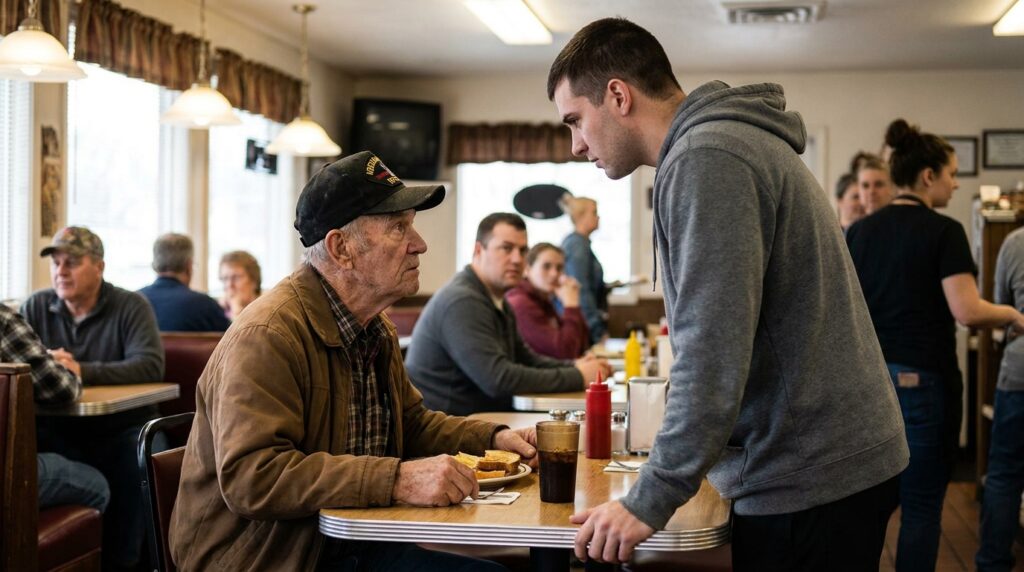
“Your old man didn’t find this in any dry-well,” the veteran said. His hand remained balanced over his fork, the tines embedded in the cold sausage link. He did not look up as the young man finally wrestled his weight onto the orange vinyl seat opposite him. “Bill Vance wasn’t a scavenger. He was a keeper. He kept the logbook for the north borehole when the core drill hit the lower limestone pocket in seventy-two.”
The boy sat heavily, his chest still heaving beneath the damp gray fleece of his hoodie. The arrogance that had occupied his shoulders five minutes ago had flattened out into a gray, defensive posture, his skin looking the color of wet lime under the flickering fluorescent tubes. He placed his palms flat on the formica, his fingers trembling slightly against the grease-filmed wood.
“He died three months ago,” the boy muttered. He didn’t look at the veteran. His eyes were fixed on the tarnished silver disc resting between the salt and pepper shakers. “The cancer took him from the lungs upward. The company doctor said it was the lime dust from the aggregate pit, but my old man knew better. He gave me that pouch the night before his breath failed. He told me to find the man who signed the final containment manifest for Miller’s shift.”
The veteran’s thumb slowly traced the split hide of the leather pouch. The physical connection to the object brought a memory back through his palms—the exact vibration of a diesel generator churning through flooded clay, the oily sludge of sulfur water rising over the boots of three men who didn’t have the clearance to ask what was in the tanks.
The decoy secret was now flat on the table, clear and solid as a forged bolt. The boy thought he was tracking a rogue sergeant who had abandoned his team after an industrial accident. He thought the medallion was proof of a desertion, a cold betrayal that had left Bill Vance and J.E. Miller to choke on the runoff while someone else walked away with a clean pension. It was a perfect explanation. It covered the gap in the town’s history like a heavy iron plate over an abandoned shaft.
“He thought you ran,” the boy said, his voice gaining a thin, bitter edge that didn’t rise enough to disturb the silence of the neighboring booths. “He said the man in the black cap was the only one who didn’t sign the waiver when the state closed the creek gate. He thought you took the settlement money and left the rest of the crew to bury the slurry.”
The veteran let his fork drop back against the plate. The ceramic ring was sharp, a single clean note that caused the cook behind the counter to shift his feet against the rubber floor mat.
“The settlement money was never paid, son,” the veteran said, his voice dropping into that flat, gravelly register that left no room for interpretation. “There wasn’t any money to take. The company didn’t buy our silence. They bought your father’s house. They paid the mortgage on every property from the railway spur down to the marsh because if they didn’t, the banks would have dug into the topsoil to verify the collateral before the loans were bundled.”
He picked up the silver chain. Close up, the small flakes of zinc coating were missing from the lead weld, leaving the raw iron beneath vulnerable to the salt air. It hadn’t been modified in a tank bunker; it had been repaired in the maintenance shed of the municipal water works three days before the pumps were filled with liquid concrete.
“Miller didn’t die in the shift,” the veteran continued, his gaze narrowing on the boy’s collarbone. “He died three miles out, in the back of your father’s station wagon, while they were trying to find an intake valve that didn’t show up on the county grid. Your old man didn’t give you this to find a ghost. He gave it to you because he knew the municipal authorities were going to re-open the north borehole for the summer intake.”
The boy’s hands tightened against the formica until the knuckles turned the color of lard. “The water’s fine. The town tests it every October.”
“The town tests for iron-shavings and lime-crust,” the veteran said, his face hardening into an expressionless mask of rusted iron. “They don’t test for what happens when the limestone dissolves into the lower sump. Your father knew the concrete cap was thin. He knew it because he poured it.”
The veteran pushed the leather pouch back across the table, his fingers letting go of the silver chain with a slow, deliberate click. The micro-mystery of the rectangular weight had been solved, but the true reality—the heavy, rotting core of the valley’s soil—remained locked inside his own memory, a secret that had cost him his name and his life before this boy was even a single cell.
Across the room, the waitress finally moved, her rubber-soled shoes sticking to the floor with a soft, tearing sound as she approached the booth with the fresh pot of coffee. Her face was blank, but her eyes stayed fixed on the tarnished metal disc that now lay exactly between the two men, its silver chain coiled like a dead snake on the gray laminate.








