
CHAPTER 2: THE WIDTH OF A FORGED INCH
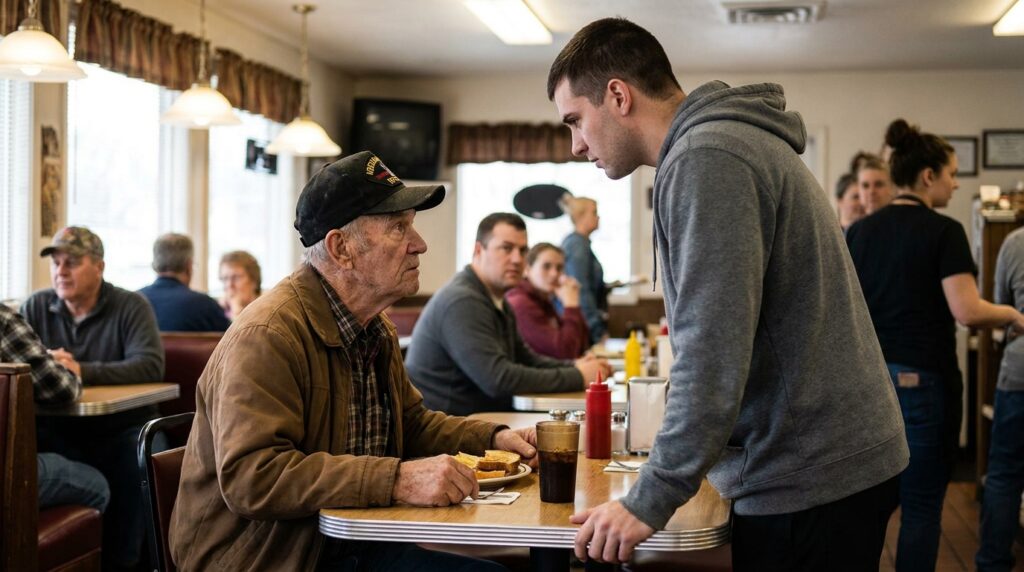
The pulse in the young man’s throat didn’t slow. It quickened, a small, ragged hitch in the flesh that the veteran tracked with the same dull, clinical detachment he used to measure the deflection of wind through dry timber. The boy’s hand came down on the edge of the formica, fingers splaying wide, the nails rimmed with the black carbon grime of grease-guns and low-grade diesel oil. The metal table frame groaned under the sudden application of leverage.
“You think that hat makes you tough, old man?” The words were thick with the flat vowels of the river valley, but they lacked weight. They were air—vocal chords vibrating under the influence of an adrenaline spike that hadn’t found its channel yet. “Get out of my booth.”
The veteran did not drop his chin. He let his thumb remain hooked over the small, silver-rimmed edge of his coffee mug. The ceramic was thick, commercial-grade, retaining a low, greasy heat that had settled deep into the calloused whorls of his palm. Through the laminate, he could feel the vibrations of the boy’s boots—the slight, rhythmic rocking of an athletic frame shifting its weight from the heel to the toes, preparing to launch a downward vertical shove.
“You should walk away now,” the veteran said. His voice was a flat, low-register rumble, the vocal cords scarred by years of breathing alkali dust and the dry, recycled oxygen of steel bunkers. It didn’t lift above the low whistle of the kitchen exhaust fan. “Before you make a mistake.”
The young man didn’t answer with words. He answered with momentum. His right hand left the table, a short, violent hook intended to bunch the collar of the brown jacket and yank the elder out of the vinyl corner. The movement was wide, unpolished, driven by the simple confidence of a body that had never met an equal resistance on a concrete floor.
The veteran’s left hand didn’t travel more than six inches. It didn’t need to.
He didn’t stand. He didn’t shift his hips from the orange vinyl. He simply caught the boy’s wrist at the intersection of the radial bone and the tendon, his thumb driving into the narrow channel where the nerve ran open against the structure of the joint. The physics were elementary—leverage applied to an accelerated mass that had already overcommitted its center of gravity. With a short, downward rotation of his forearm, the veteran redirected the thrust, using the boy’s own forward lean as the fulcrum.
The gray hoodie bunched. The boy’s shoulder dipped violently as his balance evaporated into the narrow space between the benches. There was a brief, wet skid of rubber soles on the floor composite, followed by the dull, hollow thud of eighty pounds of bone and muscle meeting the gray linoleum.
The salt shaker didn’t move. The pepper pot remained exactly two inches away. The small, yellow pool of grease around the rim of the sausage plate didn’t even ripple.
The silence that followed was total. It was the specific, heavy quiet that always follows the sudden loss of pressure in a hydraulic line. Three booths down, the waitress stood with her arm extended, the copper-banded pot suspended an inch above a ceramic mug, her face turned toward the floor with the blank, unblinking stare of someone who had just watched a stone wall slide an inch to the left without a sound.
The boy lay on his side between the table legs, his breath coming in short, whistly gasps as his ribs reacted to the flat impact of the floor. His eyes were wide now, the arrogance stripped away to reveal the yellow white of the sclera, the pupils blown wide as they tried to find the thread of what had just occurred. His gray hoodie had ridden up, exposing the pale skin of his flank and the heavy, rectangular silhouette that had been clicking against his thigh.
It wasn’t a weapon. It was an old leather grease-pouch, its surface cracked and stained with the green oxidation of old brass rivets. From the split seam at the top, a single tarnished silver chain hung loose, its links ending in a heavy, stamped military disc that bore an inscription the veteran recognized before the light even caught the metal.
The old man looked down over the edge of the table, his hand still resting on the rim of the coffee mug. His face was identical to the face he had worn five minutes ago—weathered, gray, and completely empty of vindication.
“Patience carried me through worse than this, son,” he said. The gravel in his tone was dry, unhurried, the sound of an iron gate closing on an empty yard.
He reached down, his fingers moving with the slow, deliberate economy of a mechanic adjusting a valve. He didn’t touch the boy’s throat or his shoulder. He simply took the edge of the leather pouch where it sat against the linoleum and drew it out of the hoodie pocket. The silver chain rattled against the floor composite with a small, iron ring that seemed to occupy every corner of the frozen room.
The boy didn’t move. He remained pinned by the weight of his own sudden insignificance, his hand twitching once against the base of the table leg.
The veteran turned the leather pouch over in his palm. The brass rivets were green with salt-crust, but the name stamped into the back of the hide was still legible beneath the grease of fifty years: MILLER, J. E.
The veteran’s thumb stopped on the letter M. A small, cold draft came through the bottom of the booth, smelling of wet asphalt and the old, leaden fuel that the trucks dropped by the pumps outside. The room was still holding its breath, forty eyes locked on the quiet old man who had just taken a piece of a dead man’s history out of a bully’s pocket without rising from his seat.








