
CHAPTER 6: THE SLAG BOUNDARY
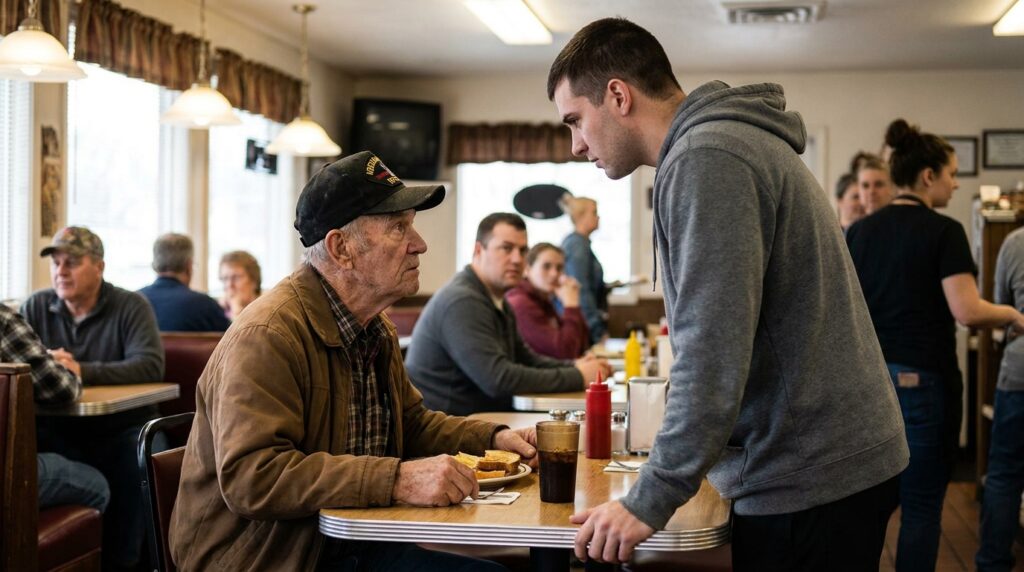
The air outside didn’t hit like weather. It hit like the exhaust of a wet coke oven, heavy with sulfurous steam that turned the back of his throat to raw sand. The bill of his veteran cap collected three drops of sleet in the first two paces, each one leaving a light, yellowish ring against the black twill as the sediment dried instantly under the wind. His boots struck the gravel lot with a dead, crunching thud that was entirely muffled by the low-frequency rumble vibrating through the earth below the state road.
He didn’t make for an old sedan or a farm truck. He didn’t have one registered in this county. He walked straight toward the drainage ditch that marked the northernmost property line of the diner’s lot—a three-foot trench lined with un-mortared limestone rock that had stayed dry since the spring floods of eighty-two.
Except it wasn’t dry now.
A thick, milk-colored slurry was boiling up through the gaps in the stone, its surface carrying a iridescent sheen of old lubricant and fine coal dust. The runoff wasn’t flowing toward the creek basin; it was backing up, the hydraulic head from the lower sump forcing the fluid backward through the porous limestone shelves until the entire gravel shoulder of the highway was beginning to look like wet salt.
The heavy, metallic rattle of an un-muffled manifold rose behind him. Through the steam, the young man from the booth came stumbling across the parking lot, his gray hoodie unzipped and flapping against his ribs like a torn tarp. He was carrying the leather grease-pouch in his left hand, the silver chain wrapped twice around his fingers until the links cut deep into his skin. His athletic stride was gone, his feet slipping into the slushy gravel as he struggled to maintain his balance against the slope of the grade.
“The bridge road is choked,” the boy yelled. He had to push his voice through his teeth to clear the sound of the booster station. “The sheriff’s got a truck across the line near the culvert. He says the culvert’s bowing upward from the bottom.”
The veteran didn’t stop. He cleared the lip of the trench with a short, economical stride, his brown jacket catching a spray of mud from the passing state vehicle that didn’t even slow for the yellow light. “The culvert is bowing because your father ran the relief line directly through the old masonry arch. The water isn’t going under the road, son. It’s going into the core.”
“We can shut the bypass manually,” the boy said, grabbing the stiff canvas of the veteran’s sleeve. The grip was desperate, lacking any of the leverage he had attempted inside the diner booth, his fingers slick with cold grease and rainwater. “My old man had the key-iron in the back of the shop. I know where the riser is.”
The veteran stopped his boots exactly on the white line of the shoulder. He turned his head slowly, looking down at the hand on his sleeve until the boy’s fingers uncurled from the fabric.
“There is no bypass, Vance,” the veteran said. The name came out dry, level, and final. “The riser your father told you about is an inspection pipe. It doesn’t connect to a gate valve. It connects to the void. If you turn a key-iron in that slot, you aren’t closing a line—you’re relieving the top-pressure that keeps the lower cave from collapsing into the clay shelf.”
The paradigm shift hit the young man’s face like an iron rod. His mouth opened slightly, his jaw trembling as he tried to reconcile the simple mechanical instruction his dying father had given him with the massive structural failure that was currently telegraphing itself through the soles of his boots. The decoy secret—the belief that his father had been a good mechanic trying to fix an old man’s mistake—was completely dead now, broken by the physical reality of the water columns rising through the gravel.
Across the highway, the first major fracture appeared. It wasn’t a sudden explosion of dirt; it was a slow, deliberate settling of the state road’s shoulder. A fifty-foot section of the asphalt parted with a dry, tearing sound that resembled canvas ripping over a frame. The white paint line fractured into clean, three-inch segments as the aggregate beneath subsided into the lime pool, leaving the raw base-course exposed to the sleet.
The radio inside the sheriff’s truck three hundred yards down gave a long, high-register shriek of feedback that died instantly as the telephone poles near the spur tilted six degrees to the west. The wires didn’t snap—they groaned, their copper cores stretching under the sudden tension until they hummed like steel cables on a winch drum.
The veteran reached into his jacket pocket and pulled out his hands. The skin was gray, the old scars from the ninety-four containment wall showing white against his knuckles. He didn’t have a plan to save the ridge, and he didn’t have a tool to stop the limestone from dissolving. His agency was entirely bound to the preservation of the truth he had carried into the room thirty years ago—a truth that was now writing itself across the landscape in sections of collapsed road and orange creek water.
“Get behind the diner,” the veteran told the boy, his fingers pointing toward the concrete pad where the propane tanks were anchored to the bedrock. “The pad is six feet of reinforced granite mix. It’s the only thing within two miles that isn’t sitting on your father’s cement.”
The boy didn’t run. He stood looking at the split road, his hands hanging limp at his sides while the tarnished military disc from the leather pouch swung back and forth against his thigh, a small pendulum marking the final seconds of the valley’s equilibrium. The main conflict hadn’t been resolved; it had simply outgrown the walls of the booth, leaving the protagonist standing on the boundary line of a failure he had spent half his life trying to outrun.








