
CHAPTER 3: THE CALCULATION OF DISTANCE
The name MILLER, J. E. did not vanish when the veteran blinked. It stayed fixed under the yellow light, the crude indents of the metal stamp filled with grease that had hardened into a crust blacker than the leather itself. The veteran’s thumb remained on the hide, feeling the cold transfer of temperature from the oxidized rivets. Fifty years of storage in an unheated shed or a damp basement had left the leather brittle, its grain splitting into tiny, jagged canyons where the thread had rotted out.
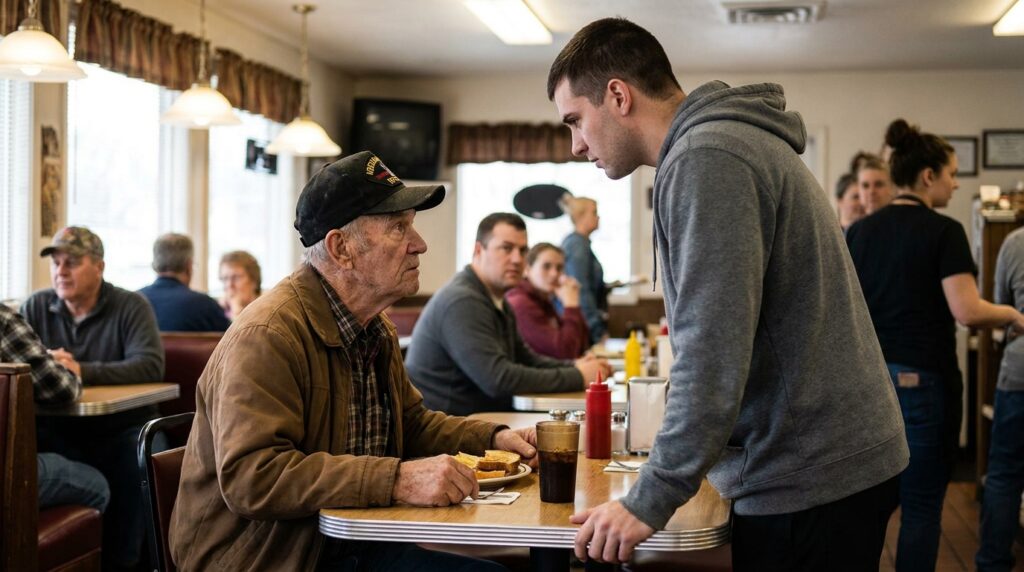
On the floor, the young man’s breathing changed from a ragged gasp to a sharp, defensive click. He pulled his knees toward his chest, a primitive defensive curl that brought his shoulders closer to the dark composite of the booth’s support structure. His boots scraped the floor again, leaving a dull, chalky line where the wet salt from the gravel outside met the dry linoleum. He didn’t try to lunging up. The physical reality of the floor had settled into his nervous system; he was tracking the older man’s left hand, which had returned to the thick rim of the coffee mug.
“Give that back,” the boy muttered. The pitch of his voice had dropped, the public bravado drained by thirty inches of vertical displacement. “That ain’t yours.”
The veteran didn’t look at him. His eyes remained fixed on the double-link chain extending from the split pouch seam. Near the small silver disc, a secondary link had been flattened by a heavy tool—pinched together and welded with a crude bead of lead solder that had turned gray and dull with age. It was a repair job done over an open furnace, the type of field modification they used to perform on tank treads and heavy gear-straps when the supply lines were choked with mud at the mouth of the valley.
“Miller didn’t have a boy,” the veteran said. The words came out clear, without the rising cadence of a question. They were stones dropped into a shallow well. “He had a sister in Altoona who died of the croup in sixty-eight. And he had three acres of sour dirt behind the coke ovens that the county took for back taxes before the ground even froze over his box.”
The silence in the diner expanded, absorbing the small, rhythmic clink of a metal spoon hitting a ceramic saucer two rows over. The waitress had lowered her pot, her hand resting flat against the edge of the formica counter as if she needed the solid wood to anchor herself against the shift in the room’s pressure. Behind the grill, the cook stood with his spatulas down, his grease-streaked apron motionless against the white enamel of the cold-table. Everyone knew the name Miller, but in this basin, Miller was just a label on a rusted iron gate three miles north where the creek ran orange.
The boy shifted his weight, his shoulder pressing into the vinyl skirt of the booth. “My old man found it,” he spat, his fingers curling into the fabric of his hoodie. “In the dry-well behind the old pump station. When the town shut the line down.”
The veteran’s thumb didn’t move from the letter M. The information didn’t alter the set of his jaw, but his mind silently recalculated the parameters of the grid. The old pump station sat on the lower shelf of the ridge, exactly four hundred yards from the boundary line where the foundry used to dump its core sand. If the leather had been in the dry-well, it hadn’t been lost; it had been dropped into the intake shaft before the concrete cap was poured.
“Your old man is Bill Vance,” the veteran stated, his gaze finally shifting down to the boy’s face. It wasn’t an interrogation; it was a verification of a mechanical blueprint. “He was the supervisor for the third shift when the seals failed on the lower sump.”
The boy didn’t answer, but the skin around his jaw tightened, the blood returning to his cheeks in a dark, mottled flush. He looked at the patrons in the adjacent booths, searching for the collective weight that had supported him when he first crossed the threshold, but the faces he met were blank, turned away, or focused entirely on the salt shakers. The social contract of the diner had re-formed around the old man’s posture.
The veteran picked up his fork. The tines were heavy, stamped steel that had seen ten thousand washings, the edges rounded by years of scraping against thick ceramic plates. He slid the metal through the cold yolk of the egg, his movements unhurried, his breathing regular. The boy on the floor was no longer an active vector of kinetic force; he was an item of inventory that needed to be cleared from the right-of-way.
“Get up, son,” the veteran said, his tone dropping into the quiet, flat rhythm he used when the line was secured and the trucks were idling in the yard. “You’re getting grease on your jacket.”
The young man didn’t move immediately. He waited for three full cycles of his own short breath, his eyes darting between the leather pouch in the veteran’s left hand and the heavy work boots planted six inches from his nose. Then, with a clumsy, multi-stage heave that lacked any of the athletic grace he had carried through the door, he pushed himself up onto his knees, his hands gripping the edge of the table to steady his frame.
The table shook an eighth of an inch. The silver chain rattled against the formica, a small, cold sound that seemed to mark the exact micro-second the boy’s status in the valley changed from a threat to a witness.








