CHAPTER 7: THE RISING MUTTER
The click inside the partition wall repeated twice—sharp, dry, mechanical sounds like an empty firing pin striking an old chamber. A low, grey vibration seemed to travel out from behind the service counters, rattling the metal frame of the change tray at window four before dying into the floorboards.
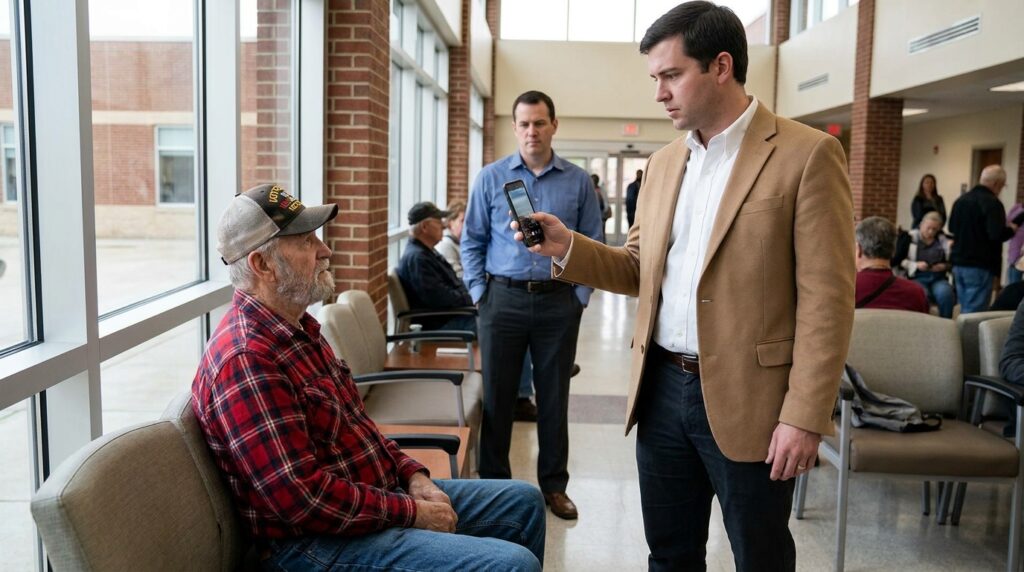
Miller didn’t draw his arms back. He stayed locked in his slight lean over the yellow line, the weight of the dead slate pressing into his palms until his thumbs turned a pale, waxy white under the fluorescent glare. The plastic pen Arthur had laid across the dark glass remained perfectly level, its translucent blue barrel split by a long reflection of the flickering ceiling tube.
“The trace doesn’t clear if the database stays cold, Mr. Vance,” Miller whispered. His voice was no longer a structured compliance tool; it had shrunk to a dry, rattling wheeze that barely traveled across the armrest. His eyes stayed glued to the small, circular scar on Arthur’s thumb. “The district network is on a ninety-second cycle. If the central frame doesn’t see a valid credential update before the clock resets, it flags the entire sector terminal for manual recovery. They’ll clear the whole house.”
“They’ll clear what they can see,” Arthur said. He didn’t shift his hips on the stiff plastic of his chair. He kept his heels dug flat into the salt-rimed grey linoleum, his gaze lifting past Miller’s shoulder to trace the line of benches behind him. “But they won’t find the source code in the district portal, son. They’ll just find the scraps you left behind the counter.”
Behind Miller’s back, the row of vinyl seats began to stir with a heavy, restless motion. The man in the blue shirt took his hands off the steel barrier rope and stepped across the gap, his heavy work boots striking the stone with an unhurried, rhythmic thud that made the security guard turn his chin. Two benches down, the woman with the canvas bag rose halfway from her seat, her fingers hooking into the worn strap as she pointed a thin, silver smartphone toward the investigator’s hunched shoulders.
“He told you no, kid,” the man in the blue shirt said. His voice was thick with the flat, heavy cadence of the county line, loud enough to strike the drywall ceiling and drop back down over the partitions. “We’ve been sitting under these lights for two hours listening to you talk about code forty-two and ledger discrepancies. Now your machine goes black, and you’re trying to squeeze an old man for an override. Put the slate down and open the gate.”
A sharp murmur ran through the rest of the line—the low, dangerous sound of twenty people who had spent their afternoon tracking a blinking red clock while their engines idle-burned four-dollar diesel in the muddy lot outside. A second phone rose near the back row, its glass lens catching the glare of window four’s dead desktop lamp.
“He’s obstructing an active inquiry,” Miller said, his head jerking back toward the crowd for the first time, though his feet didn’t move an inch from the yellow marker. His face was dry and gray, the skin around his manicured beard looking thin and tight like wet paper stretched over a frame. “The terminal lock is a security protocol. If you cross the barrier line, the guard has the authority to—”
“The guard is checking his own terminal, Miller,” Arthur said softly.
The room went dead silent again. The security guard had stepped back to his small iron desk near the double entrance doors, his leather gloves still gripped in his right hand as he used his left thumb to strike the keys of his base radio. The grey screen on his wall unit wasn’t showing the county security feed anymore. It was running a solid block of amber diagnostic rows, the characters wiping from left to right with the same rapid, automated rhythm that had burned through Miller’s slate three minutes prior.
The guard didn’t look at the crowd. He pulled his lapel mic free from his shoulder strap and spoke into the mesh, his voice flat and perfectly level: “Base, this is unit two. The main entry gate just took an external data lock. The magnetic latches aren’t responding to the local override key. Advise if there’s a district drill in progress.”
The radio didn’t spit back a voice. It gave off a high, continuous data squeal—the cold, dry hiss of a communication line that had been severed from the top down by an automated defense intercept.
Miller’s shoulders sank another inch, his sharp tan jacket wrinkling across his back as he looked back down at the dead glass in his hands. The small white dot that had been pulsing in pairs was gone. The screen was cold, dark, and hollow, holding nothing but the grease-streaked image of his own wide eyes and the faded gold lettering of Arthur’s cap.
The low-frequency click behind the wall stopped. A secondary buzzer sounded from the deep hallway beyond the counters—a single, long mechanical tone that indicated the regional authority had bypassed the district terminal entirely.
Arthur reached out and took the plastic pen back from the dead glass, his fingers wrapping around the barrel with an unhurried, heavy precision that made Miller step back half a pace. The veteran didn’t look at the dead slate or the trembling hand that held it. He looked toward the heavy iron doors of the back office as the latch began to move from the inside.