CHAPTER 2: OVER THE YELLOW LINE
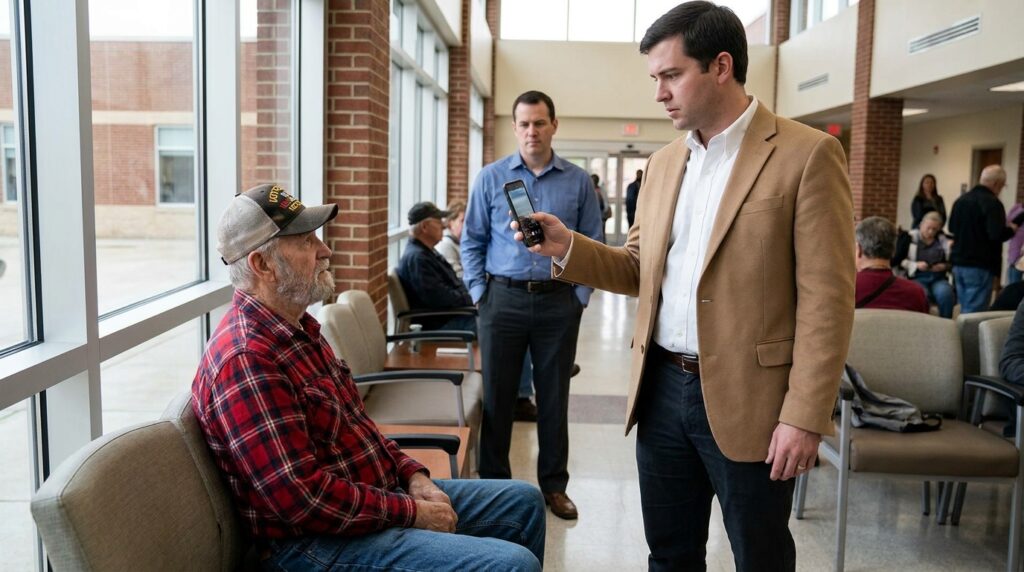
“The clock doesn’t care about eighty-one, Mr. Vance,” the auditor said. His fingers didn’t leave the black plastic pen resting on Arthur’s knee. He leaned further into the old man’s space, his tan blazer stretching tight across his shoulder blades until the fabric groaned. “The terminal closes out the queue at sixteen-hundred. If that waiver isn’t scanned, your medical allowance returns to the general county pool. I’m trying to help you clear the line, but you have to cooperate.”
Arthur looked at the pen. It was a cheap, disposable thing with a bitten cap and blue ink visible through the translucent barrel. A tool for signing away rights on grey paper. He didn’t pick it up. Instead, he lifted his hand from his jeans, his thumb trailing over the split ridge of his nail, and let his fingers rest flat on the cold laminate armrest of his chair.
“You’re standing over the yellow line, son,” Arthur said. His voice was a low, steady rumble, like a gravel truck idling on a steep grade. He didn’t look up into the auditor’s eyes yet; he kept his focus on the small plastic badge pinned to the young man’s lapel—M. Miller, Compliance Investigator. “The county code says the public must remain behind the yellow line unless called forward by name. You didn’t call my name. You walked back here to look for me.”
Miller’s face hardened. The pink blotches along his jaw deepened into a dull, angry red, the color of clay after a heavy rain. He stepped half an inch closer, his leather-soled shoe grinding a grain of salt into the grey linoleum floor. The smell of his mints was gone now, replaced by the sour tang of nervous sweat that clung to the synthetic weave of his shirt.
“I don’t need to call your name to do my job,” Miller muttered. His voice dropped an octave, trying to keep the conversation from spilling over into the next row of benches. He tapped the glass of his terminal again, his finger striking the screen with a sharp, greasy slap. “Your file is a ghost, Vance. It’s sitting in a restricted holding index that’s screwing up my section metrics. I’ve got three supervisors tracking my clear-rate today. I’m not losing my quarterly bonus because an old man wants to fight over a forty-year-old signature.”
Arthur let the silence grow between them. It was a heavy, tactical silence, the kind he used to keep when the radio went dead in the tree line and the only sound was the drip of water off a grease-coated canopy. He watched the white dot pulsing in the corner of Miller’s screen. It wasn’t a standard battery indicator or an app refresh signal. It was an active sync command, flashing three times fast, then holding a long, steady beat. A data hook.
Behind Miller, the security gate buzzed—a dry, mechanical rattle that sounded like a cicada dying in the grass. The clerk at window four turned her head, her heavy plastic earrings clicking against her collarbone as she stared toward Arthur’s corner. She didn’t return to her terminal. She kept her hands frozen above her keyboard, her eyes wide under the green glare of her desktop lamp.
“Look at your screen, Miller,” Arthur said softly.
“I’m looking at your waiver, Vance. And I’m looking at—”
The device vibrated. It wasn’t the soft, polite chime of a text message; it was a deep, continuous hum that shook the young man’s hand until the plastic casing rattled against his ring. The blue grid vanished from the display. In its place, a solid block of amber text began to cascade down the screen, characters wiping from left to right so fast they blurred into a single yellow smear.
Miller frowned, his thumb hooking into his sleeve as he lifted the device closer to his face. His knuckles were white against the leather casing. He swiped down once, then twice, his thumb leaving broad, wet streaks of oil across the glass. “The system is looping. It’s an administrative lock.”
“That’s not a loop,” Arthur said. He finally raised his eyes, his gaze locking onto Miller’s face with the flat, unblinking weight of iron plates. “That’s a query flag. Someone just noticed you’re pulling water out of a dry well.”
A low mutter rippled through the row of vinyl chairs behind them. The man in the blue shirt stood up, his work boots thudding against the floor as he angled his head to see over Miller’s shoulder. Two benches down, an older woman pulled her canvas bag closer to her chest, her eyes darting toward the heavy glass doors of the entrance where a lone security guard was slowly rising from his stool.
Miller didn’t look back at the crowd. His eyes were fixed on the bottom of the screen, where a single line of text had stopped scrolling. The letters were black against the amber background, solid and blocky, spelling out a sequence that didn’t belong on a county ledger.
SECURITY OVERRIDE CODE: SIGNALS-4-ALPHA.
A sharp, metallic pop echoed from the back office behind the security glass. The automated ticket dispenser on the wall groaned, its internal rollers spinning wildly for three seconds before spitting out a long, blank tongue of white paper that coiled onto the floor. The red digital clock didn’t click to sixteen-hundred. It frozen at fifteen-fifty-nine, its elements flickering rapidly like a dying fire.
Miller’s fingers loosened. The black pen rolled off Arthur’s knee, landing on the grey floor with a hollow bounce.