CHAPTER 3: THE RAISING OF VOICES
The terminal didn’t strike sixteen-hundred. The digital numbers remained pinned at fifteen-fifty-nine, the red LED bars vibrating with a dull, frantic pulse that made the dust motes look like static sparks dancing in front of the lens.
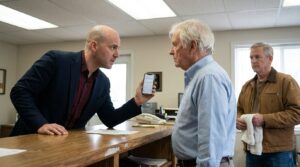
Arthur watched the auditor’s fingers. They were no longer tapping the glass; they were hooked rigid into the leather edges of the terminal casing, trying to stabilize a hand that had begun to shake with the dry, rapid rhythm of an engine running out of lubricant. The amber glare from the screen caught the sweat gathering under Miller’s jawline, highlighting the sharp twitch of a tendon near his ear.
“It’s a network-level freeze,” Miller said. He didn’t speak to Arthur; he spoke down into the glass, his voice rising in pitch until it cracked against the silent row of plastic benches behind them. He pulled his torso back out of Arthur’s personal space, but his heels didn’t shift from the yellow line. “The entire regional database just disconnected from the local terminal. This isn’t an internal loop.”
“I told you,” Arthur said, his hand remaining heavy and flat against the iron-stained denim of his knee. “You’re digging in wet ground, son. The deeper you go, the more things cave in.”
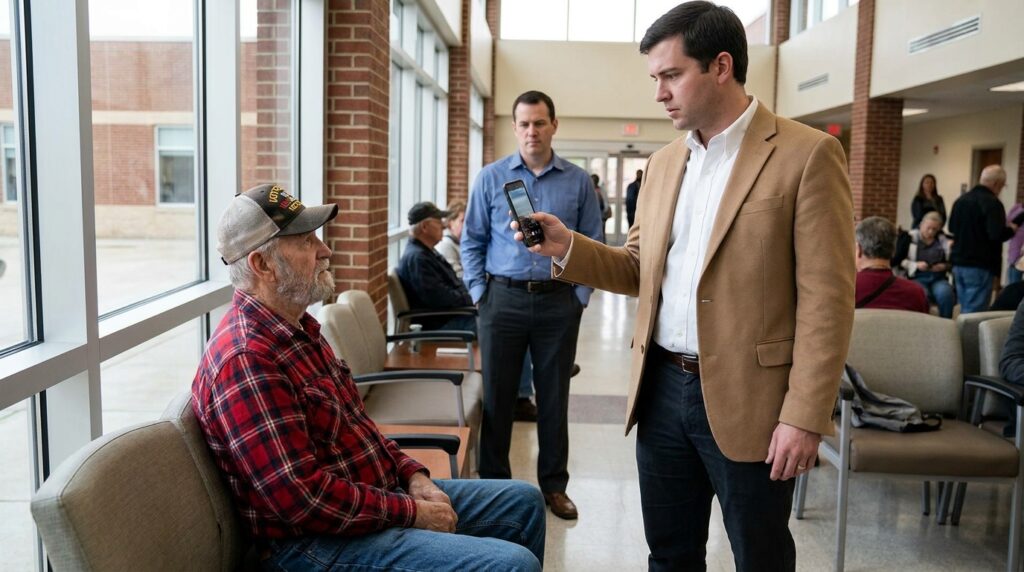
Miller looked up, his teeth clicking together as he forced his shoulders back into a rigid, defensive square. He looked toward window four, then over his shoulder at the security desk by the double glass doors. The guard was standing now, his belt groaning under the weight of his radio and his plastic handcuffs as he took three measured steps onto the linoleum. The small room had grown narrow, the smell of wet wool coats and stale chemical floor cleaner thickening into a cold grease that stuck to the back of the throat.
“You’re trying to disrupt a county audit, Mr. Vance,” Miller shouted. He didn’t use his controlled corporate tone anymore. He threw his words across the wide grey gap of the waiting room, deliberately targeting the bystanders who sat with their bags clutched against their knees. “The compliance office has full legal authority to verify legacy vouchers. If your paperwork is out of compliance, it’s a misdemeanor under code forty-two. You don’t get to freeze our terminals because you don’t want to sign the disclosure.”
The man in the blue shirt stood up fully now, his thick leather gloves clutched in his right hand like a club. He didn’t look at Miller; he looked down at Arthur’s blue cap, his eyes tracing the faded gold thread of the lettered rim. “The old man hasn’t touched your machine, kid. He’s just sitting there.”
“He’s refusing to comply with a standard reconciliation,” Miller said, his boots clicking twice against the salt-streaked floor as he turned his back to Arthur to face the benches. His tan blazer swung loose, revealing the silver clip of a pager and a secondary database key dangling from his belt loop. “The county is losing sixty thousand dollars a month on unverified medical accounts in this district alone. We are clearing the dead weight from the ledger. If he doesn’t sign, he’s obstructing public administration.”
Arthur didn’t rise. He kept his spine straight against the rigid plastic backing of his chair, calculating the geometry of the room. The distance from his boots to the security rope was four paces. The distance from Miller’s outstretched terminal to the hard edge of the laminate table was two. He could feel the familiar, cool pressure behind his temples—the old command math that had nothing to do with county regulations or administrative fines.
He reached down and picked up the black pen that Miller had dropped. The plastic was cheap, cold, and slightly greasy from the auditor’s fingers. Arthur turned it over once between his fingers, his thumb feeling the small, circular dent in his nail.
“You’re talking about sixty thousand dollars like it’s a big number, Miller,” Arthur said. His gravelly voice was low, but it cleared the room like a dry wind over a range. The auditor froze, his shoulder blades tightening through the fabric of his jacket. “That’s two months of diesel for the regional drainage pumps. Or it’s five seats on the municipal water board. Why don’t you check where that ledger actually routes when the signature isn’t there?”
Miller turned around slowly. His eyes were wide, the pupils shrunk down to small black points under the harsh overhead tubes. “The ledger routes to the general fund, Vance. It’s an automated transfer.”
“It routes to an escrow box in the second-tier database,” Arthur said, his fingers tightening around the cheap plastic pen until the translucent barrel began to bend. “It’s been routing there since ninety-six. Every time an account defaults from an old unit file, the balance doesn’t go back to the state. It goes into the discretionary maintenance budget for the third district supervisors. Your clear-rate isn’t an audit, son. It’s a harvesting operation.”
The clerk at window four let out a sharp, indrawn breath that died behind her teeth. She pulled her hands completely off the desk, her fingers curling into her palms as she looked down at the amber screen of her own terminal. The display wasn’t running the county log anymore. It was mirroring Miller’s screen, the same amber letters scrolling in a continuous, rapid cascade that cast a yellow shadow across her face.
The security guard stopped five feet from the yellow line, his hand resting on the leather flap of his holster. He didn’t look at Arthur. He looked at Miller’s terminal, where the white dot had turned a solid, burning red.