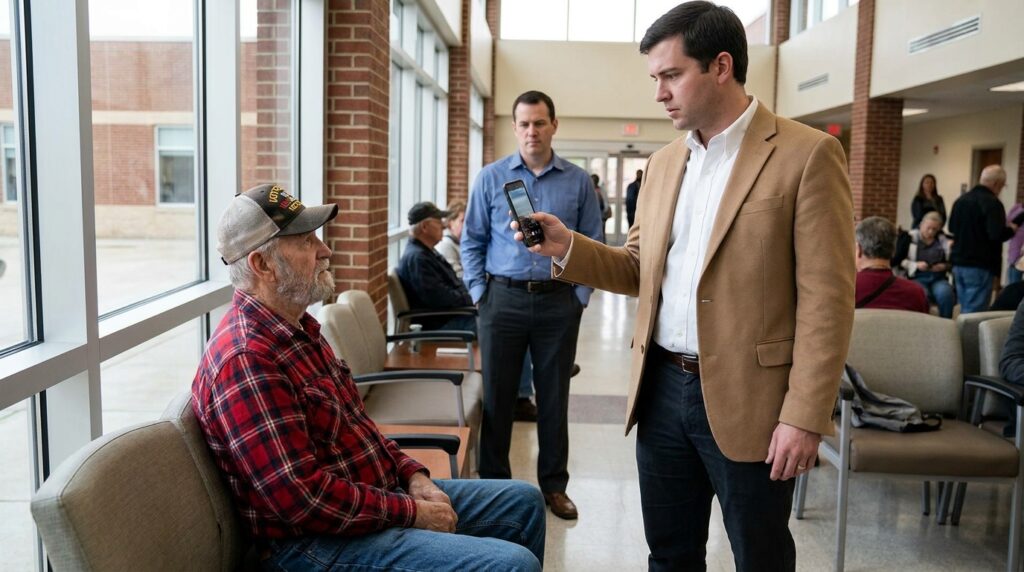
CHAPTER 6: THE EXTENDED HAND OF REVERSAL
The black glass of the slate reflected the overhead tubes as twin grease-smeared tracks. Miller’s thumbs stayed clamped to the edges of the plastic shell, his knuckles grey against the tan fabric of his cuffs. The deep hum that had been vibrating through his sleeve died out with a low, metallic click from the internal board, leaving only the sound of a heavy diesel truck down-shifting two blocks away on the state highway.
“Fine,” Miller muttered. His voice was a flat, dry scrape that barely reached past the yellow line. He didn’t lift his face to look at Arthur or the row of benches behind them; his head stayed bent over the dead device as if he were trying to read his own reflection in the dark. “Fine, let’s settle this respectfully and move forward.”
He didn’t pull the device back to his chest. He kept his arms extended, his elbows locked as he slid the black rectangle across the grey laminate armrest of Arthur’s chair. His manicured beard was trembling slightly at the edges, the hair coarse and stiff with wet salt. He held the dead weight of his career out between his hands, offering the physical proof of his own failure to the old man he’d tried to force out of the room ten minutes ago.
“You’re still holding the line, son,” Arthur said. He didn’t pick up the slate. He reached out with his right hand, his calloused fingers wrapping around the cheap plastic barrel of the pen Miller had left on his knee. He didn’t drop it into his pocket; he just laid it lengthwise across the dark glass of the dead terminal, the translucent casing clicking against the reflection of the overhead lights. “A handoff doesn’t change the ledger. If your profile is locked at the central frame, it stays locked until a supervisor pulls the hardware key from the back room.”
“The supervisor won’t touch the key,” Miller said. His tone was tight, transactional, and fast—the voice of an insurance salesman calculating a loss on a wet porch. He looked up then, his pupils large and watery under the green reflection of the dead window lamps. “The regional office has an automated backup route for district code forty-two. If a terminal drops out under an integrity flag, the mainframe isolates the sector within ninety seconds. My name is on the local session log, Mr. Vance. It’s the only name that’s active on this side of the gate.”
Arthur looked down at his own right shoe, where the scuffed leather was white with salt from the driveway puddle outside. He could feel the cold draft from the floor vents hitting his ankles, bringing the smell of damp oil and rusted iron pipe from the crawlspace beneath the floorboards. The county had built this annex over an old maintenance yard, and the earth underneath still held the grease of fifty years of road graders and stone crushers.
“They built the system to isolate the branch so the leak wouldn’t show on the main state ledger,” Arthur said, his gravelly voice dropping down into a level vibration that stayed between them. “Every time an old voucher is closed out by hand, the transfer file gets a temporary index mark. If the integrity check flags the index, the sector gets wiped to protect the board. You aren’t the first clerk they’ve left behind the glass with a dead terminal, Miller.”
Behind them, the security guard’s boots shifted against the linoleum with a long, wet creak. He didn’t use his radio anymore. He’d pulled his heavy black leather gloves out from his belt, his fingers working into the stiff hide with slow, deliberate tugs as he watched the back exit door behind window four. The glass pane was still dark, but a low-frequency click—three quick beats—echoed from the internal locking mechanism inside the partition wall.
The man in the blue shirt stood up fully from his bench, his heavy flannel jacket swinging loose as he leaned both hips against the steel barrier rope. “He asked you a question, kid. Is the gentleman’s voucher clear or not? We’ve been sitting here since two o’clock, and some of us have trucks running in the lot.”
Miller didn’t turn his head toward the crowd. His shoulders were hunched tight under his tan jacket, his collar bunching up against his ears until he looked thirty pounds lighter than he had when he walked over the yellow line. He kept his arms extended, the dead black slate resting on his palms like an old plate.
“All right,” Miller whispered, his eyes dropping back down to the plastic pen Arthur had laid across the glass. “All right, let’s keep this civil. Just give me the old branch routing code from eighty-one. The database index will hold the session open if there’s a matching prior system record.”
Arthur let the pen sit on the glass. He didn’t move his hand to touch the slate, his thumb tracing the white, split ridge of his own nail with a slow, flat pressure. He knew exactly what was behind the grey amber text that had flashed before the screen went dark—the ultimate reality of the joint-command signal array he’d wired into these very walls before Miller’s office was even mapped. It wasn’t an administrative code. It was a live trigger, and it was currently counting down the seconds until the state line went dead.
“ThePrior system record is closed, son,” Arthur said softly.