CHAPTER 5: THE SHATTERING OF THE SHIELD
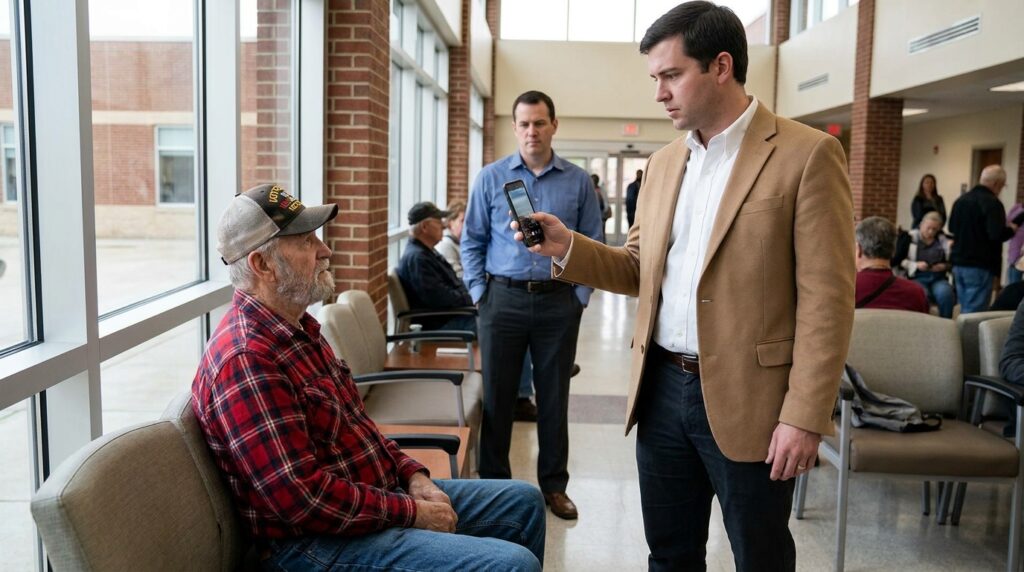
Arthur did not reach for the extended glass panel. He let Miller’s arm hang there in the empty air between them, the terminal’s amber backlight casting horizontal lines of sharp orange across the investigator’s white shirt like bars on a cage. A drop of sweat fell from the point of Miller’s trimmed beard, hitting the edge of the screen with a faint, wet tap that seemed to echo through the silence of the waiting area.
“The script doesn’t stop from the outside, son,” Arthur said. He kept his hands dropped flat against his thighs, his calloused thumbs aligned with the hard seam of his jeans. “Once the state auditor’s flag drops down onto an active terminal, it means the gate is locked from both sides. You’re the one holding the latch.”
Miller’s thumb twitched against the plastic border of his casing. The display was no longer running his local clear-rate log; it was dumping blocks of red hexadecimal strings, each sequence wiping out an entire tier of regional data with a dry, mechanical sizzle from the terminal’s internal speaker. The top line of the header remained fixed, spelling out his complete compliance profile next to a cold, automated declaration: FEDERAL INTEGRITY ENFORCEMENT—CRITICAL ADMINISTRATIVE BREACH.
“I didn’t open a restricted box,” Miller said, his teeth clicking against each other as his voice dropped into an erratic, hollow rattle. He didn’t look at the crowd of bystanders who had shifted closer to the security rope. He kept his eyes pinned to the gold thread along the edge of Arthur’s faded cap. “The regional director gave me the compliance index code. It was on the weekly ledger update. He said it was an unassigned legacy pool.”
“He told you what you needed to hear to make you run the plow,” Arthur said softly. He turned his wrist slightly, the cheap black pen he’d taken from his knee pointing directly at a small, triangular symbol flashing beneath the red security flag. “That’s a joint-command intercept mark. It’s been sitting on that ledger since the county lines were re-mapped in ninety-two. The regional board didn’t unassign it. They just hid it behind the medical voucher system so they could draw the interest off the reserve pool without triggering a state disclosure.”
Miller’s hand shook so violently the terminal slipped an inch through his palms, the hard corner scraping against the metal armrest of Arthur’s chair with a dry, grinding screech. He caught it against his stomach, his sharp tan blazer wrinkling as he leaned his torso over the glass like a man protecting a wound. “If the integrity flag clears to the central office, my credential profile is permanently locked. Every file I handled in the third district gets routed for a forensic review. They’ll pull the audit trace back through the last three fiscal years.”
“They’ll look at everything you touched,” Arthur agreed. His gray beard didn’t shift. His voice had the flat, unyielding weight of an iron stake driven into dry earth. “They’ll see where the money went when the older applicants didn’t sign the disclosure waivers. They’ll look at the municipal water board accounts, and they’ll look at the regional drainage pump contracts. They’ll find the entire secondary ledger you’ve been cleaning for the district supervisors.”
Behind them, the security guard took another step back, his heavy black boots squeaking against the linoleum as his radio began to emit a steady, high-pitched data hiss. A metallic voice broke through the static, truncated and distorted by the network block inside the building: “Terminal three status… alert… integrity failure at portal four… hold all field personnel…”
The guard didn’t answer his lapel mic. He looked at the window where the clerk had left her station, then down at his own small digital monitor on his belt. The screen had gone dark, replaced by the same amber block that was currently burning through Miller’s slate.
The man in the blue shirt let out a low, dry chuckle from the first row of benches. He didn’t move away from the security rope. “Looks like the kid found out who owns the well. Maybe you should’ve checked the name on the cap before you started talking about code forty-two, Miller.”
Miller didn’t turn to face the room. His face had gone completely grey, the color of dry alkaline powder. He looked at Arthur, his chest heaving under the synthetic weave of his white shirt as he realized the decoy secret he’d been using to protect his career—the small-scale county fraud he’d been hiding behind—was being systematically crushed by a massive, automated system he couldn’t see.
“Help me stop the trace,” Miller whispered. His voice was raw, stripped of every ounce of bureaucratic authority. He dropped his knees slightly, his height lowering until he was eye-level with the seated veteran, his hands offering the vibrating screen once more like an old bucket filled with hot coals. “You have the override line, Mr. Vance. Just give me the old unit identifier. It will stall the flag until the regional director can pull the terminal off the grid.”
Arthur looked at the screen, his gaze tracing the red hexadecimal strings as they hit the end of his own secure file index. The absolute truth of his old work—the network he’d built to monitor these very boxes forty years ago—remained perfectly hidden behind the amber wall, locked away from the small investigator’s sight.
“The regional director isn’t coming to pull your terminal, son,” Arthur said. He leaned his back against the vinyl seat, his shoulders square and solid against the plastic. “He’s currently deleting his own login keys from the supervisor loop. You’re the only name on the header today.”
The terminal gave off a final, short beep, and the screen turned completely black except for a single line of grey text that settled across the center of the glass: TERMINAL DECOMMISSIONED BY EXECUTIVE AUTHORITY.