
CHAPTER 7: THE RECOGNITION LOCK
“Stand down,” a voice ordered from the top of the stairwell landing.
The command didn’t come through the short-range tactical radios. It didn’t have the standard digital clip or the frantic cadence of the basement detail’s tracking loop. It was a heavy, gravel-edged rasp that cut clean through the basement’s damp air conditioning hum, carrying the kind of raw, structural authority that only forty years of command-lane service could burn into a man’s throat.
The three security guards froze, their high-lumen tactical lamps dropping instantly toward the concrete floor. The beam of the lead light washed over the old veteran’s boots, catching the white flakes of dried floor wax still stuck to the dark leather creases. The men didn’t lower their weapons completely, but their boots ground against the gritty floor lime as they stepped out of their tight containment wedge, opening the narrow lane between the transformer box and the masonry wall.
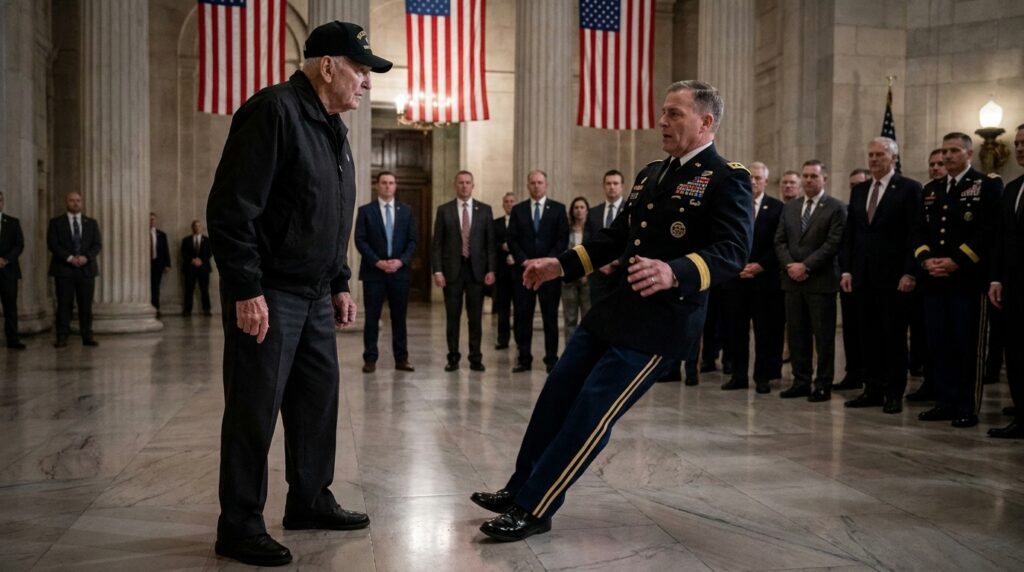
A tall, broad-shouldered man in an unvarnished garrison coat walked down the steps. His silver hair was cut into a sharp, square line that mirrored his jaw, his uniform free of the bright, multi-colored ceremonial ribbons that the captain had paraded upstairs. He wore only a single ribbon—the muted olive-and-black bar of a desert logistics commander from the old Cold War sector tiers. On his lapel sat a small, tarnished brass pin bearing a four-star command cluster.
The senior general stopped exactly three inches from the edge of the old man’s shoulder line. His gaze didn’t linger on the faded canvas of the black zip jacket or the plain black cap; his eyes went straight to the old man’s right hand, which was still wrapped tightly around the brass ignition key inside his pocket.
“You haven’t changed your alignment, Vance,” the general said. The words were quiet, but they bounced off the wet lime walls with a weight that made the junior guards adjust their stances. “Still holding the left heel light when you trace a perimeter.”
The veteran didn’t release his grip on the notched metal key. He looked at the general’s face, tracking the deep, weather-beaten creases around the eyes—the permanent squint left by three years of salt-flat glare during the forty-one-two deployments.
“The brackets are still drawing power, General,” Vance said, his voice flat, a hard line of mechanical iron that matched the rhythm of the rotary transmitter clicking behind the junction shell. “The logistics ledger says the sector was bulldozed in eighty-five. The ink was blacked out. But the copper’s live.”
The general turned his head slightly toward the lead security guard, his thumb making a small, downward gesture that commanded the tactical lights to be extinguished completely. The basement plunged into a dark, amber wash, illuminated only by the faint red diagnostic bulb on the side of the transformer housing.
“The logbook is a decoy, Vance,” the general said, his voice dropping into a low register that remained below the pickup range of the modern monitoring grid upstairs. “The administration wiped the file because they needed a clean paper trail to satisfy the oversight committees. They wanted the world to think we left thirty men out there because of a failed radio rig. It was an easy lie to write into the budget.”
Vance pulled his right hand out of his jacket pocket. He didn’t make a sudden movement, but the brass utility key clinked sharply against his old horn-handled pocketknife as he held them out in his palm. The general looked down at the metal, his fingers reaching into his own coat to produce a matching artifact—a scratched, heavy Zippo lighter with an unpolished command insignia etched into the brass casing.
“They think you came here to expose the purge,” the general whispered, his eyes locking back onto Vance’s steady gaze. “The captain upstairs thinks you’re an old vagrant looking for a pension voucher. He doesn’t know that the forty-one-two node isn’t just an old deployment sector. It’s the primary relay link for the deep-set communications bunkers. The receivers are still running on an automated cycle, Vance. And the code slip you’ve got in your knife is the only thing that can shut the automated transmission loop down before the modern networks intercept the frequency.”
The lead guard took a short step forward, his boot sole scraping a warning against the concrete. “Sir, the command staff upstairs is logging the delay. The captain is demanding a formal trespass report for the civilian observers.”
The general didn’t look back at his man. He reached out and placed a heavy, gloved hand onto the old veteran’s forearm, the stiff leather of his cuff pressing against the rough canvas of Vance’s sleeve with a firm, transactional grip that felt like a transfer of duty.
“Get out through the pump lines,” the general said, his thumb pointing toward the dark, unmapped drainage shaft at the rear of the alcove. “The logbook won’t help you out there—it’s just dead paper meant to keep the lawyers busy. The transmission is what matters. You hold the coordinates for the live line, Vance. If they take you here, they find the slot.”
The old man turned his face toward the dark secondary exit, his boots already adjusting to the downward tilt of the wet stone floor. He could feel the cold draft of the rain coming from the city’s storm grid below, the raw texture of the world outside waiting to reclaim him. He had been given a false flag—a book of wiped records that meant nothing compared to the live iron hum vibrating through his shins. The lane was clear for now, but the true confrontation was no longer on the marble floor upstairs; it was waiting for him out in the salt flats where the old network refused to die.








