
CHAPTER 4: THE WEIGHT OF THE ANCHOR
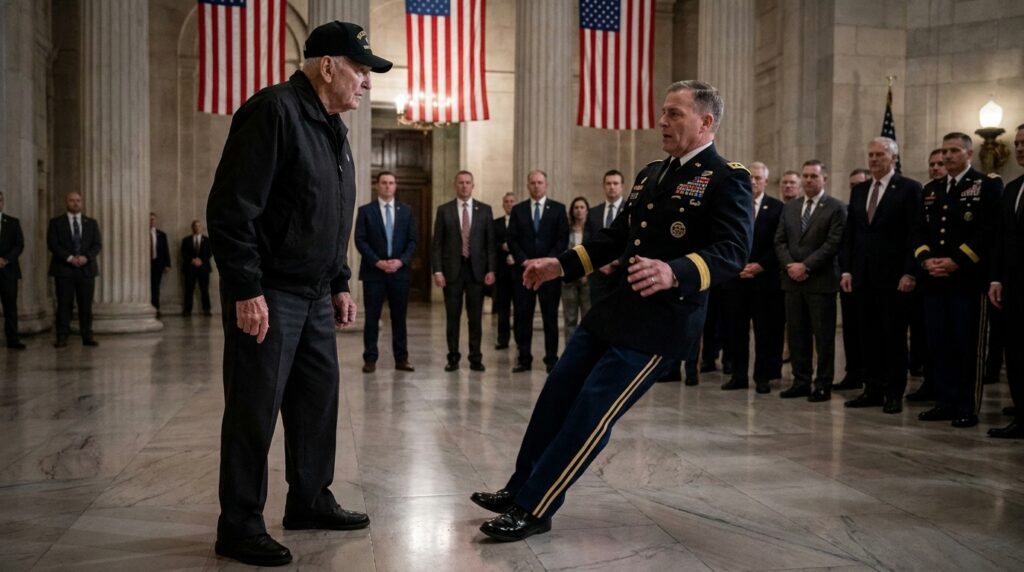
The young technician’s warning dissolved into the low mechanical rumble of the ventilation shafts as a shadow cut across the polished floor displays. It was a heavy, hurried stride, the sound of thick leather soles slapping against the marble with an uneven rhythm that betrayed a broken center of gravity. The Uniformed Officer had closed the distance, his starched dress blue wool taut across his chest, his face darkened by an administrative humiliation that could not be permitted to exist in front of witnesses.
“Step away from that console, old man,” the captain said. The words were choked, raspy with a sudden spike of adrenaline that fouled the crisp, cold air of the hall. He didn’t wait for compliance. His large right hand came forward again, his fingers hooked like a steel clamp, targeting the faded canvas collar of the black zip jacket with a blunt force meant to settle the ledger instantly.
The veteran did not drop his chin. He stayed rooted over his boots, his heels resting directly above the concrete seams where the old routing brackets met the modern floor. Through the soles of his leather shoes, he registered the specific micro-tremor of the younger man’s approach—the heavy, off-balance heel strikes of a physical bully who relied on mass because he had never been forced to hold a perimeter against an active breach.
Inside his pocket, the veteran’s thumb stopped rolling the flat brass ignition key. He let his fingers open, releasing the cold notched metal to rest flat against the coarse lining of his jacket. His hand didn’t emerge as a weapon; it rose like a counterweight, a steady iron rod sliding up through the empty space between the captain’s extended wrists with the dry, rasping friction of rough canvas cutting against immaculate blue wool.
“I told you once, son,” the old man said, his gravelly tone flat and level, lacking the rapid, breathless panic of the modern crowd. “You’re leaning.”
The captain’s fingers never completed the grab. Instead of striking a soft, brittle frame that would yield to his weight, his palm collided with a mass that felt like an industrial hitching post anchored four feet into frozen shale. Before the officer could adjust his hips or bring his trailing leg forward to lock his stance, the veteran turned his left shoulder by exactly two inches—a subtle mechanical pivot that closed the opening and redirected the younger man’s forward momentum.
It was an effortless application of low-tier defensive leverage, a manual technique that had been scrubbed from the modern training academies in favor of electronic tasers and administrative distance. The old man caught the captain’s extended wrist with the meat of his thumb, his forearm acting as a rigid block that trapped the officer’s leverage at its highest, most unstable point.
The captain’s pristine dress shoes lost their purchase on the high-gloss wax. For one brief, silent fraction of a second, the clinking silver medals on his chest plate flared outward like small tin coins before his center of gravity crossed the irreversible line of his toes. The momentum he had used to intimidate the elder became his own trap.
A loud, heavy thud echoed through the grand ceremonial hall as the captain’s muscular frame hit the polished marble floor. The impact was dense and metallic, the sound of bone and starched wool slamming flat against solid stone, instantly shattering the polite hum of the civilian gatherers near the VIP ropes.
The room went completely dead. The distant click-clack of the security terminals stopped. A middle-aged observer holding a champagne glass froze, his hand trembling as the liquid sloshed against the crystal rim. Every face in the immediate tier turned toward the center display, their eyes wide with the sudden, impossible realization that the pristine institutional hierarchy had just been dropped by a man in a plain black cap.
The veteran stood perfectly upright, his boots planted firmly over the sprawled form of the decorated officer. He did not look at the crowd; his cold, weathered gaze remained fixed on the small shaving nick under the captain’s left ear, which had begun to bleed slightly from the shock of the fall. The old man’s face was an unreadable sheet of stone, free of malice and entirely clear of exhaustion.
“You picked the wrong veteran to challenge today,” the old man said into the absolute silence of the room. His voice didn’t rise, but it carried the raw, unpolished density of an old diesel block ticking over in a scrap yard.
The captain lay flat on his back, his breath knocked from his lungs in a sharp, ragged wheeze. The silver bars on his shoulders looked crooked against the gray marble, his fingers clawing weakly at the slick stone as his brain struggled to process how a body so old could hold so much unyielding iron. He didn’t try to rise; the physical reality of the leverage had logged an absolute truth into his muscles that his uniform could not dispute.
The veteran didn’t offer a hand. He turned his thumb back toward the pocket of his jacket, finding the edge of the brass utility key once more as the first low murmurs began to ripple through the outer edge of the audience.
“Stay down,” the veteran added, his voice dropping into a deeper, commanding register that hadn’t been heard in this sector for forty years. “And think first.”








