
CHAPTER 1: THE FRICTION OF EXCLUSION
The security gate smelled of cold zinc and the chemical signature of cheap plastic identification cards. It was a sterile, high-ceilinged sorting pen designed to filter out the small, inconvenient realities of the outside world before they could touch the polished wood of the main gallery. Beyond the stanchions, the marble of the ceremonial hall gleamed like wet slate under the high-intensity halogen arrays, casting long, sharp-edged shadows that made the incoming guests look taller than they actually were.
He stood three inches from the edge of the gray rubber conveyor belt, his fingers resting inside the right pocket of his zip jacket. His thumb turned the flat brass ignition key over and over—a small, notched piece of metal belonging to an old truck that had sat dead in a gravel driveway since ninety-four. The key was cold, but the friction of his skin kept it from freezing entirely.
“The invitation list is closed for non-vetted personnel, sir,” the clerk behind the terminal said. She didn’t look up from her screen. The blue light of the monitor caught the edges of her hair, turning it the color of industrial grease. “If you don’t have the digital registration bar, you need to step back behind the blue tape.”
The old man didn’t move his boots. They were black leather, thick-soled, with the salt-rings of three winters dried into the creases near the welt. He looked at the brass stanchions, noticing how the velvet rope sagged exactly four inches under its own weight—too loose to stop a determined stride, but just enough to signal an institutional boundary.
“I’m here for the command registry,” his voice was dry, the sound of iron dragging over gravel. It wasn’t loud, but it didn’t have the breathy hesitation the clerk was used to hearing from the elderly who wandered off the transit buses.
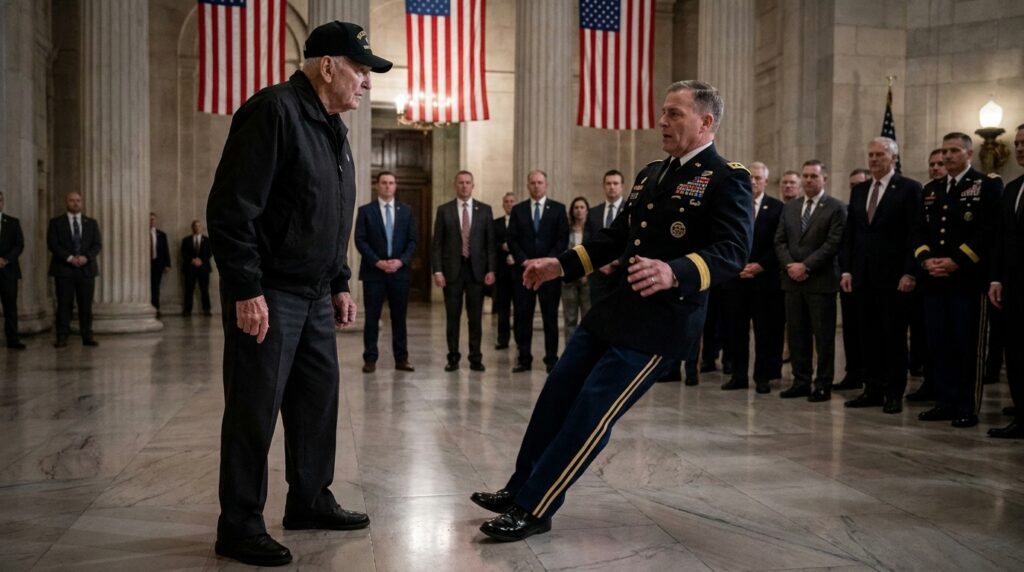
A Uniformed Officer stepped through the security lane from the inner hall. His dress uniform was immaculate—dark blue wool so stiffly starched it didn’t wrinkle at the elbows, the silver captain’s bars on his shoulders catching the overhead light with a bright, aggressive glare. His high-and-tight haircut showed the pale skin of his scalp, scrubbed clean of everything but arrogance. His eyes passed over the veteran’s plain black cap, his gaze dropping instantly to the faded canvas of the black jacket. To the officer, the old man was a structural blemish in a room meant for television cameras and corporate donors.
“Is there a problem with processing here?” the officer asked. His voice had the performative resonance of an auditorium microphone. He didn’t speak to the veteran; he spoke over him, addressing the clerk as if the space between them were completely empty.
“He doesn’t have the registry code, Captain,” the clerk said, her fingers clicking against the plastic keys with a rhythm like dry beetles. “He keeps asking for the old command files.”
The captain shifted his weight forward, his pristine leather belt creaking against his hips. The silver medals on his chest clinked together—a thin, tinny sound like coins falling into an empty cup. He stepped into the veteran’s personal space, his chest expanding slightly to utilize his height advantage. He was thirty years younger, forty pounds heavier, and entirely convinced that authority was something manufactured by a tailor.
“Sir, you need to step away from the floor right now before I move you myself,” the captain said. He reached out, his thick fingers opening into a wide, demanding grip that targeted the old man’s shoulder.
The old man didn’t flinch. He looked down at the officer’s hand, watching the knuckles whiten as the muscle tension grew. Beneath the black cap, his steady eyes caught a tiny white scar just below the officer’s left ear—a sloppy shaving nick from that morning, the mark of a man who rushed through his details because he thought no one was close enough to see the mistake.








