
CHAPTER 5: THE SHIFTING LINE
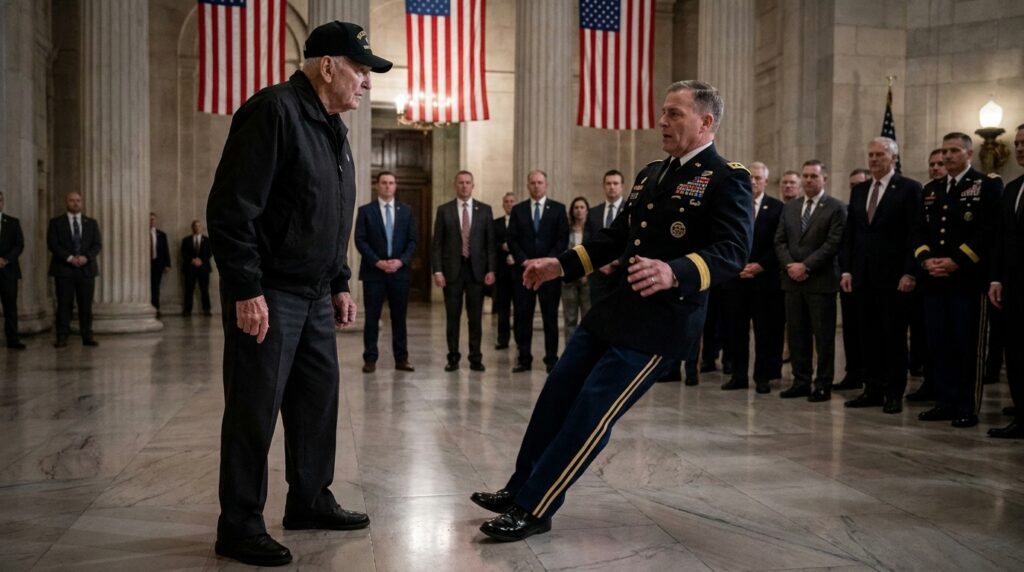
The heavy, reverberating echo of the captain’s fall stayed in the marble floor like a physical stain. No one moved. The civilian onlookers near the velvet ropes remained held in place by their own low-level panic, their fingers frozen over the glass rims of unraised drinks. The veteran looked at his own black leather boots, noticing the tiny white flecks of dried floor wax that had flaked off the stone from the pure friction of the leverage.
He left the captain on his back. A man who relies entirely on starched wool to hold his weight does not deserve a clean exit. Instead, the old man turned his back to the fallen officer, his black veteran cap catching the blue glare of the nearest terminal monitor as his stride took him toward the small technical room behind the central display enclosure.
His hand was back in his jacket pocket. His thumb dug into the notched edge of the brass utility key, using the steady pain to burn through the rising adrenaline in his chest. The young technician from the exhibition tier was missing, his empty identification tag lying on top of a fiberglass routing crate—a frantic, civilian retreat that left the secondary perimeter completely unguarded.
The small iron door at the rear of the display alcove was heavy, held together by five flat-head machine screws that had been painted over so many times the slots were almost flush with the metal. The veteran didn’t use force. He reached into his left pocket, pulled out an old two-inch folding knife with a worn horn handle, and used the blunt spine of the blade to scrape away the thick, industrial gray enamel. The paint came off in stiff, dry curls, smelling faintly of lead and cold zinc.
He turned the top screw. The old iron gave a short, metallic scream as the rusted threads broke their forty-year weld against the casing.
Inside, the routing well was narrow, free of the bright silver shielding and composite ribbons that dressed the public display out on the main floor. Here lay the unvarnished lineage of the installation—thick, bundle-wrapped copper lines insulated with oil-soaked jute twine, their black surfaces coated in a heavy layer of coarse desert dust that had never been vacuumed by the modern maintenance crews.
The veteran didn’t look at the copper. His eyes went directly to a heavy, canvas-bound logbook wedged into the structural gap between the junction box and the load-bearing concrete column. The cover was stamped with the same three-digit prefix he had spotted beneath the fiberglass console shroud: 4-1-2.
He pulled the book from the slot. The old binding groaned, releasing a small cloud of dry, sulfurous powder that settled into the lines of his palms like grey soot. He flicked the pages over with his thumb, tracking the faded purple ink entries from the late summer of eighty-five. The names were written in the blocky, standardized hand of a long-disbanded logistics command—names of operators who had supposedly been reallocated to European stations after the desert sector was wiped from the master maps.
Halfway down the page for August twelfth, the ink changed from purple to an oily black. A single, heavy red line had been drawn across the column headers, obliterating the serial numbers of the transmission arrays. Beneath the strike-through, someone had typed a single administrative note using an old manual typewriter that had a broken R key: ALL FILES PURGED PER DIRECTION OF COMMAND TIERS – RECORD CONFLICT RECORDED AS MECHANICAL FAILURE.
The veteran’s thumb stopped on the page. The friction of the yellowed paper against his scarred skin felt rough, like sand over a fresh wound. The document didn’t describe a routine decommission; it was a structural erasure, a calculated record wipe designed to bury a thirty-man deployment beneath three feet of bureaucratic salt. They had called it a failure to avoid paying the pensions, turning an active tactical withdrawal into a shameful mechanical panic.
The sound of boots scraping against the iron rail outside the alcove broke his focus.
It wasn’t the slow, clumsy shuffle of the captain trying to find his balance. These steps were light, perfectly synchronized, and accompanied by the distinctive metallic rattle of three-man security details moving into an active containment formation. The institution was no longer trying to manage a public embarrassment; they were trying to recover a stolen archive before the civilian donors could track the origin of the noise.
“He’s in the routing tier,” a voice called out through the narrow door frame. It was sharp, cold, and entirely free of the performative arrogance the captain had used. This was the voice of the actual security apparatus—men who didn’t care about medals because they were paid to handle the structural grease.
The old man didn’t drop the logbook. He slipped the canvas binding beneath his zip jacket, the heavy paper pressing hard against his ribs like a cold iron plate. He turned his face toward the dark secondary exit that led down into the building’s basement pump rooms, his boots already finding the correct angle on the concrete floor to take the weight of the coming rush. He had the names now, but the line was already closing behind him, and the ultimate truth of the live signal remained locked beneath forty feet of institutional concrete.








