
CHAPTER 7: THE CLOSING MANIFEST
The master warrant officer’s fingers remained locked against the sharp brim of his utility cover. He didn’t drop the hand. In the cold, desaturated glare of the alcove, his posture held the absolute rigidity of a cast-iron pillar supporting a dead load. Behind his shoulder, the junior trainees at the front benches had stopped shifting completely; their bodies were frozen in varying degrees of mid-movement, their faces turning toward the gray plastic card resting on the zinc ledge like men watching a crack open in a structural retaining wall.
The recruit’s breathing had slowed to a shallow, rhythmic wheeze. He stared down at Vance’s salute, his eyes traveling from the starch-stiff cuff of the warrant’s sleeve down to the dark purple fluid that had now reached the toe of his own boot. The liquid was thicker here, leaving a sticky, iridescent glaze over the pitted concrete. It smelled of fifty years of stagnant storage oil, a dense, metallic rot that had been sealed behind four feet of subterranean masonry until the automated pumps had forced the valves past their tolerance.
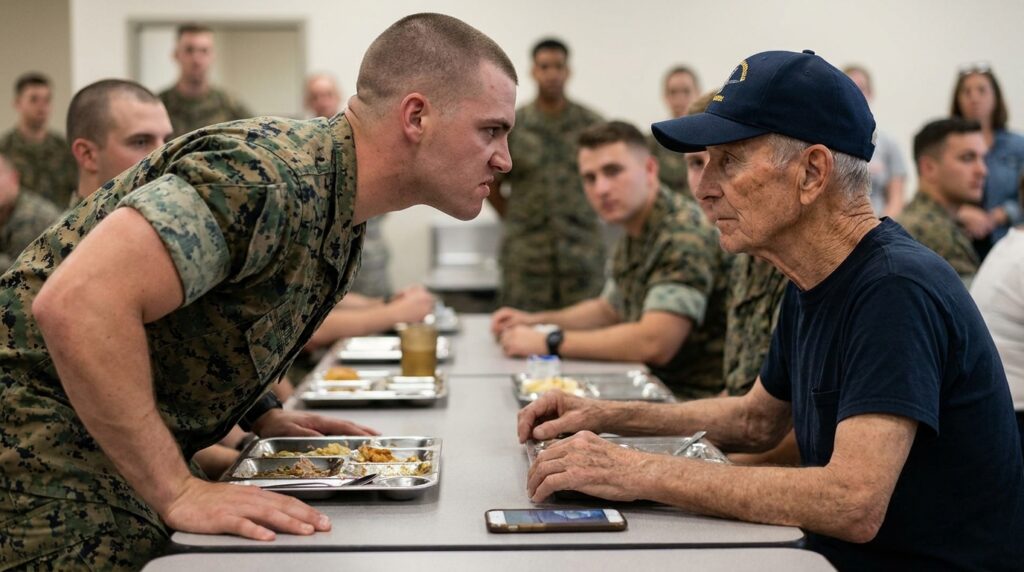
“Class dismissed, son,” I said to the recruit.
My voice didn’t rise, but inside the narrow tile lane of the dish-return, the words had the heavy, flat impact of an iron hatch dropping into a rubber seat gasket. The kid didn’t answer. He backed out of the table lane one slow inch at a time, his stiff leather boots sliding through the grease without a sound. His broad shoulders were curved forward now, the raw, gym-built mass of his chest collapsing under the weight of an institutional hierarchy he hadn’t known existed when he signed the morning detail log.
The watch on my wrist gave its final, muffled click. The time was precisely twenty-two minutes past the noon bell.
Beneath the deck, five yards down through the drainage vents, the mechanical vibration changed its frequency. The high-pitched whine of the digital system didn’t cut out all at once; it began to hunt, the pitch dropping into a low, guttering growl as the silt from the marsh drains completely choked the internal impellers. The concrete floor plate beneath my boots vibrated with a short, sharp shiver—a micro-settlement of the foundation plates that caused the black tea inside my ceramic mug to slosh over the rim, leaving a dark, circular stain on the green laminate table.
The old man from the supervisor’s cage stepped out fully into the light tier, his heavy work shoes clicking against the iron drainage grate. He didn’t look at the warrant, and he didn’t look at the trainees. He laid the canvas folder onto the table right beside my cap, his thumb pressing into the rotted twine of the binding until the weathered paper stock split open along the spine.
The top sheet wasn’t a modern digital layout. It was an original linen draft from nineteen fifty-two, the lines drawn in faded blue indelible ink that had begun to lift from the fibers. The title block in the lower corner was stamped in the same black ink as my card: SUB-TIER 3 – SPECIAL ORDINANCE BASE STRUCTURE. Across the center of the cross-section, a thick red line had been drawn by hand through the backing plates of the primary foundation bolts—a structural warning marker that indicated the existence of a permanent, uncorrectable shear fault where the shale slope met the concrete anchor block.
“The digital manifest only tracks what’s connected to the network,” I told Vance, my hand coming down over the edge of the canvas folder to keep the old paper from curling under the draft from the ventilation fan. “But the network doesn’t hold the weight of the hill. When the tide comes up through the marsh drains, the pressure doesn’t look at the tablet screen. It looks for the thinnest piece of iron.”
Vance slowly lowered his hand, his arm dropping to his side with a stiff, calculated mechanical precision. His gray eyes remained fixed on the red line on the blueprint, his jawline locked until the muscle beneath his ear showed white through the tan skin. He didn’t check his electronic tablet. He knew the math on the linen was absolute; he knew that the modern base infrastructure had been built directly over a cold-storage vault that had been officially forgotten because the truth was too heavy for the current administrative budget to carry.
“We have two divisions of recruits in the lower barracks section,” Vance whispered, his voice losing its clipped, non-commissioned authority, dropping into the raw, flat register of a soldier who has just recognized a fatal alignment on his map. “The duty officer has them on a four-hour maintenance hold.”
“Then you’d better move them to the upper tier before the afternoon shift begins,” I said, picking up the navy cap and sliding the gray laminated card back behind the wire anchor insignia until it was fully dark. “The silt isn’t going to wait for the machine shop supervisor to sign the log.”
I turned away from the alcove, my old work shoes finding the dry line along the outer wall where the purple fluid hadn’t yet reached the grout. The old man from the cage followed me into the exit corridor, his heavy brass keys giving one short, clean rattle as he swung the supervisor’s gate shut behind us.
Behind our shoulders, the mess hall remained completely silent. The hundred junior trainees stayed frozen behind their rows of green tables, their forks still suspended mid-air, their eyes tracking my navy cap until the heavy iron fire doors swung shut with a slow, pressurized hiss that locked the old architecture back into the dark.








