
CHAPTER 3: THE TOLERANCE LIMIT
“The present day doesn’t change the coefficient of drag,” I said, my fingers remaining perfectly still against the lip of the tray. “You can put three hundred thousand tons of new superstructure on an old hull, but if the keel is pitted with oxidation, the sea still finds the math.”
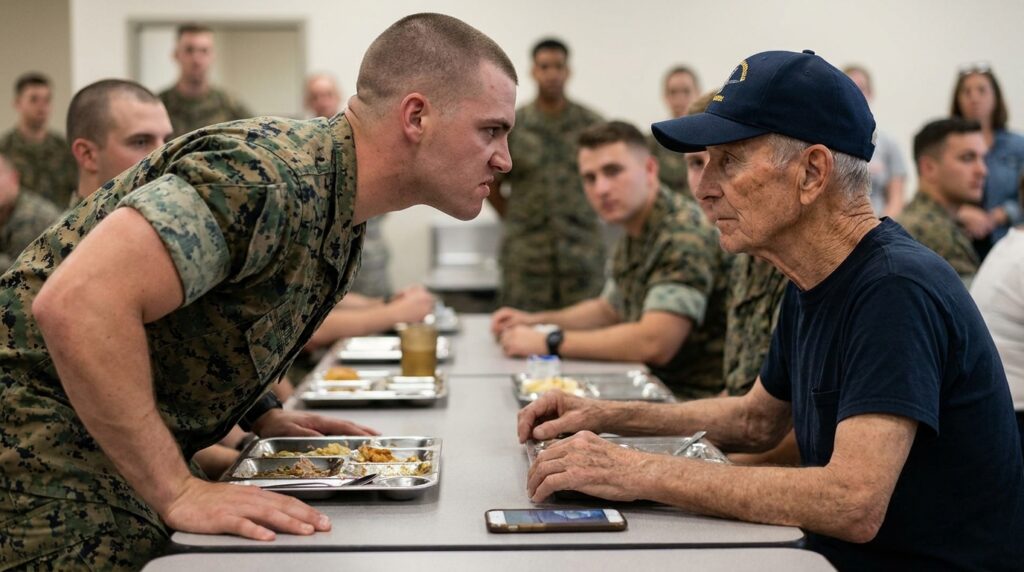
The recruit’s shoulder dropped another quarter of an inch. His breath came faster now, a dry, rapid scraping through his nostrils that indicated his pulse had climbed past one hundred. Under the stiff camouflage utility cloth, his trapezius muscles were locked, white-knuckled under the skin from pure, unchanneled tension. He was committed to the forward lean, his boots so far behind his center of mass that his entire weight was riding on the friction of his right palm against my table section.
Across the aisle, the kid with the unbuttoned collar let his hand drop completely from his tray. The silence had deepened from an expectant lull into a dense, oppressive vacuum where the clank of the overhead ventilation fan sounded like an axe hitting dry timber. Every eye in the third row was fixed on the space between our trays—the specific four inches of scratched green plastic where the recruit’s grease-smeared sleeve cuff hung like a weight.
“You like the sound of your own clock, don’t you?” the recruit said, his voice dropping into a harsh, tight register that lacked the volume to clear the row but carried the full force of his insecure anger. “You talk about keels because you can’t touch the modern hardware. You don’t know what a digital hydraulic load looks like.”
“I know what the grease looks like,” I murmured, my gaze shifting precisely from the white razor scar on his jaw down to the dark smear on his cuff. “That’s lithium three. High-pressure marine compound. They haven’t used it on upper-tier base equipment since the nineties because it breaks down when the salinity hits four percent. If you’re pulling that off a modern hydraulic rod, someone in the machine shop is lying to your logistics officer.”
A small, rhythmic clank-clank sounded from the dark corridor near the supervisor’s cage—the deliberate, measured impact of a heavy brass key striking an iron door frame. It wasn’t an alarm, but it was a rhythmic signal, a sequence I had memorized during the winter of ninety-six when the sea-pipes froze in the lower gallery. The face in the shadow didn’t move, but the rhythm of the iron keys remained steady. Two strokes, then a three-second delay. A warning that the low-level pressure valves were hunting.
The recruit’s eyes drifted toward the sound for a fraction of a second—an operational error that cost him his remaining leverage. When his gaze snapped back to my face, his jaw was clamped so tightly the muscle below his ear looked like a knotted rope. “We don’t have a marine shop on this side of the ridge. You’re hallucinating, old man. You’re living in the old storage manuals.”
“The manuals are still printed on oil-paper because cotton rots when the drains back up,” I told him. My right hand remained loose, but my forearm adjusted its angle by three degrees, my elbow finding the structural seam where the bench frame was bolted directly through the concrete slab into the sub-deck iron. “You think this building is sitting on solid shale. You haven’t looked at the drainage manifests for the third tier.”
He didn’t listen to the architecture. His left hand came up from his side, his fingers hooking into a rigid curve as he prepared to grab the edge of my tray and jerk it six inches toward his chest—a classic leverage-breaking movement intended to drop my face forward into the cold tea. His weight shifted onto his toes, his heels lifting slightly from the salt-crusted floor. The stiff leather of his issue boots gave a short, high-pitched squeak against the gray sealant.
The room held its collective breath. A trainee three tables down slowly closed his fingers around his paper napkin, his knuckles turning white as he calculated whether to stand or stay behind his bench line. The unwritten rules of the base structure were clear: if a recruit initiated contact with an older civilian figure within the administrative perimeter, the entire unit shared the collective liability until the duty officer signed the daily log.
I let my shoulders sink an eighth of an inch, allowing the heavy wool of my old Navy t-shirt to absorb the residual vibration of the concrete floor. The watch on my wrist gave its faint, mechanical click. The time was precisely twelve minutes past the noon bell. The logistics manifest down in the sub-tier was already twelve minutes out of tolerance, the gray clearance card in my shirt pocket cold against my ribs.
“One more inch,” the recruit whispered, his face leaning down until I could see the individual broken capillaries around the bridge of his nose, the sweat beginning to gather in the fine stubble of his buzz cut. “One more line about the old days, and I’ll show you how we clear the deck in the current cycle.”
I didn’t answer with text. I merely loosened the thumb of my right hand from the watch crown, allowing my palm to turn upward, open and dry, against the scarred green laminate.








